By: Vida Kocjan
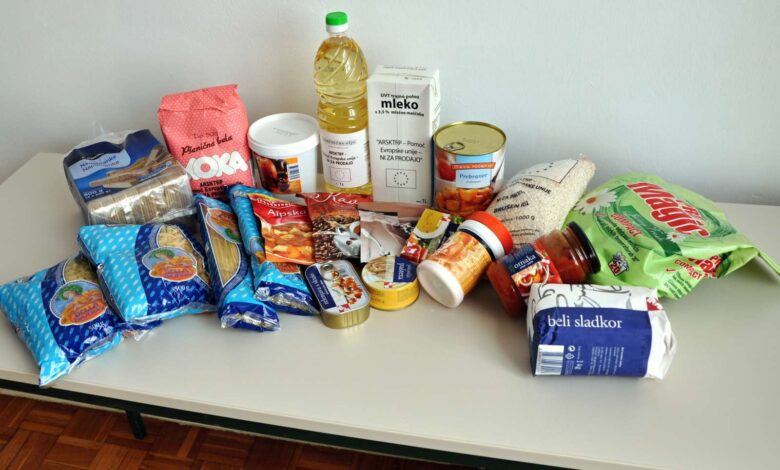
The price basket of 15 food items, whose monitoring the government paid the selected company €311,881 for, which was 6.6 times more than the originally agreed price, was deliberately understated for propaganda purposes. In reality, food prices were not falling; on the contrary, they were rising sharply. We witnessed a major deception, about which no one wants to hear anything anymore.
It is becoming increasingly clear that the ruling coalition (Svoboda, SD, and Levica) lied and seriously misled the public about food prices.
As recently as last autumn, Prime Minister Robert Golob repeatedly stated publicly that he could not ignore rising food prices and even announced the possibility of regulating or controlling them. Later, the government withdrew this position, and the official stance of the responsible ministry became that there would be no price regulation because no one in the supply chain was to blame for the price increases.
The highest food inflation in the EU
According to data from the Organisation for Economic Co‑operation and Development (OECD) for December 2025, Slovenia had the fastest growth in food prices in the entire European Union, 6.8 percent, while in most other countries prices were stabilising or falling. Yet Golob refused to clearly acknowledge this figure in the National Assembly when questioned by MP Suzana Lep Šimenko (SDS). Instead, as we have come to expect from him, he misled the public once again.
Promises vs. reality
At the very time when food prices were rising the fastest under Golob’s government (in 2024 and 2025), the government promised intervention measures, monitoring of profit margins, and data collection on prices along the supply chain. The overall effect, however, is that food in Slovenia remains among the more expensive in the EU. Food prices also rose in other countries, but Austria, for example, cut VAT on basic food items in half – from ten percent to five. In Slovenia, however, Golob’s coalition rejected a similar proposal from the opposition parties NSi and SDS, arguing that the state budget would lose around 100 million euros in tax revenue. That same 100 million euros would have remained in the pockets of citizens, but this is of no interest to these transitional governments.
Golob’s misleading “government basket”
But that is not all. Let us recall: shortly after taking office, the ruling coalition invented the concept of the “government basket” of basic food items. The government presented it as a symbol of its measures against rising food prices and used it as proof that the prices of basic goods were stabilising or even falling. Meanwhile, people’s real‑life experience showed the opposite, the general food basket was and remains expensive.
The government basket tracked the prices of 15 basic food groups, a very limited, minimalist survival basket. The Golob government also devised a special method for this. The process began in September 2022, was temporarily frozen in January 2024, and the price‑monitoring project was abolished in March 2024.
How did it work? The first physical price checks under this so‑called anti‑inflation measure began in September 2022, with the first results published in mid‑September. The main period ran from September 2022 to September 2023, with interruptions and restarts. There were two phases: September 2022 to March 2023, and June 2023 to December 2023. On 24 January 2024, the ministry led by Čalušič announced that physical price checks were being temporarily suspended. According to the latest updates, the project was officially concluded in March 2024.
After January 2024, physical price checks were no longer carried out regularly, at least not in the same form. Today, the government no longer publishes weekly or monthly prices for this specific basket of 15 food groups.
Who carried out the price checks?
Anyone who thinks that civil servants performed the price checks is mistaken. The main coordinator was the Ministry of Agriculture, Forestry and Food, but the physical checks (every 14 days) were carried out by an external contractor selected through a public tender. Their representatives visited stores and monitored prices at the six largest retailers in Slovenia (Mercator, Spar, Tuš, Lidl, Hofer, Eurospin, and sometimes others). Initially, the government announced that price checkers would occasionally compare prices with those in neighbouring countries, but this never happened. The data was published on the government portal Gov.si under “Measures to mitigate rising food prices.”
The agency was paid an astonishing €312,000
Budget documents for 2023 and 2024 listed this measure as part of a broader package, without a separate line item. Later it became known that the physical price checks for the 15‑item basket were carried out by the Ljubljana‑based private company April 8 d.o.o. (Agency April 8). This was confirmed by several sources in 2022, when retailers (e.g., Hofer, Spar, Tuš) publicly protested against the methodology and mentioned April 8 as the contractor. April 8 won the public tender with the lowest bid, around €47,000 for the basic part, plus additional fees for extra items added later. And many items were added, significantly increasing the final cost.
From the initial €47,000, the final amount rose to €311,881. That is how much the Ministry of Agriculture, Forestry and Food paid the company between December 2022 and February 2025. Most payments occurred between December 2022 and April 2024. The data comes from the Erar transparency portal, run by the Commission for the Prevention of Corruption.
Practice and deception
The prices of the 15 items in the basket dropped sharply, and the government, led by Golob, boasted that its measure to control the prices of basic necessities was working. But it quickly became clear that the low prices applied only briefly and only to limited quantities of specific items. Before and shortly after the checks, prices were significantly higher, or the products were no longer available. One example is gouda cheese: a 400‑gram piece cost €0.85 in one store during the check, but before and immediately after the check it was more than €2 higher. Today it costs more than €3. It also became widely rumoured that retailers knew exactly when the price checkers would arrive and which items they would inspect. Officially, everyone denied this.
Directly or indirectly, this amounted to a deception that could no longer be concealed, which is why the checks were discontinued at the end of 2023.
According to these measurements, the price of the 15‑item basket at the end of 2023 was only €16–18, with the lowest recorded price being €15.87, a drop of roughly 55–60 percent.
None of this reflected reality. The government basket did not represent actual food inflation. Statistical data showed high food price growth during this period: 13–15 percent in 2022 and 7–9 percent in 2023.
Note: The article was originally published in the magazine Demokracija.