By: Dr. Stane Granda
Neither Janšism nor anti‑Janšism has ever been seriously defined. What we have are ideologically driven, pathological pamphleteering interpretations. I leave that task to wiser minds, as I am interested in the social and historical dimensions.
For a long time, a “Janšist” simply meant someone who credited Janez Janša or DEMOS with the key role in Slovenia’s independence. Their opponents were the “Kučanists.” They spread the theory that independence had been carried out by Kučan in agreement with Milošević, and that Janša merely “messed everything up.” This is how members of the Association of Fighters (ZB), who for quite some time hovered intensely around me, explained it. After the Kučanists took over the Association of Veterans of the War for Slovenia, I have personal, though not public, peace from them.
Janšism as an excuse
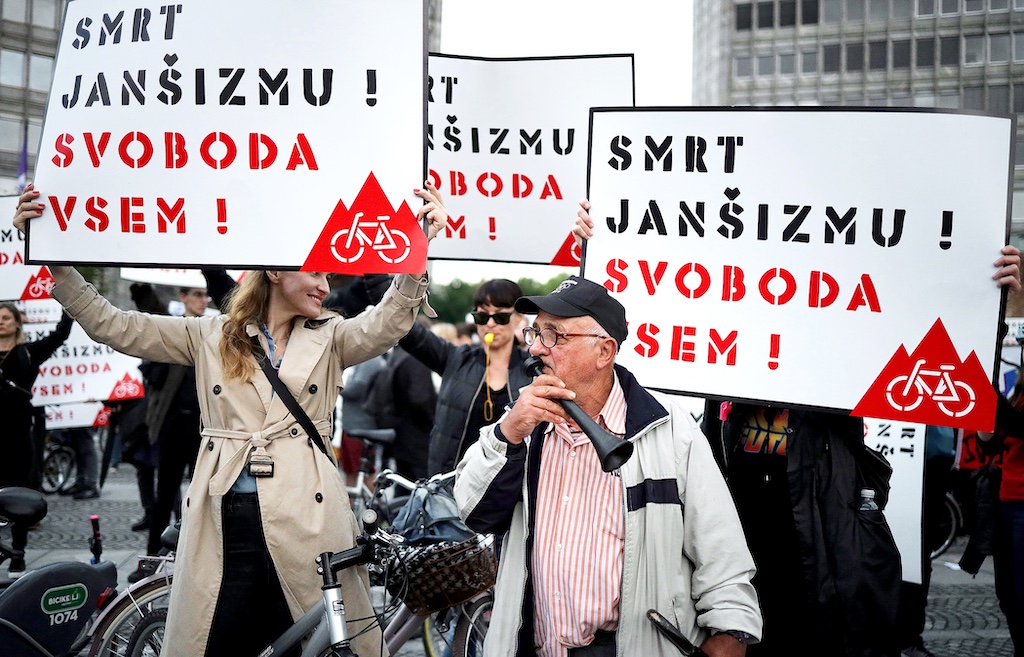
The word “anti‑Janšism” became popular before the last parliamentary elections. It served as a rallying slogan for voters around Dr Robert Golob. Because it initially drew on anti‑vaccination sentiment, it carried a strong mark of eccentricity. It was clear that at the outbreak of COVID, no one knew what was happening or where things were heading. The experiences of Bergamo and Spain were horrific. Some irresponsible doctors, who underestimated or were sceptical of vaccination, contributed to the confusion by admitting their own unpreparedness and helplessness. That part is understandable. What is not, and this is their sin, is that they offered no alternative. Suggesting seaside holidays and vitamins was an indecent form of cynicism. With accusations about the use of water cannons, violence, and especially “gassing”, with barely concealed allusions to Nazi methods, anti‑Janšism took on ideological dimensions. This was confirmed by Kučan himself, who placed himself at its head. He confirmed this again recently when, over breakfast at Tošić’s café, a gesture with at least symbolic meaning, Janković demonstrated his control over Golob. It would be interesting to know whether he will also hand over the remaining billions that flowed from wild privatisation and the rise of tycoons, money Kučan never shared with the United List but kept within his UDBA‑mafia clan. Kučan’s leadership and steering of anti‑Janšism is at least twofold, since its probably more important component is the President of the Republic, Dr Nataša Pirc Musar. The global machinery behind this duo is a financial oligarchy in which Bulgarian capital of dubious origin is becoming increasingly influential.
How “anti‑Janšism” manifests under Golob
Because the full content of anti‑Janšism, as a label, will only be revealed over time, this overview will focus solely on Golob’s part.
- Moral decay. If even a five‑minute ban on lying had been imposed, Golob would never have existed politically. The man has such difficulties with truth that it defies the understanding of a social scientist and calls for the involvement of another discipline. Whoever lies also steals. His GEN is an example of siphoning off financial returns from former state property, privatised through extortionate energy prices. It is easy to be wealthy at someone else’s expense; no exceptional business ability is required. The entire financial and tax policy of the state is one big theft from the poor. It is no coincidence that the totalitarian left holds the ideological ladder for him; after taking care of its own moustache or beard, it knows only how to distribute what it has taken. It is incapable of creating shared public or national wealth because it despises the individual, the only true subject of a free society.
- State decay. The ruling anti‑Janšism immediately dissolved the Museum of Slovenian Independence and abolished the Memorial Day for the victims of totalitarian regimes. It revealed its undemocratic nature and its inclination toward totalitarianism, which underpins the financial oligarchy. The values of independence have been trampled, and the independence‑makers declared fascists. A cult of totalitarianism is rising, as independence is portrayed as the result of the Bolshevik revolution. This legitimises wartime and post‑war killings and the totalitarian regime. Independence is being nullified through exaggerations about the “erased,” confirmed not only by the monument in central Ljubljana but also by the central, apparently permanent, message of the historical exhibition opened in Nova Gorica at the end of the EPK. There was space for that, but not for the Slovenian minority across the border. The Slovenian nation is concluding the anti‑Janšist era of its existence with a level of division unprecedented in its history. Ljubljana will even be forbidden from being Slovenian, and folk music will not be allowed there.
- Economic and social decay. The government had neither an economic nor a social policy, yet in the name of both it impoverished citizens. It even incited them against doctors and farmers. Despite the necessary Christmas bonus and the higher minimum wage, poverty is rising due to predatory economics and plundering governance. Both measures are a slap in the face of poverty, because inflation erases them before people even receive them. They are not the result of social or economic policy but of pre‑election vote‑buying. Old age is not sadness; old age and frailty are despair, and to address that despair, the prime minister and the ruling coalition offered state‑assisted suicide.
Golob’s government, RIP. A mature state would take you to court; a totalitarian one would put you before a firing squad.
Note: The article was originally published in the magazine Demokracija.