

By: Nova24TV.si
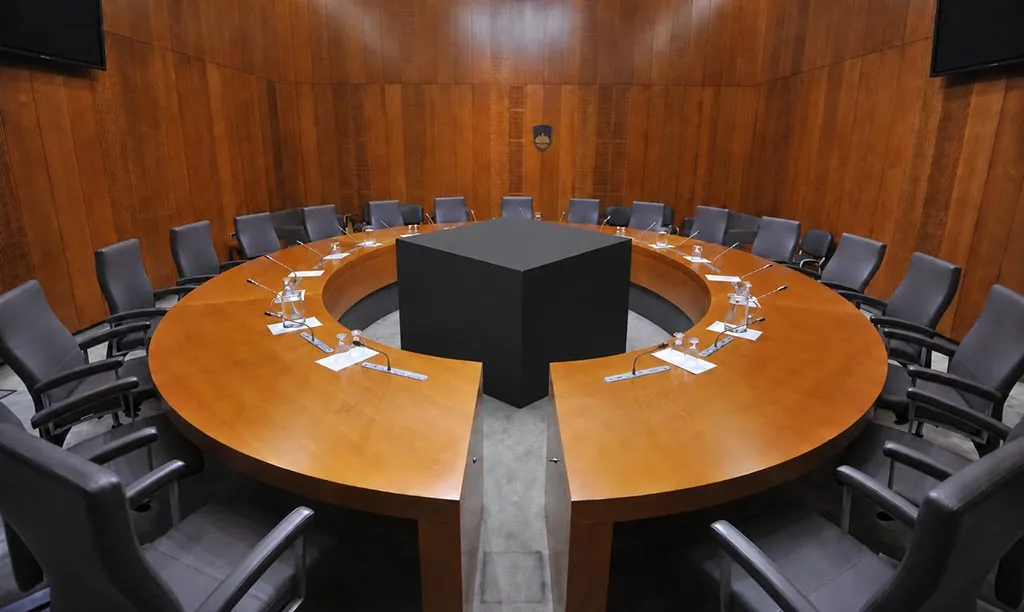
The parliamentary inquiry regarding the Black Cube affair and the alleged suspicion of unlawful financing of political parties was rejected on Tuesday at the session of the National Assembly.
As we know, this affair involved an attempt to discredit the Slovenian Democratic Party before the elections, and later SOVA allegedly admitted that there was no adequate evidence that the party had ordered the wiretaps and recordings in which individuals connected to the previous government spoke about the workings of the deep state in Slovenia.
The parliamentary inquiry was rejected when the agenda of the extraordinary session was not approved. Interestingly, this happened also thanks to the left‑wing opposition, which had demanded the inquiry. MPs from SDS, NSi, and Resni.ca voted to reject the agenda, while the Democrats abstained. Left‑wing MPs also contributed to the rejection through their absence; the session was not attended by Svoboda MPs Janja Sluga, Vinko Logaj, or even Robert Golob himself. The leader of the Social Democrats, Matjaž Han, was also absent. On the other hand, the leader of Svoboda’s parliamentary group, Borut Sajovic, as well as Levica MP Tina Brecelj, according to the voting record, did not vote at all – although Asta Vrečko claims this is not true for Brecelj.
Let us recall: the recordings that surfaced before the elections strongly implicate several individuals close to the previous government, as well as left‑wing power brokers such as Janković and Kučan. Below you can refresh your memory of what was said. To this day, however, none of these “confessors” has been questioned by the police regarding their claims.
Among the recordings that reveal the workings of the deep state, the most crucial was certainly the recorded conversation with former justice minister Dominika Švarc Pipan. In the recordings, she plays the role of a lobbyist and explains that Zoran Janković is untouchable and that Robert Golob, then still prime minister, continues to control GEN‑I from behind the scenes. Švarc Pipan also mentions Damir Črnčec as “a very powerful man”, as well as former minister Emilija Stojmenova Duh, whom she wanted to include in the project being discussed. She also reveals that Golob tried to protect both fallen ministers – herself and Stojmenova – and urged them to remain in their positions, but the pressure was too strong. Nevertheless, they remained Golob’s “shadow advisers”. Furthermore, she admitted the involvement of the Social Democrats in the scandal surrounding the purchase of the building on Litijska 51, which ultimately led to her resignation.
Regarding then‑Prime Minister Golob, Švarc Pipan explains that he still controls GEN‑I, meaning that no decision is made without him, while the position of director is merely “formal”. Even in the event of an election loss, Švarc Pipan assures her interlocutor that Golob would still retain significant influence from behind the scenes.
Milan Kučan as the behind‑the‑scenes patron, Zoran Janković at the centre of corruption
Švarc Pipan also fully exposes the workings of the deep state in the recordings. She speaks about Janković’s influence over Golob and their shared business and political interests. She says that Janković is the one who makes things happen. She admits that the Ljubljana mayor “has great influence – truly great. He is powerful in every respect: politically, economically, and in business. Immune to everything, anything launched against him collapses in court.” She also mentions Milan Kučan as someone who is very powerful within left‑wing politics in Slovenia, and alongside Janković describes him as a “king‑maker”.
Attorney Nina Zidar Klemenčič says similar things, describing Milan Kučan as a behind‑the‑scenes patron and Janković as a powerful figure. She says he is “corrupt” and “untouchable”. She also boasts that she herself, with her network, can achieve anything. “A strong personality. A very strong personality and very corrupt. It is very easy with him. He wants his 10 percent, and that is it. So, you give him 10 percent and you get everything,” Zidar Klemenčič says about the Ljubljana mayor. According to her, Janković can ensure fast procedures and provide the necessary permits if he receives those 10 percent. She also points out that although Janković undergoes house searches every six months, it is merely a show for the public: “Then he influences the court, then they assign his cases to one judge, and then they replace the judge, you know, and such things happen all the time. But somehow, he still survives.”
Regarding Kučan, Zidar Klemenčič says that he has significant influence over Robert Golob, as well as over the media and developments within left‑wing politics. Although he operates from the background, he is “the one who has great influence in the media and still directs things.”
Financing media and companies aligned with left‑leaning governments?
Attorney Jože Oberstar, former chairman of the supervisory board of DARS and later chairman of its financial commission, claims in the recordings that his departure from the supervisory board did not mean a loss of influence. As he says, as head of the financial commission he still had insight into key decisions, and he allegedly maintained connections at the top of the company. According to his statements, politics used its influence over the state‑owned company to direct funds toward politically aligned organisations, media outlets, and NGOs. The purpose of such financing, he claims, was to ensure support for the government, or at least a neutral stance toward it, in the public sphere.
Oberstar claims that the mechanism was simple: political representatives or representatives of ruling parties allegedly provided DARS leadership with lists of organisations or recipients of sponsorship funds, and the management then approved such funds. According to him, the money was intended for “political entities, political agencies, NGOs, and media outlets that support the government or at least do not oppose it.” As an example, he mentions the alleged financing of media publications about DARS projects, although it was unclear whether he meant individual journalists or media companies. He emphasised that this was a practice aimed at creating a positive image of the company and, indirectly, of the current government.
In the recordings, he also touched on the issue of awarding contracts to companies connected to people close to the government. According to him, some contractors began receiving significantly more business after Robert Golob’s government took office, especially in the field of construction work related to motorway infrastructure. He highlighted the influence of the Ljubljana mayor, claiming that he has significant influence over political developments and relationships within state‑owned companies. In this context, he also mentioned the company KPL, saying that its first contracts on motorway projects came precisely because of political connections between the company’s leadership, the Ljubljana city authorities, and national politics.
Lobbyist Rok Hodej, in a conversation with an unknown interlocutor, describes the workings of political backstage networks and the ways of influencing state‑owned companies, the media, and other actors in the public sphere during Golob’s government. When asked about the former prime minister’s influence over GEN‑I, Hodej replies that it was primarily informal, exercised through people in the company’s leadership and a broader network of associates. According to him, the Slovenian Sovereign Holding also plays an important role in influencing state‑owned companies, as politics allegedly maintains direct control over the management of state enterprises through it. Hodej emphasised that the political leadership, due to personal connections, can always reach responsible individuals within the companies. He also discussed his own work in lobbying. He explained that he operates as a registered lobbyist and has participated in projects requiring legislative changes both at the Slovenian and European levels.
He devoted particular attention to the issue of media financing and political influence. According to him, support for politically aligned media is often provided indirectly, mainly through advertising contracts and funding from state‑owned or state‑linked companies. As an example, he mentioned Telekom Slovenije, which he described as an important advertiser in the Slovenian media market. According to Hodej, the government, through its influence over state‑owned companies, can direct advertising funds toward media outlets that are politically closer to it or at least not openly critical. He highlighted printed media in particular, which face financial difficulties and are therefore, in his view, more vulnerable to influence through advertising contracts and other forms of financial support.
Andrej Poglajen: Those responsible for corruption will have to be held accountable
Regarding the outcome of the Black Cube affair, as well as the fact that the agenda including the parliamentary inquiry was not approved at the extraordinary session, we also spoke with SDS MP Andrej Poglajen. As he told us, a new request for an extraordinary session has already been submitted. He added: “I hope that this time all MPs will attend the session. As we know, Robert Golob and Borut Sajovic from the Freedom Movement were absent this time, as well as some other MPs from left‑wing parties.” Poglajen adds that they themselves see no problem with conducting an inquiry, but he wonders: “I do not know whom or what they even intend to investigate, given that it was already stated at the KNOVS session that there is no evidence regarding this. I do not know what such an inquiry would even deal with if there is no evidentiary material.” Regarding the second inquiry, the alleged suspicion of unlawful financing of political parties, Poglajen warns that this one is problematic, since such an investigative commission has already been established, led by Tamara Vonta, and its work has already been completed. We also asked Poglajen how he comments on the fact that none of the above‑mentioned “confessors”, who casually discuss corruption, have yet been questioned by the police. “Absurd, but on the other hand also a realistic picture of the police, the judiciary, and other such institutions in our country,” he replied, emphasising: “This is precisely why we need the announced changes, among which the most important are the establishment of SKOK and the amendment of the law on parliamentary inquiries.” He highlighted that the fight against corruption is a cornerstone of the current government’s coalition agreement, and that those responsible for corruption will have to be held accountable: “It must be clearly stated, everyone who managed public money and diverted it elsewhere will have to answer for it.”


