

By: C. R.
At an extraordinary session, the National Assembly adopted the amendment to the Act on Concealed War Graves and the Burial of Victims with 50 votes in favour and 32 against. The amendment declares 17 May as the National Day of Remembrance for the Victims of Communist Violence. It also stipulates the transfer and burial of the remains of victims of the wars and the revolution at the Žale cemetery in Ljubljana.
The amendment, prepared by the coalition of SDS, the Democrats, NSi, SLS and Fokus, once again declares 17 May as the National Day of Remembrance for the victims of communist violence. This day had already been declared in May 2022 during the government of Janez Janša, but was abolished a year later under the government of Robert Golob.
Under the amendment, the remains from concealed mass graves will be respectfully and permanently buried at the Žale cemetery in Ljubljana, with this part of the cemetery receiving the status of a cultural monument of national importance.
The amendment also introduces the obligation to collect biological samples for the purpose of genetic analysis and identification of victims. The same applies to the remains of all victims who have not yet been buried. It further mandates the permanent storage of samples and the provision of state‑budget funds for the collection, storage and analysis of biological samples and related research. It also allows for the possibility of concluding international agreements or special arrangements for transferring DNA samples to foreign state institutions.
The transfer and burial of the victims’ remains at the Žale cemetery must be carried out no later than six months after the entry into force of the implementing regulation. The law will enter into force the day after its publication in the Official Gazette.
The amendment also changes the composition of the government commission for addressing the issue of concealed mass graves: the criminal‑investigation expert will be replaced by a museum expert, who will act as the custodian of artefacts recovered from concealed wartime graves.
In addition to the proposers, the amendment was supported by MPs from Resni.ca and both minority MPs. Zoran Stevanović, MP and leader of Resni.ca, explained that they absolutely support the amendment and the burial of victims’ remains at Slovenia’s largest cemetery, but they have reservations regarding the designation of the Memorial Day.
“We believe there is no need to divide the nation further or deepen ideological conflicts by introducing new dates and new holidays, because people would like to move on,” he said. According to him, they supported the law unanimously solely because they value the dignified burial of all victims far more than anything else. “Otherwise, if our amendment to the article concerning the holiday had not been blocked, we would certainly have removed that article,” he added.
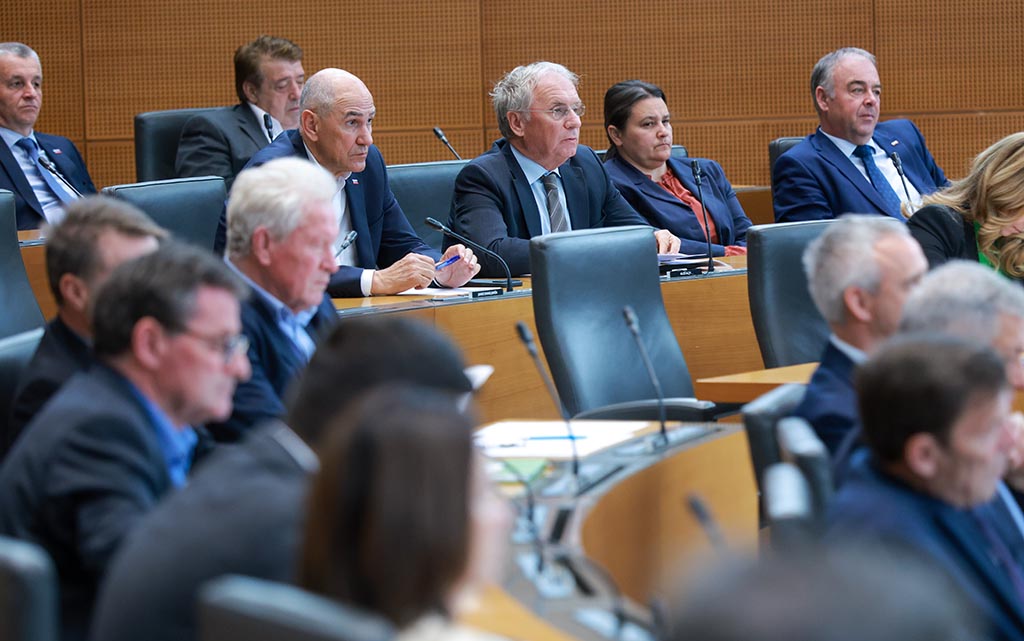
Most of the parliamentary debate revolved around who was, and who was not, on the “right side” of history, and which location is more appropriate for the transfer and burial of the victims’ remains. While coalition MPs insisted that only Ljubljana is suitable for the burial, opposition MPs highlighted the Teharje Memorial Park, the central national memorial dedicated to the victims of post‑war extrajudicial killings.
Janja Sluga, an MP from Svoboda, disagreed that the purpose of the amendment is reconciliation. “If that were truly the intention, all the dead would be honoured equally, with one law, one place, one method, and we would stop dividing people again and again with what is written in this law and even with the name you gave it,” she said. She added that left‑leaning MPs attend all commemorative events, both those related to the resistance movement and those organised by war invalids.
She accused NSi MP Iva Dimic of not knowing that the Teharje Memorial Park is a monument of national importance, and said she had seen her there only twice since Sluga became an MP. “I absolutely reject your criticism that I am not present in Teharje. Clearly, some of you come only on 1 November, while some of us feel differently and can come more often, and elsewhere too. And interestingly, colleague Janja, in Teharje we are able to speak to each other differently than we do today in this chamber,” Dimic replied.
Today, the National Assembly adopted the amendment to the Parliamentary Inquiry Act with 48 votes in favour, 32 against and two abstentions. Among other things, the amendment limits the possibility of challenging the act ordering a parliamentary inquiry before the Constitutional Court. In addition to the proposers, SDS, NSi, SLS and Fokus, the amendment was supported by the Democrats and Resni.ca. The opposition voted against it, warning of several constitutional issues.
The amendment was drafted by SDS together with NSi, SLS and Fokus. It restricts the possibility of contesting the act ordering a parliamentary inquiry before the Constitutional Court. Under the new rules, only the Judicial Council or the Prosecutor General may request a constitutional review within 30 days of the inquiry being ordered.
The proposers argue that the arrangement adopted in the previous parliamentary term, on the proposal of the then Speaker of the National Assembly, Urška Klakočar Zupančič, was by design an excessive and disproportionate interference with the effectiveness of the parliamentary inquiry as a constitutional instrument. In their view, such an arrangement led to lengthy procedural complications and blockages in initiating parliamentary inquiries.
The amendment adopted today also introduces judicial protection in the parliamentary inquiry procedure through the possibility of filing an administrative lawsuit. A person under investigation may file an administrative lawsuit within eight days of receiving the final report of the parliamentary inquiry commission if their human rights have been violated.
The National Assembly may also no longer order an inquiry into the same matter for which a final report has already been adopted. According to the proposers, the amendment also clearly defines cases in which an MP may not participate in a parliamentary inquiry commission.
The amendment was opposed by MPs from Svoboda, SD, Levica and Vesna. They argued that removing safeguards and constitutional‑court oversight enables abuses of parliamentary inquiries. They also warned that the amendment abolishes judicial protection for members of inquiry commissions who are designated as persons under investigation or as witnesses.
They believe this is an attempt to silence the opposition, as the parliamentary majority will be able to prevent the opposition from initiating inquiries. They also warn that the political majority will decide on MPs’ conflicts of interest. The proposers were further accused of wanting to prevent full investigation into circumvention financing of parties and the media.
In addition to the proposers, SDS, NSi, SLS and Fokus, the amendment was supported by the Democrats and Resni.ca. MPs from Svoboda, SD, Levica and Vesna voted against it. The two minority MPs abstained.
With 32 votes in favour and 48 against, the National Assembly rejected Svoboda’s amendment proposing that the implementation of the law be postponed by one year. In their explanation, they stated that the delay would allow the Constitutional Court to rule on the constitutionality of certain disputed provisions, as initiatives for constitutional review have already been announced.