

By: Andrej Sekulović
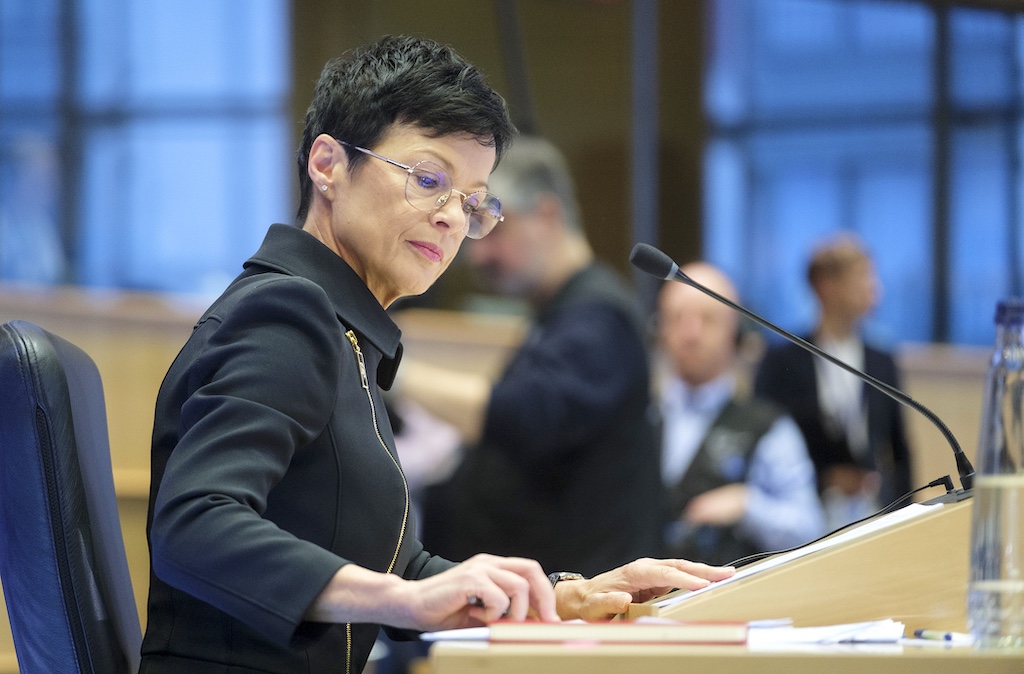
New revelations in Igor Omerza’s book Komisarka allegedly show that Marta Kos was connected to UDBA. Janez Janša warns that, if this is true, the Slovenian EU Commissioner for Enlargement represents the greatest security risk for Europe. Did Kos lie to the European Parliament? Her hearing will be repeated.
Publicist and researcher Igor Omerza, who specialises in the workings of the Yugoslav secret services, presented his new book Komisarka in early March, both in Ljubljana and in the European Parliament in Strasbourg. The book focuses on the political career of EU Commissioner Marta Kos and her alleged links to UDBA, the former Yugoslav political secret police. The presentation in the European Parliament, where the book was also available in English, was organised by Slovenian MEP Romana Tomc of the European People’s Party (EPP).
The book appears to have attracted considerable interest. After the presentation, the EPP called for Commissioner Marta Kos to be questioned again. Following Omerza’s revelations, Kos now faces new accusations concerning alleged cooperation with the notorious UDBA in the 1980s. Only a few days after the book launch, Romana Tomc, who also serves as an EPP vice‑president, publicly outlined the incriminating claims. She sent a written warning to the European Commission, demanding an investigation and stating that she has new evidence of Kos’s involvement with the Yugoslav intelligence service. She also asked whether the Commission intends to examine these allegations and whether further disclosures could affect the commissioner’s credibility. During her 2024 hearing before Members of the European Parliament, Marta Kos insisted: “I was never an associate or informant of the Yugoslav secret service.” She described the accusations as “lies and disinformation.”
If documents proving her cooperation with UDBA are indeed kept in Belgrade, then Moscow is likely aware of them as well, which would mean that Marta Kos, as Commissioner for Enlargement, could be vulnerable to blackmail.
The greatest security threat to the European Union
In the context of the pre‑election and post‑election developments, and amid concerns about alleged foreign interference, Janez Janša argued that the biggest current security risk within the European Union is precisely the Slovenian commissioner, Marta Kos. “It has come to light that she lied to Members of the European Parliament,” Janša said, adding that “published evidence clearly shows she cooperated with the Yugoslav secret police abroad.” He noted that the European Parliament will repeat part of her hearing and stressed that her current role, overseeing EU enlargement, poses a serious problem and risk. He pointed out that the entire archive of the Yugoslav secret police, UDBA, is held in Belgrade. “What Mr. Omerza has published amounts to ten documents, but in Belgrade there are probably ten times as many,” he said. According to him, anyone who possesses these documents could blackmail the commissioner responsible for enlargement. He highlighted that Serbia and Ukraine are candidate countries and also warned about “the Russian factor.” In his view, this represents “the greatest security threat to Europe at the moment, coming from Slovenia, and it will cause us serious headaches.” He added that the European Commission is currently making crucial decisions regarding Ukraine and the financing of military assistance: “And sitting in that Commission is a person about whom Moscow very likely holds highly compromising material.” He concluded by saying that if Marta Kos had admitted and expressed regret for any cooperation with the secret service during her hearing, it likely would no longer pose a problem, because she could not be blackmailed. “But she explicitly denied it, which means she has created the very basis for blackmail,” he warned.
Recorded under the names “Tara” and “Blanka”
In his book, Igor Omerza presents archival documents from the late 1980s containing records under the code names “Tara” and “Blanka,” which he says were operational aliases used for Marta Kos. According to the documents, she initially cooperated under the first name, and later under the second, after taking a job at the German broadcaster Deutsche Welle in Cologne. The materials describe her employment at the station as well as her contacts with the secret service. They reportedly include precise dates, assignments, and descriptions of her activities. Omerza maintains that the documents indeed refer to Marta Kos. He states that she was first registered by UDBA as someone who passed on information, and later even as a collaborator, a designation indicating a higher level of involvement. He recently discussed the commissioner’s controversial past in an interview for the Bulgarian outlet BGNES. Like Janša, he argued that a person with such a background is not suitable for shaping the EU’s enlargement policy, especially because of the high risk of blackmail. Omerza also said that Belgrade is almost certainly aware of her background, which poses a serious security concern if other intelligence services can access the same information. “If the Serbian secret service knew about her role, I fear the Russian services could know as well, and that is very problematic for someone in her position,” he said.
Janša argues that Kos could have neutralised the threat herself if she had acknowledged her past and expressed remorse.
Manfred Weber: Lying will have consequences
In an interview for Planet TV, the president of the European People’s Party, Manfred Weber, briefly commented on the new allegations concerning the Slovenian Commissioner for Enlargement. “If archival documents were found showing that the current Slovenian commissioner had indeed cooperated with the former Yugoslav secret police and had misled the European public by denying it, would the EPP demand her resignation?” asked journalist Luka Svetina. Weber replied that it was not yet the moment to pass judgment, as new information and facts had emerged. However, he stressed that if a government leader, at national or EU level, lies to parliament, this will inevitably have consequences. “To be very clear: what we want now is for the entire Commission team to deliver results, but we take the Slovenian issue very seriously,” Weber added. In a written statement, the EPP president emphasised that this was not about prejudging the case, but that all outstanding questions must be examined and clarified. He insisted that Marta Kos must answer all questions in the European Parliament, as this is essential for safeguarding the integrity and credibility of the European Commission. Meanwhile, Romana Tomc maintains that if it turns out Marta Kos lied during her hearing, she must resign immediately.
Marta Kos will be questioned again in the European Parliament on 20 April, this time during a session of the Committee on Foreign Affairs, following the latest revelations.
Is the European Commission defending Marta Kos?
Because of the new disclosures, Kos will have to appear once more before Members of the European Parliament to address questions about her alleged involvement with the former Yugoslav security services. A new hearing had initially been scheduled for 16 March, but Kos avoided attending due to a “packed schedule.” She will therefore appear before the Foreign Affairs Committee (AFET) on 20 April. As noted earlier, the request for this extraordinary hearing was submitted by the European People’s Party, though it will take place as part of the committee’s regular session rather than as a standalone event. The Commissioner’s office declined to provide any additional comments regarding the new allegations. However, the European Commission publicly came to her defence, reportedly rejecting the claims. A Commission spokesperson stated: “The European Parliament approved her appointment under the same procedures that apply to all other commissioners. The Legal Affairs Committee found no conflict of interest. We have no further comment.”
(The article was originally published in the magazine Demokracija on 2 April 2026.)