

By: Nova24tv.si
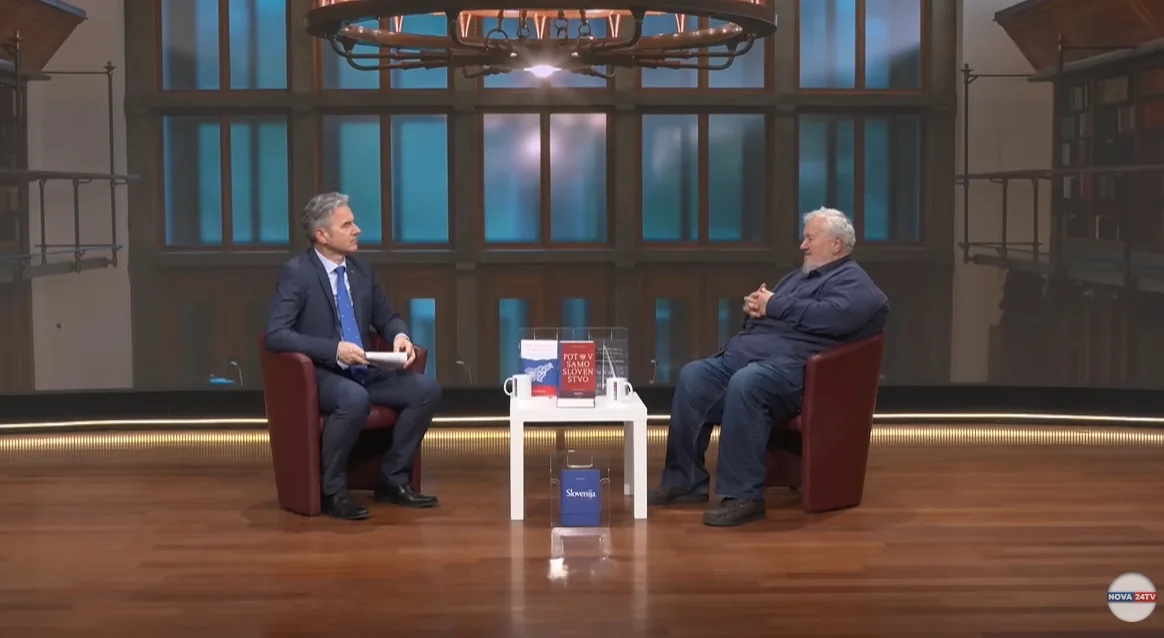
In the latest episode of Beremo, a long and content‑rich conversation took place between the host, Metod Berlec, and the historian Stane Granda. Together they discussed the findings of two new volumes published by the Study Centre for National Reconciliation and the Družina publishing house.
Among other things, Stane Granda sharply assessed the attitude of the Communist Party toward the national question, the modern rituals of celebrating the Day of Uprising Against Occupation, and the current political situation after the elections. His comment on Milan Kučan was particularly interesting.
Granda emphasised the exceptional role of Slovenian Catholic intellectuals, especially priests, in shaping Slovenian national consciousness and the demand for an independent state. The earliest known call for an independent Slovenia comes from Dr Lambert Ehrlich from the Kanalska Valley. “He was the first to demand an independent Slovenia and gathered around himself an elite group of Catholic intellectuals, the so‑called ‘stražarji’,” Granda said. “He demanded a cosmopolitan education from them. Unlike the youth of the time, who were raised more provincially, inwardly, or monastically, Ehrlich insisted that his followers be cosmopolitan.” Because of his international connections, he arranged scholarships for many of them in Paris and London.
Granda also highlighted Father Kazimir Zakrajšek, a Franciscan who, on the orders of Bishop Rožman, was already in 1941 promoting the idea of an independent Slovenian state among emigrants and American diplomats in New York. “He was extremely successful,” he added. The idea continued to live on at the gatherings on Svete Višarje, organised by Dr Janez Zdešar. Granda, who attended them himself, described them as “a living monument to Ehrlich and to Slovenian independence thought.”
A long parliamentary tradition among Slovenes
In the second part of the conversation, Granda presented the volume on the development of parliamentarism in Slovenian lands. He emphasised that Slovenes have had a parliamentary tradition since the 13th century (communal assemblies), and especially since 1848 in the Vienna Parliament, where there was “the strongest Slovene representation in any parliament”. He highlighted Dr Franc Miklošič and noted that Slovenes at the time were also active on the left, but all were strongly nationally conscious.
Communists and the national question: a duality that lasted for decades
Granda made it clear that there was no unity among Slovenian communists. There existed a “Slovene faction” and a “Yugoslav faction”, led by Edvard Kardelj. The rivalry was intense – to the point that Boris Kidrič planned Kardelj’s liquidation in 1944. The communists were officially internationalists, but some (especially those from the Littoral) maintained a strong national consciousness. Granda quoted Kidrič’s words spoken at Base 20: “I am a communist and must be an internationalist. If I had to choose between Sloveneness and the international movement, I would – although very reluctantly and with great difficulty – choose the international movement. I hope I will never have to.”
Jože Pirjevec and Milan Kučan
Granda commented on Jože Pirjevec’s upcoming book about Edvard Kardelj. Although he considers Pirjevec a good historian in some areas, he expressed doubt about his familiarity with Slovenian circumstances: “He lived his whole life in Italy; Slovenian history is a more peripheral topic for him.” Here Granda specifically mentioned Milan Kučan. According to his information, Pirjevec called Kučan and asked him to write the foreword to the book, but Kučan declined.
Granda presented this detail as an important indication of how the former president of the republic is distancing himself from the new interpretation of Kardelj and the post‑war period.
Granda was highly critical of the celebration of 27 April – the Day of Uprising Against Occupation. In his view, it has turned into a “holiday of lies”: “I have not heard so many absurdities on Radio Slovenia 1 in a long time. […] 27 April has become a holiday of lies.” He rejected historical distortions and the denial of Slovenian identity, stressing that the only genuine act of resistance was carried out by the TIGR members near Ribnica on 13 May. He was equally sharp in his assessment of the Labour Day celebration on Rožnik, where Ljubljana’s mayor Zoran Janković gave a speech; he compared it to a “perversion”, arguing that the wealthiest and most corruption‑tainted politician was lecturing workers about workers’ rights.
Regarding current politics after the elections, he said that Robert Golob’s coalition is “defeated” and that the opposition holds more seats. He also stated that President Nataša Pirc Musar “is not the president of all” and does not behave neutrally.
Independent Slovenia remains the greatest achievement
Despite all his criticisms, Granda is optimistic about the upcoming 35th anniversary of independence this June: “Even if we do not have a centre‑right government, even if we had a fascist government, those of us for whom an independent Slovenian state is a great value will celebrate. […] Slovenian independence is the greatest achievement in Slovenian history. There is no greater one.”