

By: Nova24tv.si
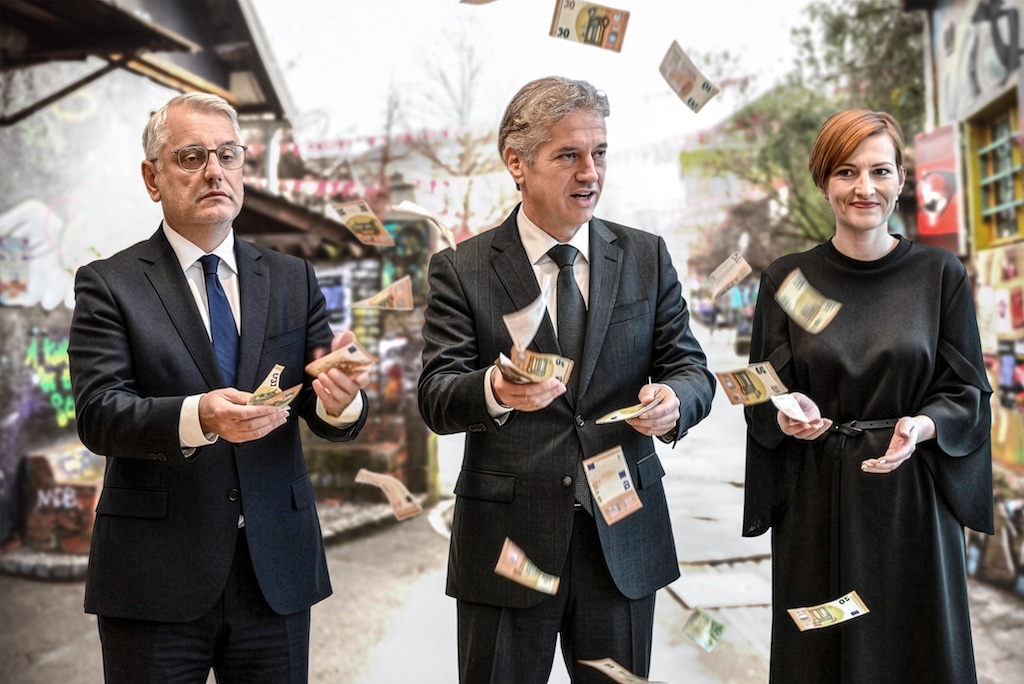
During the pre‑election period, Prime Minister Robert Golob painted an idyllic picture of Slovenia as an economic miracle that even Western European countries could look up to. Ordinary people, meanwhile, were scratching their heads and checking the numbers on lower imports, industrial output, and falling real wages, wondering whether they and the prime minister were living on the same planet. The media helped him along: news about the poor state of the economy was practically non-existent. Now, just a few weeks after the elections, the dam of information has burst, and articles suggesting that we are practically on the road to bankruptcy have begun to appear like mushrooms after the rain.
Let us recall that shortly before the elections, Golob convened a select group of pro‑government business figures, joined by Finance Minister Klemen Boštjančič, Matevž Frangež, State Secretary at the Ministry of the Economy, Tourism and Sport, and Igor Mally, State Secretary for European Affairs in the Prime Minister’s Office, where they lavishly praised their centrally planned economic concept.
In the pre‑election debates, he repeatedly claimed that the Slovenian economy was exceptionally successful, justifying this first by saying that unemployment was minimal, at 4.2%, and second, that during his government the stock market indices had jumped by 100% by all criteria, not only in terms of profits. He stressed that “investors of all nationalities appreciate the Slovenian economy and its prospects and therefore invest in Slovenian companies,” which was supposedly why the stock indices had surged.
All well and good, but opposition politicians and business leaders were already pointing out that the stock market is not everything, since the index (SBITOP) is not the entire economy – it is based on only nine large state‑owned companies. Slovenia, however, has around 200,000 companies, including 500 large and 1,377 medium‑sized ones that the stock index does not reflect, and these companies experienced real devastation during Golob’s government. We witnessed lower profits in practically all business entities, a decline in GDP growth, a sharp drop in industrial production (for a time we were even record‑holders in the fall of this index). Under Golob’s government, Slovenia lost eight places on the IMD World Competitiveness Ranking, exports fell, the share of foreign investment practically came to a halt (except where taxpayers co‑finance the investments), and the employment figures Golob boasts about are highly selective (jobs in the public sector are increasing, while jobs in the private sector are disappearing).
Slovenia as Europe’s patient
Back in 2022, when the effects of Janez Janša’s government were still being felt, economic growth, GDP growth, stood at 2.7%. In 2023, growth was recorded at 2.4%, in 2024 at 1.7%, and last year at only one percent, or 0.9% when adjusted for the number of working days.
Slovenia’s economic growth is lower than the (already low) average of the European Union. In the euro area it stood at 1.5 percent, and in the EU as a whole at 1.6 percent. A few days ago, we reported that the Slovenian economy has become lethargic due to the socialist policies of the current government. The situation is quite the opposite in neighbouring Croatia, where numerous Slovenian companies are relocating. Croatian media have written this year that life in their country is already easier than in Slovenia. But the negative trends do not stop there. Exports (recall that export‑oriented companies are the backbone of the Slovenian economy) increased by only 0.3 percent. Imports, however, rose by 2.1 percent, according to the STA.
What stirs the most controversy is the imbalance between wage growth in the public and private sectors and the disproportionate staffing expansion of the public sector. Last year, the average wage in the private sector rose by 3.9 percent, while in the public sector it increased by as much as 9.4 percent. In state institutions, wages rose by 11.2 percent, which is partly linked to the pay reform. Because the public sector is expanding in terms of personnel and because these employees have higher wages, the total public‑sector wage bill is consequently rising sharply.
Post‑election enlightenment
We knew all this already at the time. The media knew it too, but remained silent. And today? Both the media and left‑leaning politicians have experienced a sudden “enlightenment” and are now, all at once, beginning to acknowledge the seriousness of the situation. The finance minister has already sent a letter to the ministries, urging them to submit proposals on how they will implement savings measures in response to the fiscal crisis. Even Robert Golob now admits that the situation is critical and requires timely and coordinated action, and he is trying to use this crisis as an excuse for forcing together a left‑wing government. The newspaper Delo reports that the economy is in spasm and that the budget deficit will be higher than expected, potentially reaching 3.5 percent. Economist Bogomir Kovač warned on RTV Slovenia that the coming crisis will be worse than the one in 2022. On Odlazek’s Svet24 they report that the pharmaceutical supply chain has already collapsed due to the crisis and frozen margins.
Suddenly, then, everyone has realised that we are heading toward the crisis of all crises, even though throughout the entire pre‑election campaign we kept hearing that the government was performing excellently and that the economy was in outstanding shape.
Politicians and commentators on the right are understandably frustrated by such an obvious moratorium on reporting bad news. “Who will measure the damage caused by the poor work of journalists, who only after the elections realised the country’s poor financial condition? People cannot make informed decisions if they are served fairy tales and incomplete information. RTV Slovenia is bound by the RTV Act to balanced and credible reporting,” wrote SDS MP Alenka Jeraj.
Simon Vidmar highlighted two statements by Klemen Boštjančič that are diametrically opposed, separated by only a few weeks. On 1 December 2025, just before the pre‑election period, he said that “the scaremongering that we are walking on the edge is a great exaggeration.” Only four months later, he is now expecting proposals on where to cut budget spending.
Protecting the image and record of Robert Golob and his government
This raises the question of why no one in the media spoke about the approaching crisis before the elections. The reason is obvious: most likely no one wanted to tarnish the image and record of Robert Golob and his government. A moratorium on reporting poor fiscal and economic results prevailed in the media. We saw something similar in 2020, when major media outlets did not report on Hunter Biden’s laptop containing sensitive data that could have implicated presidential candidate Joe Biden in a corruption affair. There, too, the media collectively ignored the story, while social networks even censored it and deleted related posts.
It is clear that reporting on poor economic prospects would also have amounted to an indictment of Golob’s redistributive, centrally planned economic model.