


By: Spletni časopis
While the country is shaken by the affair involving an alleged attack on Svoboda’s social‑media profiles from Persian countries, an attack that, according to Finance Minister Klemen Boštjančič, supposedly happened early in the morning, while according to Tina Gaber Golob it happened in the afternoon, and which Svoboda has even linked to Israel and its intelligence services, with their state‑aligned media (such as Siol.net) trying to pin the whole thing on the opposition, especially SDS, a study titled Bot Activity in the Slovenian Elections has appeared on the online platform Medium, signed by an anonymous group calling itself “Slovenia Research”.
The authors, using English and quoting high‑ranking Slovenian officials, including the head of UKOM, Petra Bezjak Cirman, attempt to create an impression of expertise. But a closer look reveals that this may be nothing more than a pre‑election stunt or even a false‑flag operation. When it comes to bots and support for Svoboda on social networks, support whose financing even led RTV Slovenia to cancel the show Tarča, things are always murky. The unusual post looks like this:
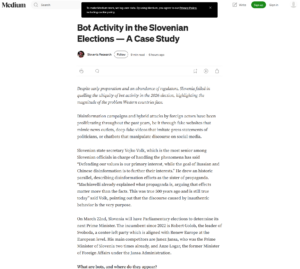
- Sloppiness regarding Janša
Although the “researchers” delve into bizarre profiles such as “Khan Khan Khan Khan” or “Zuzu Zuzu”, which like Robert Golob’s posts, their analysis contains strange errors. They write, for example, that Janez Janša was prime minister twice, even though he led three governments. Such a mistake suggests that the content was not prepared by someone who truly knows Slovenian political history, but perhaps by someone relying on generic sources and translation tools. If the authors do not even know how many governments the leader of the largest opposition party has headed, it is questionable how well they understand the algorithms and political context they claim to analyse.
- The digital mirror: Who created “Zuzu”?
The analysis correctly notes that support for the prime minister on TikTok and Facebook comes from profiles without photos, without friends, and with bizarre followers from Pakistan or Syria. But in the world of digital campaigning, there is an old trick: you create a “bot army” for your opponent, then you yourself (or through anonymous portals) “expose” it as a scandal. Or you even create the entire thing, article included, to give the impression of an attack on yourself. The article says nothing about paid social‑media assistance, which serious Slovenian media have already uncovered, for example, Tarča.
- Quotes as camouflage
Interestingly, the authors cite Vojko Volk and Petra Bezjak Cirman on the dangers of Russian disinformation to boost their credibility. This gives their text the weight of an “official fight against hybrid warfare”, while they themselves remain anonymous. Are the bots on Golob’s profiles real? Probably. Are they there because Svoboda hired them, or because someone else created them in order to “catch” them and write about it right before the elections? Or even so that Svoboda could claim that an attack really happened, something many doubt. At a time when disinformation has become the sister of propaganda, an anonymous English “study” that cannot even count Janša’s mandates is above all a warning to be cautious. Do not believe everything written in English and decorated with screenshots.
ANALYSIS OF THE MEDIUM PLATFORM: A “WEB WALL” WHERE ANYONE CAN WRITE
Readers, when seeing English text and polished graphics on Medium.com, may get the impression that they are looking at an established outlet or a professional journal. The truth is different:
- No editorial oversight: Medium is not a newspaper but an open blogging platform. It is what Blogger or Tumblr once were. Anyone can create an account and publish anything within five minutes – with no fact‑checking or editorial filter.
- Misleading “expertise”: The platform is popular for so‑called information operations. Because Medium allows clean formatting (quotes, images, graphs), posts can look like professional research even when they are merely anonymous pamphlets.
- A tool for “news laundering”: A common strategy is to publish an anonymous “analysis” in English on Medium, then have domestic portals cite it as “reporting by foreign experts” to artificially boost its credibility.
In the case of “Slovenia Research”, the profile has no history, no followers, and shows an obvious lack of knowledge about the local political landscape – all typical signs of astroturfing, the creation of a false impression of independent research.
While the government side attributes the affair with Pakistani and Syrian bots to foreign intelligence services and even Israel, an English‑language “study” has appeared that supposedly confirms these suspicions. But a detailed review reveals that the authors do not even know how many governments Janez Janša has led, raising the question: Is this a professional analysis or an amateurishly prepared pre‑election “kompromat”?
More HERE:
THE ENGLISH “INVESTIGATION” ABOUT GOLOB’S BOTS WITH AN ELEMENTARY‑SCHOOL‑LEVEL MISTAKE ABOUT JANŠA