

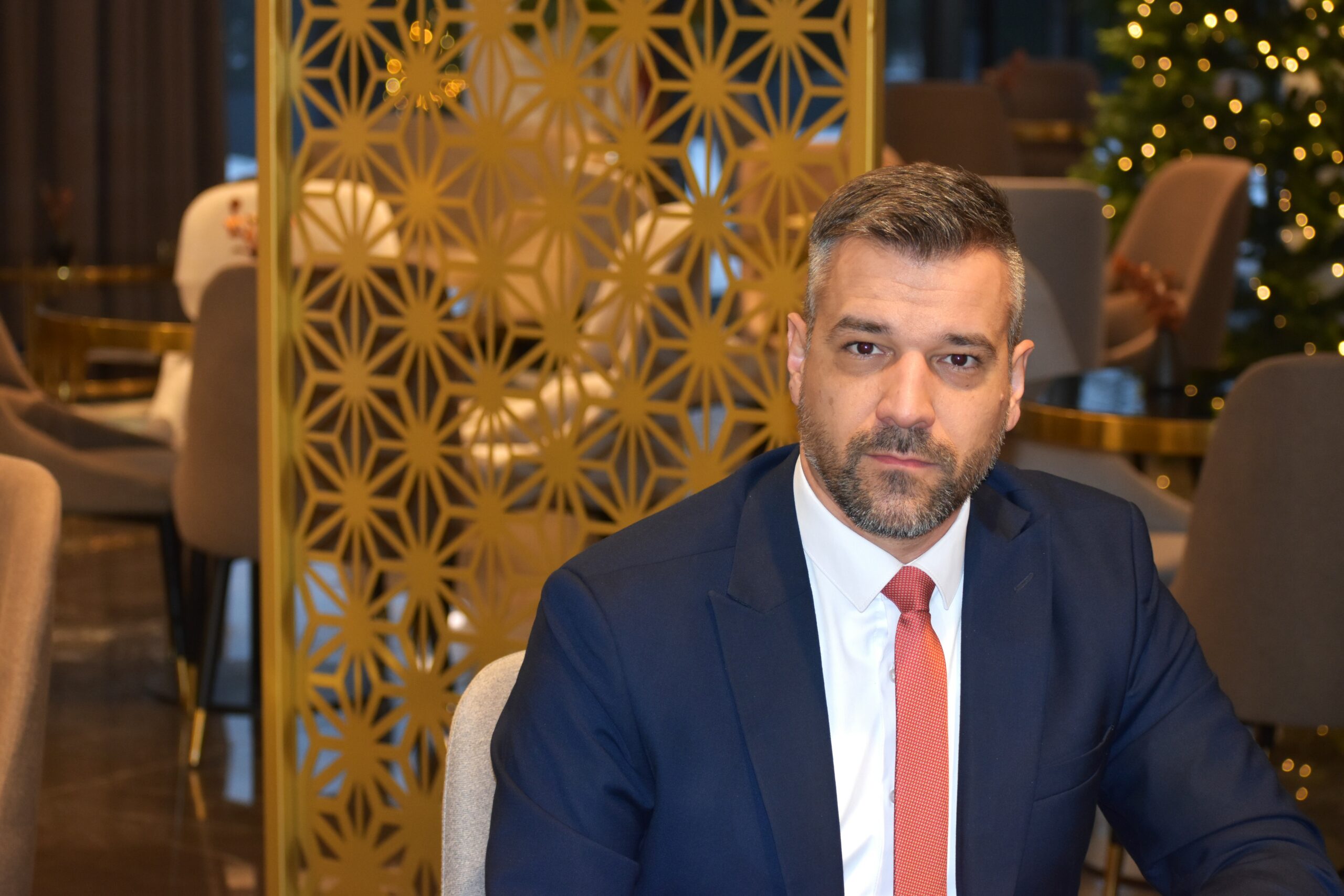
By Andrej Sekulović
András László is a Hungarian Member of the European Parliament and a member of the Fidesz party. We spoke with him about the situation within the European Union, as well as about the atmosphere in Hungary in light of the important elections that will take place this April.
Mr. László, as a Member of the European Parliament, you are part of the Patriots for Europe group, which is relatively new on the European stage…
The Patriots for Europe group and party were founded after the 2024 European elections. Very quickly, we became the third-largest group in the European Parliament. Something like this—where a newly established group immediately becomes the third-largest in Parliament—has never happened before. I believe this is simply a reflection of the will of the people, or rather European citizens, who want change both at the European and national levels. That is why we managed to form this group, which has brought together conservatives, economically liberal parties, libertarian thinking, as well as some completely new parties in the European Parliament. Former members of the European People’s Party and Identity and Democracy joined us, as did parties appearing in the European Parliament for the first time. As you say, we are quite a young group.
What are the main guiding principles of the Patriots for Europe? What kind of policies do you advocate?
We represent change in Brussels, especially on civilizational issues such as mass migration or the left-wing green agenda that has been active in recent years. We advocate sovereignty, because since the Lisbon Treaty in 2009 there have been no changes at the European level. Nevertheless, European institutions and the European Commission are in practice appropriating more and more power, without any legal basis for doing so. We therefore stand for sovereignty and for a policy that puts Europe and Europeans first; we must protect our borders and return to common sense when it comes to economic regulation and policy.
Moving on, how do you comment on the rise of technology and the internet in the context of freedom of speech and censorship?
This is a very interesting and important topic for everyone. Technology and the internet have drastically changed our lives, especially over the last 15 years. With smartphones, we carry the internet in our pockets. This has both positive and negative aspects. The positive side is that greater access to the internet provides a cheaper way of communicating. Politicians or ordinary people who want to spread certain messages can do so much more easily and can connect with others. Citizens communicate directly with politicians. The role of watchdogs and gatekeepers or opinion +once held by mainstream media has been significantly reduced.
What about the negative consequences of technological progress and the internet?
As for the negative aspects, interference in elections has become easier. Social media platforms can censor you through algorithms or covertly suppress your content so that it becomes shadow banned, without you even knowing it. Foreign interference has also become cheaper. It is no longer necessary to invest large sums of money to establish companies in foreign countries; influence can be exerted through anonymous user accounts or websites. In this way, anyone from outside can interfere.
In this context, proposals by the European Commission to establish a so-called “democracy shield” are also often mentioned…
Measures, such as the democracy shield or EU fact-checking networks, represent a reaction. All of this is a major problem, because it solves nothing. They want to censor certain information and decide what people can access. In doing so, they nullify the democratizing effect enabled by technology, the internet, and social media. I believe people are capable of understanding and distinguishing between what is good and what is bad, and of deciding the direction in which their country should go. Therefore, they should have the right to free expression and to communicate with one another and with political leaders, without interference.
We often hear warnings that an unregulated internet could open the door to fake news and manipulation. What is your view on this?
Although all this enables cheaper and easier manipulation, lies and manipulation also become much more visible. If someone posts something on social media, any other user can point out that it is false and present the true course of events along with appropriate evidence. This creates a kind of spontaneous social oversight. I believe that in a democracy we must trust citizens, who can themselves exercise this social oversight over others and over issues they consider important. This at the same time ensures freedom of speech, even though it is, of course, at odds with the interests of some—especially on the political left.
You are also a member of the Hungarian governing party Fidesz led by Viktor Orbán. Given that you also have important elections this year, could you tell us how much public support Orbán’s government currently enjoys and what we can expect in the upcoming parliamentary elections?
In Hungary, elections will take place in April. Parliamentary elections are held every four years. This time we are witnessing a very unusual situation, as the old left-wing parties—as well as liberals and greens—have essentially disappeared. A new party, or rather a new individual, has occupied the entire political space of the opposition. This is a Member of the European Parliament who essentially has no new vision for Hungary. He merely seeks to channel anger, create controversy, increase pressure on the government, and demand change. At the same time, he is in every respect dependent on the entire left-wing infrastructure—that is, their networks and institutions on which our old opponents from the left relied in the past. He relies on the same media and experts, which means that his policies are shaped by the same people. He presents himself as someone who brings change, but is in fact merely a new face of the old left-wing establishment. I think this is something that is very common in Slovenia and many other countries as well; it is an old trick used to try to deceive the nation.
What do you think the outcome of these elections will be? How will Fidesz perform?
I believe we have a very good chance of being re-elected. Hungary has taken the right stance on many issues, because common sense is the pillar of our policy. Instead of what EU bureaucrats want for Europe and Hungary, we defend the political decisions, interests, and wishes of Hungarians at the European level. This is, of course, disliked by many leftists in Brussels, but at home our family-friendly policies and our stance against illegal migration have been very popular for ten years now.
Hungary is, of course, known for having policies that differ significantly from Brussels’ left-liberal guidelines…
Our policy of national sovereignty, pursued in the face of enormous pressure from Brussels elites, is very popular among Hungarians. They also value our policies that help young couples buy and create a home, as well as tax relief policies for businesses and families. They appreciate that over the past fifteen years that we have been in power (since 2010), we have consistently opted for a common-sense approach desired by the majority of the population, and have ensured stability at a time when Europe is experiencing a great deal of instability, even in major countries such as Germany, France, and Spain. I know that at the level of individuals, something new always sounds exciting and stimulating, but I believe that when people look around and face the decision of whom to trust with the next four years of governance, they will realize that we are a safe and reliable choice they can depend on. This is also our promise to the Hungarian people.
Do you think Brussels will try to interfere from the outside in the elections in Hungary?
Brussels already tried to interfere in the last elections in 2022. Of course, it has continued to interfere since then, for example by withholding European funds that were allocated to Hungary under the agreement on the EU budget. They refuse to release these funds because of our policies on the war in Ukraine, mass migration, and pro-family policies that oppose transgender ideology. They have made this very clear. The most problematic aspect is that these are not matters within the competence of the European Union. Education, social, and family policy fall under national jurisdiction. Foreign policy does as well. Migration policy and border protection are primarily security issues, which are also within national competence. It is therefore clear that they are violating EU treaties; they do this in order to help our opponents and put the government in a difficult position. They did this during the last elections and continue to do so today, including by withholding money that belongs to Hungary. In this way, they actively and passively assist our opponent in the elections.
Finally, one last question: What changes would be necessary within the European Union for Europe to once again become a strong geopolitical power?
Fundamental changes within European politics will only occur if there are fundamental changes in national policies. The direction in which the European Union moves is not determined solely by the European Parliament and the Commission, but also by the European Council, where representatives of the member states—prime ministers or presidents—represent the positions of their countries. As long as there are no changes in many national governments—and I hope that more conservative and patriotic parties come to power—there will unfortunately be no changes at the European level. Among the issues that need to be put in order are the migration crisis, whose consequences after ten years are extremely negative, and energy policy, because we cannot have a competitive European economy and industry without cheap energy. If gas and electricity in Europe are two or three times more expensive than in the United States or China, not only will their companies be more competitive, but European companies will leave Europe and relocate their production to other countries. This is not good for Europe.