By: Vida Kocjan
Some time ago, outgoing Prime Minister Robert Golob said in the National Assembly: “Anyone in Slovenia who does not have a personal doctor simply does not want one.”
What do citizens say to this? Perhaps even in Borovnica, where Golob’s Freedom Movement won the last election, yet only a few days later residents were standing for hours in a long queue? At this moment, we do not know.
What we do know is that, according to the latest publicly available data, almost 140,000 people in Slovenia are without a chosen personal doctor (family doctor), including around 20,000 children without a paediatrician.
The number of people without a personal doctor has increased noticeably under Robert Golob’s government. At the end of 2021, according to the Medical Chamber of Slovenia, there were slightly fewer than 122,000 people without a chosen doctor. Since then, the number has risen by roughly 15 to 20 percent. The data include insured persons with permanent or temporary residence in Slovenia. Particularly worrying is the number of children without a paediatrician.
What happened in Borovnica
The problem in Borovnica began when long‑time doctor Marija Munda retired. After nearly four decades of work, the local clinic was left without a lead physician. The municipality initially prepared a call for a concession, but the municipal council ultimately decided not to award it. Instead, the clinic was taken over by the Vrhnika Health Centre as a satellite unit. Doctors were supposed to cover it alternately on several days of the week.
In practice, this means that the clinic does not operate as a fully staffed family‑medicine practice with one permanent doctor, but as an outpost where doctors work only part of their working hours. One covers roughly 60 percent of the programme, another around 20 percent. This model allows for minimal functioning but raises questions about continuity of care and stability.
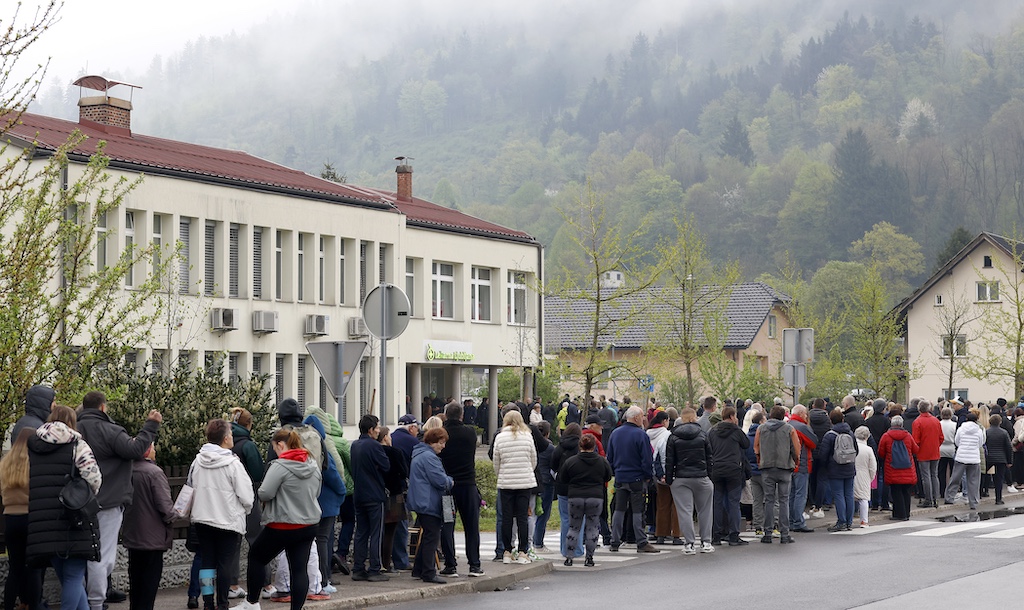
On 15 April 2026, a new doctor, Lucija Galič, began working at the family‑medicine clinic in Borovnica, replacing the retired concession holder. Due to the rules of the Health Insurance Institute of Slovenia (ZZZS), which do not allow the automatic transfer of patients, each person had to sign a declaration in person to choose their doctor. This caused long queues already on the evening of 14 April. Some people, including the elderly, the sick, and parents with children, waited from 10 or 11 p.m., others from 4 a.m. The queue stretched about 300 metres. Registration began at 7 a.m. By 9 a.m., around 800 people had been registered, and by the end of the day all who had been waiting. The new doctor’s quota amounts to 1,348 capitation points.
Registration was not limited to residents of Borovnica; unassigned patients from the surrounding area could also register.
The position of the ministry, the municipality, and the health‑centre management
The Ministry of Health, led by the outgoing minister Valentina Prevolnik Rupel (Freedom Movement), has not issued any public statement regarding the events in Borovnica. The Municipality of Borovnica published only the Vrhnika Health Centre’s notice about the start of registration on its website, without any additional critical comment.
The director of the Vrhnika Health Centre, Anja Jovanovič Kunstelj, later told the media that all those waiting had been registered and that none of the former concession holder’s patients had been left without a doctor.
The problems are not limited to Borovnica
Borovnica is just one of many cases. The shortage of family doctors is occurring across Slovenia. The highest numbers of unassigned patients (people without a doctor) are in municipalities such as Kočevje, Hrastnik, Velike Lašče, and Ravne na Koroškem. In Ljubljana, around 28,000 adults were reported to be without a personal doctor at the end of 2025. There are also problems on the coast (Koper, Piran, Izola), where several hundred people are without a doctor.
Slovenia has roughly 1,450 primary‑care doctors, and the system is struggling to keep up with the needs of an ageing population. On top of this, during Golob’s government, doctors were subjected to significant verbal attacks, including being called “idiots”.
A system that does not ensure continuity
The case of Borovnica once again raises a systemic question: what happens to patients when a doctor leaves. Under the current rules of the Health Insurance Institute (ZZZS), patients are left without a chosen doctor and must find a new one themselves. Health‑care experts therefore propose the automatic transfer of patients to the new doctor, similar to other public services. The patient would confirm consent at the first visit. This would prevent administrative limbo and long queues every time a doctor retires or leaves.
How do clinics for unassigned patients operate?
Within the Vrhnika Health Centre, the clinic for unassigned patients operates three afternoons a week (from 14:30 to 18:30), and on Wednesdays also in the morning (from 9:00 to 12:00) and in the afternoon (from 14:30 to 17:30). Outside these hours, there is no additional coverage. For acute problems, patients are directed to the emergency department. As of 13 April 2026, an additional family‑medicine clinic for people without a chosen doctor has been introduced. Five sessions are planned for April.
These clinics are mostly temporary bypass solutions and do not address the fundamental problem – the shortage of family doctors and the overload of existing teams.
A boomerang of political decisions
The Borovnica case also has a political dimension. The local community strongly supported the ruling Freedom Movement in the elections, even though the government had in recent years intensified its confrontations with the medical profession. The fact remains: when doctors leave, it is smaller municipalities that feel the empty clinics first.
The story from Borovnica is therefore not merely a local issue. It is an illustration of the broader problems of the Slovenian health‑care system as shaped under Golob’s government, a system that relies on improvised solutions while the structural shortage of doctors remains unresolved.