

By: G. B.
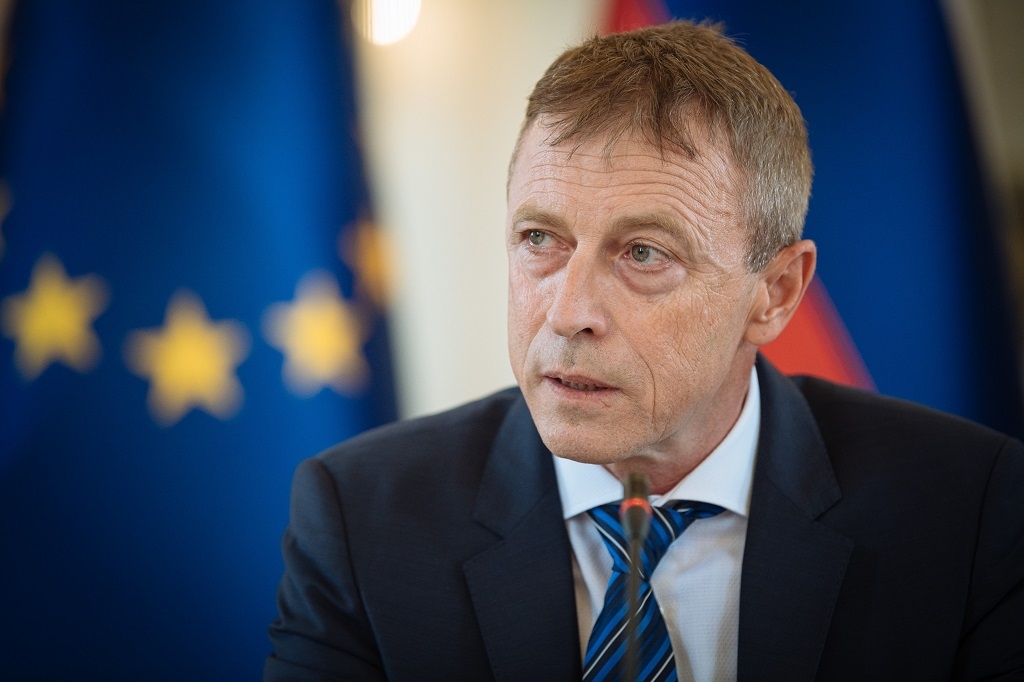
Constitutional Court President Rok Čeferin stated at the State Attorney Days that Slovenia had witnessed an attempt to influence the election results this year. He did not specify what he meant, making it clear that the statement primarily served as a bombshell intended to fuel discussion about the Black Cube affair, in which nothing has been proven.
He added that even human rights already won in the past are not guaranteed, which is why institutions that safeguard the systems of a democratic society, including the State Attorney’s Office, must be protected.
In his address at Brdo pri Kranju, Rok Čeferin also reflected on current global political developments, noting that democracy is being eroded worldwide, including in Europe.
“Executive branches in some European countries are restricting media freedom and political competition, changing legislation to entrench their power, and limiting judicial independence. Democratic systems in these countries are gradually, step by step, turning into autocracies,” he warned.
The text comments that it is rather bizarre he is speaking about this only now, after four years of silence on the matter. It also suggests he does not seem troubled by the fact that former EU Commissioner Věra Jourová visited the Slovenian Constitutional Court just before the decision on RTV.
The most bizarre part, according to the text, is the ambiguity surrounding alleged foreign influence on elections. Čeferin said we live in a time when intelligence services influence election outcomes. “I am not referring only to the most notorious cases, such as Brexit or the 2016 U.S. presidential election. This year, we witnessed similar attempts to influence election results in Slovenia,” he stated.
Čeferin argued that nothing achieved in the field of human rights is permanently secured. Therefore, whenever the “immune system” of a democratic society is being dismantled, institutions that protect it, such as courts and the State Attorney’s Office, must be defended.
He began by noting that several questions arose while reading the provisions of the State Attorney Act, particularly regarding the independence of state attorneys in performing their duties. Although the law defines the State Attorney’s Office as an autonomous body, state attorneys must follow government instructions when carrying out the most important procedural actions. According to Čeferin, this shows the legislature intended to subordinate the State Attorney’s Office to the government.
He identified another contradiction in the provision requiring state attorneys to act in a way that protects the rights and interests of the Republic of Slovenia, thereby strengthening the rule of law. This assumes that protecting the state’s interests automatically strengthens the rule of law, yet the law does not define what the “state interest” is in any given case.
“Neither the State Attorney Act nor any other regulation contains safeguards preventing the government from defining the state interest arbitrarily, politically, or in ways that benefit the ruling power rather than the rule of law,” he warned.
According to Čeferin, the current legal framework theoretically allows situations in which state attorneys would have to assist the government in misusing the law to achieve political goals unrelated to strengthening the rule of law.
He believes such cases are rare or non-existent but insists the law must be clear enough to prevent even theoretical abuses. He recalled similar issues during the COVID‑19 epidemic, when the government demanded that the State Attorney’s Office file lawsuits to recover security‑related costs from individuals who exercised their constitutional rights to assembly and free expression in defiance of government decrees.
Justice Minister Andreja Kokalj, currently serving in a caretaker capacity, stressed that the ability to effectively exercise and protect rights is one of the key achievements of the modern state. However, every legal system must also confront the challenge of abuse, when procedures are used to delay, exhaust the opposing side, or undermine trust in institutions.
“At that point, we are no longer dealing merely with procedural issues, but with a broader societal problem affecting the efficiency of the judiciary, legal certainty, and public trust in the state,” she said.
She also emphasised the importance of recognising cases where legal procedures are used to restrict public debate on issues important to society. She welcomed the adoption of the law on protective measures against SLAPP lawsuits, noting that state attorneys have a particularly responsible role in this area.
Supreme Court President Damjan Orož stressed that a fair and efficient judiciary must be the guiding principle for everyone in the justice system. He focused on ensuring procedural rights, which both protect parties and form the foundation of the rule of law, but can also be abused as an illegitimate defence strategy.
“All actors in the justice system are rightly expected to demonstrate professionalism, integrity, and responsibility. They must be aware of the unlawfulness of their procedural actions and their consequences, and be accountable for them,” Orož said.
General State Attorney Ana Kerševan also spoke about the limited autonomy and influence of the State Attorney’s Office. She recalled that state attorneys had long advocated for an amendment to the State Attorney Act to prevent situations in which they could become targets of improper pressure.
She noted that the proposed amendment would have strengthened the advisory role of the State Attorney’s Office and shifted more procedural direction into the hands of state attorneys. She expressed regret that the solutions developed by the ministry’s working group were not implemented in the new law, though they remain a good foundation for the future.
The State Attorney’s Office has had another successful year. In compensation disputes against the state, it achieved a 98.71% success rate relative to the amounts claimed. The state was required to pay only 1.29% of the total claims, €627,094.29, while opposing parties sought €48,696,691.14 in damages.
This year’s State Attorney Days, held today and Wednesday at Brdo pri Kranju, are dedicated to an in‑depth reflection on the role of the state and state attorneys in preventing abuses of rights in judicial and other proceedings.