

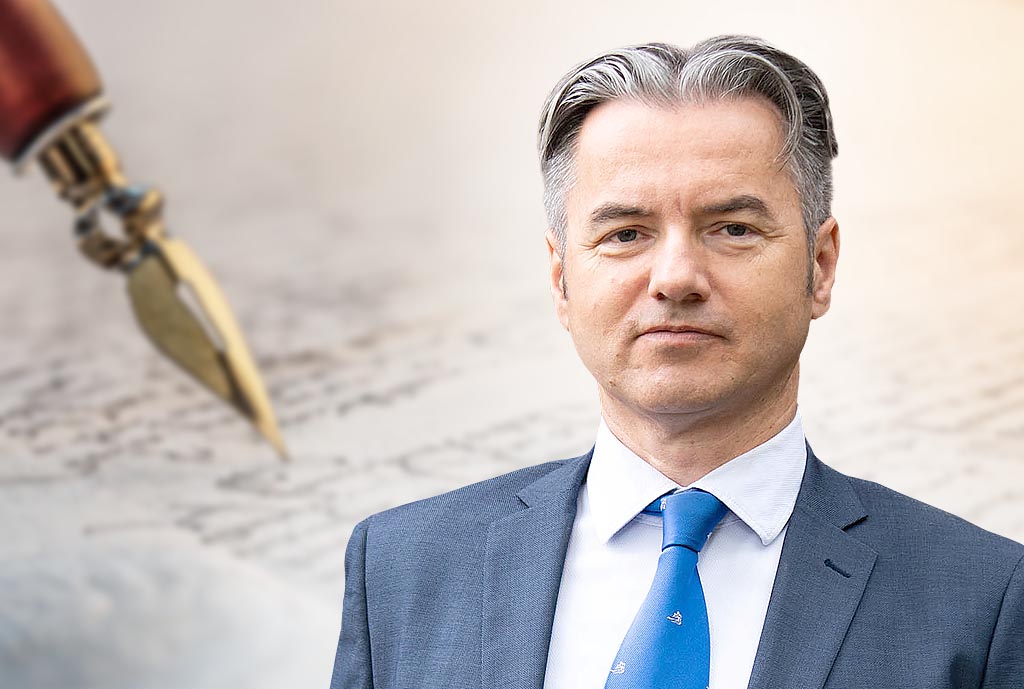
By: Dr Metod Berlec
On the 30th anniversary of the weekly Demokracija, I will, for once, be a bit more personal, as this is an important media achievement to which I myself contributed, even though I must admit that in my childhood I never imagined I would end up in the media world, become a journalist and an editor. But I come from a nationally conscious Christian family from Kamnik. After the Second World War, my grandfather was declared a “reactionary” and imprisoned for half a year – solely so they could nationalise several houses he had acquired through hard work before the war. My father, who had always been critical of the communist totalitarian regime and of the SFRY, contributed significantly to my worldview. At home he told us that Slovenia should become independent. With his help, I soon realised that newspapers, radio, and television served the one‑party regime and that one must keep a critical distance from them. And that Slovenia urgently needed regime change, democratisation, and media freedom.
I experienced the Yugoslav economic crisis, rising national tensions, the Slovenian Spring, democratisation, independence, and the beginning of the transition actively throughout my high‑school and university years. I worked various student jobs, taught history and geography at a primary school, and guided visitors through the exhibition Slovenians in the 20th Century at the Museum of Contemporary History of Slovenia. But since I did not have a permanent job, I told myself: why not try journalism? First, the legendary editor Danilo Slivnik took me into Mag. There I learned the basics of the journalistic craft. Then came a call from Demokracija, followed by a permanent position in March 2001. The jump from Mag to Demokracija was instructive: from the most modern computers and software of the time to outdated machines inherited from the defunct Slovenec. At Komenskega Street, where our editorial office was located, I first worked on an old Macintosh that was useful only for writing texts. In the newsroom itself, there was only one modern computer with internet access. Over time, conditions improved. By a twist of circumstances, at the beginning of 2002 I first became acting editor‑in‑chief, and then editor‑in‑chief of Demokracija. During the first Janša government, in addition to editing, I also became director of our publishing house Nova Obzorja. Every month I bought one modern PC for the newsroom, simply to enable normal journalistic work…
In the past, our magazine was often the only medium in Slovenia that did not succumb to orchestrated pressure from the left‑wing mainstream and did not join the chorus. Demokracija did not demonise the politics of the Slovenian Spring, it defended them. We presented their positions and published what others deliberately concealed. Together with the first editor, Vida Kocjan, we continued her excellent work and gave space to people who had been humiliated and insulted under the previous system, while also presenting alternative solutions. We were aware of our mission, so we published exclusive stories that resonated across the public – from the Udba.net affair in April and May 2003, to the Delo salary revelations in April 2006, to exposing the plagiarism of the Minister of Education in April 2015. We will continue in this direction!