

By: STA, G. B.
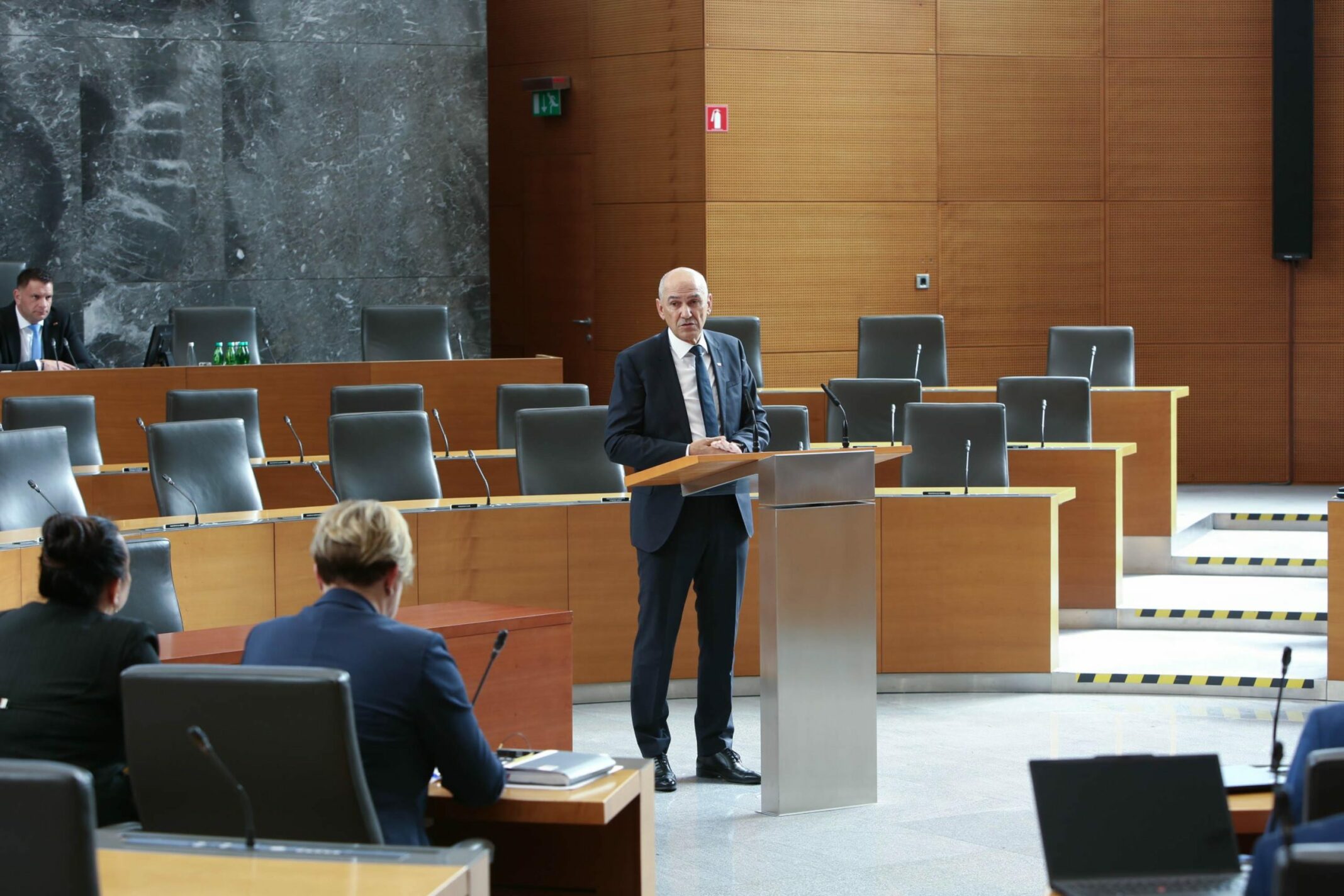
Prime Minister Janez Janša, responding to a parliamentary question about the announced education reform, said that in light of poor results in international comparisons, “burying our heads in the sand” would be a serious mistake. He believes that these results are not the consequence of a shortage of staff, but at the same time stressed that reform cannot be implemented without the participation of teachers and educational experts, which is why the reform council has been structured accordingly.
Janez Janša responded to a parliamentary question from Damijan Bezjak Zrim (SD) about the planned education reform by arguing that change is necessary because, in his view, “the harsh reality shows that the knowledge young people are acquiring in the Slovenian education system is no longer on the same level as that of comparable countries or the broader global environment.” He pointed to international assessments, noting that only a decade ago Slovenians often performed above average, whereas today Slovenia is falling behind.
“If the system were ideal, the results would be different. To bury our heads in the sand and pretend that we are moving in the right direction would be a serious mistake and a disservice to those on whom our future depends,” the prime minister stressed.
He argued that these poor results are not the consequence of a shortage of staff in education, since, in that case, outcomes would have been “significantly worse at a time when we had more pupils and fewer teachers.” As he noted, in the 1991/92 school year Slovenia’s primary schools had 225,000 pupils and 16,000 teachers, a ratio of 14 pupils per teacher. In the current school year, he said, there are 192,000 pupils and 18,754 teachers, which corresponds to a ratio of 10 pupils per teacher. According to Janša, the underlying problem is therefore not a lack of teaching staff. Rather, he argued that the causes of weaker educational outcomes lie in “the regulations, standards, and everything that has accumulated around the school system and around teachers.”
In response to Damijan Bezjak Zrim’s question about what he means by an “ideologically neutral school,” given that the members of the reform council are, in his view, largely aligned with particular ideological perspectives and reflect the preferences of the current conservative government, Prime Minister Janez Janša said that he regarded the criticism as a defence of the status quo. However, he argued that the current system “does not deliver the results we need or that young people deserve.”
Janša explained that the coalition agreement includes a commitment to “implementing an ideologically neutral school as guaranteed by Article 41 of the Constitution, rather than one shaped according to the preferences of one political option or another.” He emphasised that the Constitution provides that “the moral upbringing of children is the responsibility and duty of parents, not schools.” He explained that the government intends to implement what he described as “the constitutional concept of an ideologically neutral school.” As the goals of this approach, he identified “the removal of ideological content from kindergartens and schools, raising the status of the teaching profession, respecting teachers’ professional autonomy, and restoring teachers’ authority.”
He further emphasised that “it is clear that school reform cannot be implemented without the involvement of teachers, educational professionals, and the wider expert community.” According to Janša, the expert council established for the reform has been composed with precisely that goal in mind. “Those who are protesting are the people who were not included, but who helped build the system that is producing poor results,” he argued. He added that he understands why they are defending something they helped create but maintained that “it is not supported by the results.” Janša also stressed that the international assessments showing weaker educational outcomes were not produced by either the current government or the previous one but are internationally recognised comparisons. “If you want what is best for Slovenia and for the younger generation, then you cannot oppose correcting something that is not working well,” he emphasised.
He acknowledged, however, that the situation is not entirely negative, since these results represent national averages. “There are stronger and weaker students, better and worse schools, and better and worse practices. We simply need to take what works best as the benchmark, so that there is as little as possible of what works less well,” he added.
In his question, Damijan Bezjak Zrim argued that the proposed reform amounts to “imposing a system from the top down, when we all know that we should first build consensus from the bottom up and develop high-quality solutions.” He also criticised the composition of the reform council, claiming that some of its members “do not possess sufficient pedagogical qualifications.”