

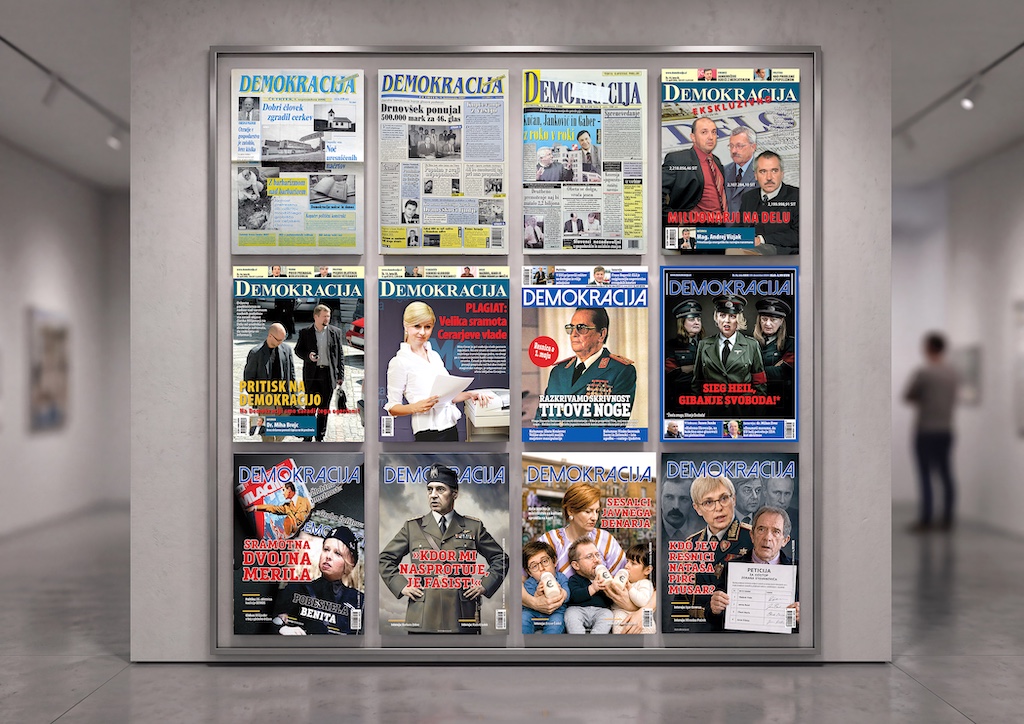
By: Gašper Blažič
The weekly Demokracija marks an important anniversary on 5 September. On this day in 1996, the first issue of the weekly you are now reading was published. Since then, it has been coming out continuously for 30 years, despite attempts to silence it.
This was not the only media outlet with this name. Already in 1918 and 1919, a newspaper called Demokracija was published in Slovenia, and it was revived again after the Second World War in the Trieste and Gorizia regions, edited by Andrej Slavko Uršič, who was a victim of an UDBA assassination. It reappeared once more in 1989 as the bulletin of the Slovenian Democratic Union, one of the first democratic parties during the period of democratic changes. With the formation of DEMOS, Demokracija became its bulletin as well, contributing to the victory in the first multi‑party elections in 1990. Later, after 1990, it ceased publication, as the newspaper Slovenec had already emerged and taken the initiative on the Spring side.
Difficult beginnings
The story of today’s Demokracija began only with the collapse of the newspaper Slovenec. The last issue of Slovenec was published in August 1996, a few months before the parliamentary elections that elevated Podobnik’s SLS, which placed immediately behind LDS. The company that published the newspaper went bankrupt, as it had in fact been in severe crisis for at least a year and unable to meet its obligations. This left an empty space on the right‑wing media landscape, and a group of former Slovenec contributors formed the core of the editorial team of the weekly Demokracija, which for its first four years was published as a newspaper, at one point even twice a week.
The beginnings were difficult. Demokracija operated for many years in modest premises with outdated computer equipment and moved several times. Journalism at that time did not yet know the internet; everything was done “in the field”, and obtaining advertisements was very challenging. At its founding, the publisher Veda d.o.o. was led by the now‑deceased Dr Jože Zagožen. For a longer period, it was also led by Dr Ludvik Čanžek, who in the 1990s was its sole owner. In 1998, the publishing was taken over by Nova Obzorja d.o.o. Its first director became the later mayor of Ivančna Gorica, Dušan Strnad, followed by Dr Božo Predalič, Andrej Lasbaher, Dr Metod Berlec, Miha Smrekar, Miha Hočevar, Miro Petek, Jože Biščak, and now Boris Tomašič.
Nova Obzorja d.o.o. began expanding its publishing activities and today even has its own bookstore. The first issue was accompanied by founding editor Marcel Koprol, followed by Vida Kocjan, who is still part of our team. Upon entering its fifth year, the newspaper was transformed into the magazine we know today. At that time, it was quite different and later changed both in design and content. In spring 2001, editing was briefly taken over by the then young Jurčič Award winner Dejan Steinbuch, followed by the current editor Metod Berlec, who had already joined the team earlier and became deputy editor under Steinbuch. Between 2018 and 2022, the editor was Jože Biščak, who began his career at Delo and Slovenske novice, later worked for Mag, Siol, Finance, and finally Reporter. The team changed over time; in the early years it included Marjeta Smolnikar, formerly a prominent journalist at Slovenec. For many years, contributions on contemporary history were also written by another former Slovenec journalist – Ivo Žajdela.
Numerous columnists Demokracija has always been accused (and still is) of being a party bulletin. However, although it supported the parties of the Slovenian Spring, it aimed to go beyond mere reporting on party events. Therefore – in addition to investigative articles – it published columns addressing events in Slovenia and around the world. From the very beginning, a regular columnist was the father of the Slovenian state, Dr Jože Pučnik; regular columnists also included current MEPs Dr Milan Zver and Branko Grims, as well as Dr Vinko Gorenak. In autumn 1999, the author of the lines you are now reading published his first contribution in Demokracija. Later, when Demokracija transformed into a magazine, other columnists joined – such as Andrej Aplenc, Dr Janez Jerovšek, Dr Matej Makarovič, Viktor Blažič, Dr Janko Kos, Dr Hubert Požarnik, Dr Marjan M. Klemenčič, Dr Brane Senegačnik, Dr Ljubo Sirc, Dr Ivan Štuhec, Dr Metod Benedik, Dr Matevž Tomšič, Dr Peter Starič, Bernard Brščič, Dr Andrej Capuder, Dr Stane Granda, Dr Janez Juhant, and many others. Between 2018 and 2020, some foreign columnists also contributed, among whom Keith Miles still regularly collaborates with Demokracija. Many of those listed are unfortunately no longer with us, while some who are still alive have been with us for a very long time. New columnists have also joined, including younger generations. For about twenty years we have also been present online, which is becoming an increasingly important medium. Recently, more people know Demokracija through the web than through the printed edition.
They did not break us!
There were many attempts to silence us. Over these thirty years, pressures kept coming; inspectors issued various fines, investigated the newsroom, followed us, watched us, wiretapped us, etc. Even readers and subscribers were not spared. The current president of the republic, Nataša Pirc Musar, as Information Commissioner, imposed high fines on us at least twice. In 2006, state supervisors Jože Bogataj and Jernej Lavrenčič visited the newsroom because they wanted to know where we obtained salary data of employees at the newspaper Delo. Bogataj was already a “familiar face” to Demokracija, as he had harassed the editorial office in 1996 over the publication of a list of collaborators of the notorious UDBA. Not to mention lawsuits and charges; in the early years there were around 30 at once. They took our time, money, and especially the much‑needed energy that we would otherwise have invested in creating new stories and an even better weekly. That was precisely the goal of those who tried to destroy us. They did not succeed. Many people sued us – from Franci Perčič, Janez Markeš, Maksimilijan Lavrinc, and Ivan Dolničar to Ciril Pucko. More serious were the interventions triggered by provocative covers – some of which even resulted in final convictions. This means that freedom of expression in Slovenia exists only on paper. Our former editor Jože Biščak could say much about this. But not even the Golob government managed to break us through advertising bans and pressure from parliamentary inquiry commissions. The weekly Demokracija has stood firm. And it will continue to be published in the future.