

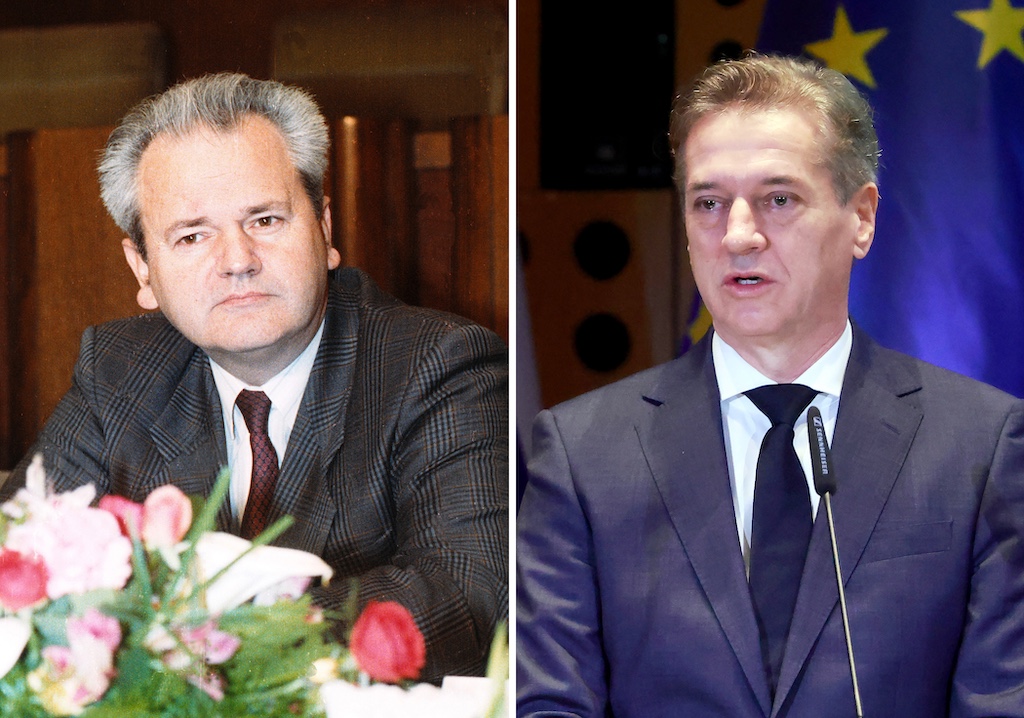
By: Gašper Blažič
The developments in our country also suggest the possibility that the transitional predatory elite will not easily let go of power and that there could even be an attempt to usurp authority.
The election campaign officially began on February 19, meaning that until March 22 the media will devote particular attention to debates between party representatives. But it seems that we will once again not have a “normal’” campaign. Prime Minister Robert Golob is becoming entangled in an increasingly severe spiral of lies and evasions – especially regarding the Ugljan affair – while at the same time trying to play the role of a victim of a so‑called cyberattack. Meanwhile, the media are searching for ways to justify the need for yet another “feathery” mandate.
How “Slobo” tried to steal the elections
But let us go back a bit into the past, to the year 2000. Not in Slovenia, but in Serbia, which in the autumn of that year finally freed itself, after nearly fifteen years, from the dictatorship of the “vožd” Slobodan Milošević. On September 24, 2000, Serbia held presidential elections that were supposed to confirm Milošević’s new mandate through a supposedly democratic process. Recall that the “vožd” rose to the top of the Serbian League of Communists in 1986, became Serbian president three years later, and from 1997 onward served as president of the Federal Republic of Yugoslavia, the remainder of the SFRY (Serbia and Montenegro). His challenger at the time was Vojislav Koštunica, but in the evening Milošević appeared to have won by a small margin, prompting the opposition to loudly denounce fraud and manipulation. They began organising protest rallies, which culminated on October 5, 2000, in Belgrade, with more than half a million demonstrators from across the country. Milošević attempted to suppress the protest by force; at least two people were killed and more than a hundred injured. However, even the army and certain elite police units refused to obey Milošević’s orders. The next day, October 6, the constitutional court, which had initially annulled the elections, confirmed Koštunica’s victory, thereby sealing Milošević’s defeat. Moscow also recognised the result, making it clear that Milošević, who died nearly twenty years ago, was now only part of the past. The following year he was handed over to the Hague tribunal for war crimes, though he did not live to see the end of his trial.
From Vučić to Janković and Golob
Why are we citing these facts from the year 2000, and what does any of this have to do with Slovenia? Let us recall that a member of the ruling nomenclature at the time – he was the minister of information – was also today’s Serbian president, Aleksandar Vučić. He serves as an inspiration for Ljubljana’s mayor Zoran Janković, who, as we know, has a decisive influence on the current government and especially on its prime minister, Robert Golob. As is well known, Vučić, particularly after the tragic accident in Novi Sad on November 2, 2024, when the collapsed roof of the railway station killed 16 people, tried to save himself through celebrity support, populism, and also through staged “sabotage” acts supposedly carried out by his opponents. And, of course, through violence against protesters. For some time now, we have been warning that political inventions from the Balkans are increasingly appearing on the Slovenian political stage. Let us recall: not long ago, a (wrongly drawn) swastika appeared on the memorial in Dražgoše, a rather clumsy attempt to declare the act, just before the elections, as the work of the “far right,” which for Levica is practically synonymous with SDS. Yet, as we have seen several times before, such vandalistic “graffiti” have in the past been the invention of left‑wing counterintelligence operatives. The author of the swastikas drawn on the Ministry of Culture building was quickly apprehended last December; it was Nikola Jokanović, who was in fact merely imitating his compatriot Vuk Ćosić, who had done similar things in the past.
But for Levica’s coordinator Asta Vrečko, this is of course not enough: practically on the eve of the elections, she filed a lawsuit, on behalf of her party, against the very media outlet you are now reading. Allegedly because of “repeated lies,” but in reality because we connected the “Slovenian Epstein affair” (i.e., Fotopub) with her party and pointed to the obvious passivity of law‑enforcement authorities, who still leave Dušan Smodej undisturbed, apparently waiting for the case to expire. Filing a lawsuit against a media outlet right before the elections is certainly a suicidal move, yet in many ways it resembles the behaviour of Milošević’s regime.
A cyberattack from Ugljan?
But there are plenty of other reasons for such a comparison. For example, Golob’s evasiveness regarding the evidence in the case of his holiday on Ugljan, which altogether resembles the bizarre copies of the diploma of the now‑former president of the Supreme Court, Branko Masleša. And then, at the end of last week, when a major power outage hit Styria due to heavy snowfall (some households were without electricity for more than 36 hours!), yet another show‑business‑style farce was staged. This time it was a supposed “cyberattack,” because Robert Golob’s Instagram profile and that of his party allegedly received so many negative comments that they could not delete them fast enough, and these were said to be artificially generated “trolls.” The whole thing resembled the “cosmic rain” that supposedly hindered the Freedom Movement MPs during voting, except that this time the “class enemy” was a Slovenian client, while the executor was supposedly from Israel. In short, a story clearly suggested to Golob by his rather confused marketing advisers. However, Golob offered no evidence for his claims, so everything depends on whether you take him at his word. The regime‑aligned media apparently do, as they carried his statements to the public without any critical distance. No one seems to consider that this might simply be a genuine reaction of the Slovenian public, and that this reaction became “viral,” as they say, especially after Golob “let slip” that the police inform him about what is happening on social media, which is reminiscent of the practices from the times when the UDBA protected those in power from the people.
Who will still take him at his word?
But just one piece of evidence showing that Golob cannot be trusted is found in the police report indicating an increase in the influx of illegal migrants into Slovenia. Golob, however, claims the exact opposite. And yet some supposedly reputable political analysts still eat out of his hand and predict that Golob could become the first, after Janez Drnovšek, to form a second consecutive government. This is why he is now searching for a suitable setting for a debate with Janez Janša, one where he would receive pre‑prepared questions. Just like on national television, where the debates have catastrophically low viewership and even lag behind Planet TV. In principle, debates should offer neutral comparisons of party programmes, but in reality, they will play little role in circumstances where the prime minister is abusing democracy, while the media aligned with him insist that the job is not yet finished and instruct the public to grant Golob another mandate.
The illegal polling station in Stožice
But what raises the greatest concern – and this is connected to the agendas of Milošević, Vučić, and, ultimately, Janković – is the attempt by the deep state to impose an omnia polling station for early voting in the Stožice arena, in violation of the law, at a cost of 150,000 euros to taxpayers. At this polling station, it would supposedly be possible for eligible voters from two different electoral districts (the 3rd district, Ljubljana Centre, and the 4th district, Ljubljana Bežigrad) to cast their ballots, which is illegal; Article 69 of the National Assembly Elections Act explicitly requires a polling station to be located within the voter’s district. “If people from Velike Lašče, Horjul, or Vodice are forced to go to Stožice, this effectively means they will be voting outside their district,” warns editor and journalist Peter Jančič. What is truly alarming is the fact that the judges who also serve as heads of the electoral commissions appear entirely unbothered by this illegality. Jančič has also published on his website the names of the judges who chair the district commissions: Barbara Žužek Javornik, Magda Teppey, Nadija Kardelj, Lidija Leskošek, Nina Drozdek Draganić, Matjaž Voglar, Maja Jurak, Marjutka Paškulin, and Marjeta Švab Širok. Some of our readers have already warned us over the past two weeks that early voting in particular may be a major “kitchen,” and therefore advise that people vote on election day itself, March 22, preferably after 4 p.m., and with their own pen. The memory of Milošević’s abuse of the elections in 2000 is still far too fresh to leave things to chance – but voter turnout is undoubtedly essential.