

By: Gašper Blažič
After the shocking October 25 – which is also Sovereignty Day, marking the official departure of the last YPA soldier from Slovenian territory in 1991 – the question arises whether Prime Minister Robert Golob is finally ‘done for,’ as the protest movement would say.
One thing is clear: after October 25, 2025, Slovenia will never be the same. The shocking death of innocent Aleš was not a surprise, but the result of the government’s ongoing disregard for problems related to the Roma community, especially over the past two years. It has become evident that these issues had a darker background. The incident in Novo Mesto also disrupted Prime Minister Golob’s plans to go on his long-awaited “honeymoon” during the autumn school break. But clearly, that was a miscalculation.
Two sacrificed pawns
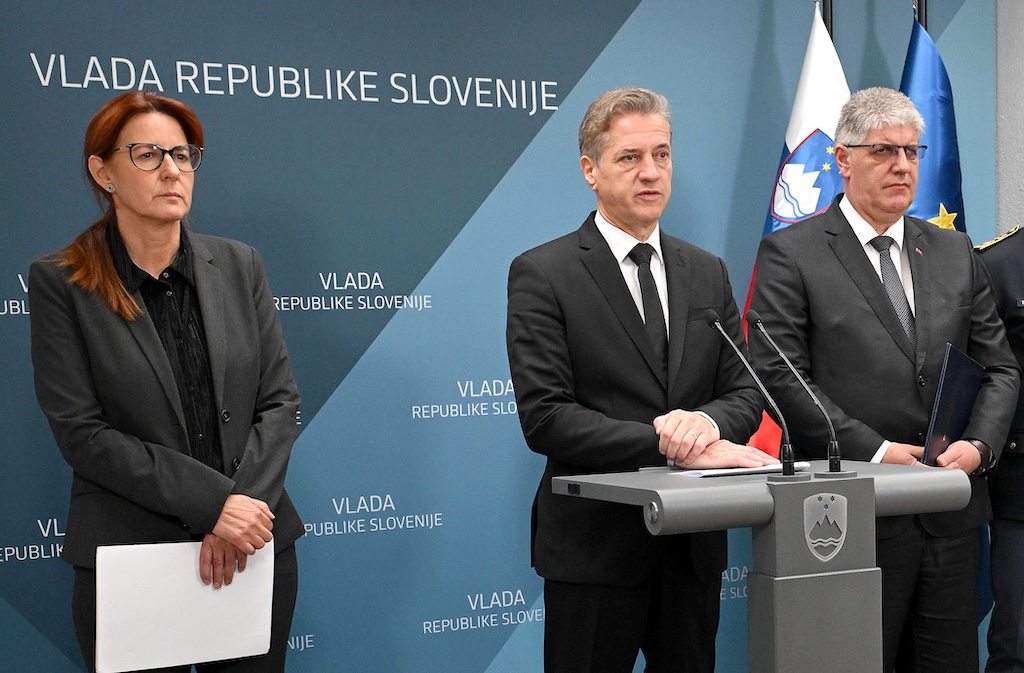
As is known, the political outcome of the tragic event in Novo Mesto was the immediate resignation of two ministers: Interior Minister Boštjan Poklukar and Justice Minister Andreja Katič. In other words, both ministers merely offered their resignations, and Golob was reportedly forced to accept them to save his own skin. He even insisted publicly that he had no intention of resigning himself, claiming that doing so would signal he was running away from problems. A truly weighty argument. Instead of both ministers stepping down immediately, they are apparently continuing in their roles until Golob finds their replacements. Let’s recall: a similar situation occurred with Milan Brglez, who also “half-resigned” as State Secretary at the Ministry of Justice early in the summer but delayed his departure until the beginning of October. In other words, Golob sacrificed two pawns on the chessboard to temporarily postpone his defeat and irreversible political end. If Golob were truly fair to himself and others, he would have immediately removed Luka Mesec from the government, Mesec, as the minister responsible for social assistance, bears the greatest share of responsibility for the unresolved Roma issue. As is known, Mesec did not dare show up in Novo Mesto. Golob did go, but only after sending in police special forces ahead of time – to protect him. From ordinary people.
But Luka Mesec did not go
It is certainly telling that Golob got rid of the two weakest links in his chain. Luka Mesec, as a key figure of the Left party – which effectively dictates Freedom Movement policy – is protected and untouchable. In contrast, Poklukar, who entered this government (as well as Šarec’s) as a “spare wheel,” is less useful. True, the ruling coalition protected him during two previous interpellations so he could remain in office. One of the criticisms in those interpellations was precisely the unresolved Roma issue, explicitly affecting the regions of Dolenjska and Posavje, and partly Ljubljana (Kleče). In reality, Poklukar was already facing serious problems when it was officially determined that he had an illegally appointed police chief by his side. When even Milan Kučan issued a directive to remove the unlawful police chief, Poklukar had to comply to stay in office. Sources say Poklukar will not suffer much after his resignation, he may well be appointed ambassador to one of the more exotic countries, where National Assembly President Urška Klakočar Zupančič once adopted monkeys. Justice Minister Andreja Katič also will not be badly off, as she is expected to take a parliamentary seat that would have otherwise gone to Janja Rednak following Jani Prednik’s departure. It is clear that Katič was neither operationally nor intellectually equipped to tackle the current problems in the justice system. Freedom Movement is “overtaking her on the right” and aggressively targeting the Judicial Council, which is “resisting reforms.” Therefore, sources claim, the departure of both ministers will not cause any major damage.
The untouchable Slovenian Molenbeek
One thing is clear: the tragic death of Aleš Šutar has upended many aspects of Slovenian politics. Many say it was only a matter of time before something like this happened, but it seems the ruling authorities assumed things would “somehow work out.” It is quite likely they viewed the Roma in Dolenjska as a potential voter base, which is why they turned a blind eye and deliberately allowed a social and security time bomb to tick away. But the reasons likely go deeper than just electoral gain among the Roma. There are growing warnings that the government deliberately withdrew from addressing Roma-related lawlessness due to the involvement of international drug cartels, which exploit Roma as “mules”, subcontractors of sorts, many of whom are also end users. It is highly probable, though concrete evidence is still lacking, that the government intentionally hindered police oversight of Roma settlements, which have become a kind of Slovenian Molenbeek (the infamous Brussels district where Belgian police fear to enter and where Sharia law has reportedly supplanted Belgian legal order). This is further evidenced by the bizarre behaviour of the police on the day of the tragic event. According to our information, Aleš died in hospital just hours after the incident, early Saturday morning. Yet news of the fatal attack only reached the public late in the afternoon. Details were released by the Municipality of Novo Mesto around 4:30 p.m. (including confirmation that Roma were involved), followed shortly by a very limited statement from the Novo Mesto Police Directorate, which gave no clear account of what had happened. It merely stated that the attacked man was fighting for his life. When the author of these lines asked explicitly around 7 p.m. whether it was true that the man had died, the police denied it, claiming his condition remained unchanged. Given that police routinely report fatalities, whether from accidents or criminal acts, their silence that day and the next suggests that the Novo Mesto Police Directorate was ordered to remain quiet. Apparently, those orders came “from the top.” They also withheld the fact that a cold weapon (a knuckle-duster) was used in the attack, which was reported by foreign media.
Drug cartels shape policy
All these facts open new dimensions regarding how realistic it is that the government is, in fact, indebted to drug cartels, and may have promised (in exchange for what?) not to let police get too close to their “holy grail.” This raises questions about how much the political leadership, the police leadership, and the intelligence agency SOVA knew, especially since SOVA likely detected visits by foreign nationals to Roma settlements in Slovenia. Let’s not forget that SOVA has been compromised multiple times due to political games played by the ruling coalition. And we must remember that the most influential patron behind Golob’s government remains Zoran Janković, who allegedly secured substantial campaign funding for Golob from abroad (read: the Serbian-Russian sphere). Just before the fateful October 25, an article by Aleksander Lucu appeared in Nedeljski dnevnik – Lucu being something of a mouthpiece for the deep state – openly suggesting that the deep state sees Golob as its first choice, while Vladimir Prebilič (who left chaos behind in Kočevje regarding the Roma issue) is merely a “sidekick” meant to help recover lost votes. The public must not accept that Golob can save himself simply by tossing two ministers “overboard,” nor allow itself to be manipulated by regime-aligned media now trying to pin the unresolved Roma issue on the previous government. The core of the problem lies elsewhere: in the alliance between the current ruling elite and drug cartels. That is the essence! And history has already shown that the Balkan Warrior and the Kavaš Clan have far greater influence over the top of Slovenia’s ruling elite than many are willing to admit.


