

By: Vida Kocjan
The ruling coalition (Svoboda, SD, Levica) and Ljubljana’s mayor Zoran Janković are planning to build a problematic waste incinerator in the Ljubljana area, specifically on the Ljubljana Marsh, that would cause significant environmental and health damage to the area and the basin.
Experts warn that there is an alternative solution for waste treatment: a sorting facility, or in technical terms, TOMRA. They point out that this sorting technology represents the pinnacle of European and global development in waste management, as it is based on circular economy principles, resource efficiency, high‑precision optical recognition, and minimal environmental impact.
In contrast, the planned incinerator on the Ljubljana Marsh is a technological solution from the past century, built on burning materials and on the necessity of generating waste, creating long‑term environmental, health, and economic burdens.
Under Janković, after protecting the water, we will now have to protect the air as well
At its October session, the Ljubljana City Council approved a draft amendment to the spatial planning ordinance, which includes the plan to place a waste incinerator on the Ljubljana Marsh. City councillor Aleš Primc opposes the project and announced that civil society will do everything in its power to protect drinking water and air quality.
Ljubljana already struggles with air‑quality issues; an additional incinerator, even a modern one, would introduce further challenges in monitoring emissions (PM, NOₓ, potential organic toxins).
The ruling coalition had already adopted a decree on the public utility service of municipal waste incineration. In mid‑April, both the Ljubljana and Maribor municipalities confirmed their intention to apply for the concession. Currently, Slovenia has one operational waste incinerator, in Celje; under the government decree, two more are planned. The existing Celje facility has a new permit to burn up to 40,000 tonnes of waste annually; the Ljubljana plant is expected to process 130,000 tonnes, and the Maribor plant 50,000 tonnes. According to government projections, concessions for Ljubljana and Maribor are to be awarded at the beginning of 2026, and the new incinerators would be built within seven years.
Ljubljana’s mayor, Zoran Janković, stated last year that the Ljubljana incinerator could be built within five years, and that the most suitable location would be next to the Regional Waste Management Centre on the Marsh. The Regional Centre (RCERO Ljubljana) operates on Cesta dveh cesarjev near the Barje collection centre. It currently handles mechanical‑biological waste treatment, sorting, recycling, and disposal, but not incineration. The new waste incinerator is expected to produce heat and electricity, for example for district heating. Several locations are possible within the municipality: besides the Marsh, also along Letališka cesta or in Moste near the heating plant. Mayor Janković personally supports the Marsh location.
What is the current status of the project?
According to available information, the project is still in the preparation phase. The call for concession applications is open until early 2026, and work is underway on the spatial plan and environmental studies. As part of this process, an environmental permit will also be required. The estimated investment value for the Marsh location is around 200 million euros.
Ljubljana’s mayor, Zoran Janković, has so far avoided obtaining the environmental permit. Here it is worth recalling the construction of the C0 sewage pipeline across Ljubljana’s main aquifer. In that case, the municipality fragmented the project into smaller construction phases and obtained multiple building permits, eight of which are reportedly final, while the ninth became stuck. An environmental impact assessment should have been carried out, but it never happened.
And what about the incinerator? Supporters (the municipality and Energetika Ljubljana) emphasise energy self‑sufficiency, lower costs (they currently export waste abroad for around 20 million euros per year), and modern low‑emission technology. Opposing the construction are doctors, environmental organisations such as Ecologists Without Borders, and civil initiatives. They warn about the poor air circulation in the Ljubljana basin, additional pollution from PM particles, NOx (nitrogen oxides), dioxins (a group of toxic polychlorinated dibenzo‑p‑dioxins), and health risks such as cancer and asthma. They also note that studies identify the Marsh as one of the worst possible locations due to its microclimatic conditions.
A better solution: a sorting plant instead of an incinerator
An incinerator would require extremely tall chimneys, taller than anything currently in use. Even with modern furnaces equipped with advanced emission‑cleaning systems, experts warn that these facilities still release greenhouse gases. Scientific literature also notes that incineration contributes to CO₂ emissions and can produce micro‑toxic compounds.
Experts stress the need for careful environmental impact assessment. They argue that incineration is outdated and highly risky from both environmental and health perspectives, and that a better, more modern, waste‑treatment method exists.
A sorting plant is a very different approach. Its purpose is to separate and precisely extract recyclable streams such as plastics, paper, metals, and secondary raw‑material fractions. In the case of a sorting plant, technically known as TOMRA, direct air emissions are significantly lower. This is because the process relies on mechanical and electro‑pneumatic systems (dust, noise, energy consumption), which do not produce dioxins or heavy‑metal emissions like combustion does. Environmental concerns are mainly related to energy use and managing small residual fractions and dust.
Differences in handling residues
In an incinerator, the combustion process leaves behind flue‑gas filter dust, which is captured in the filters. Flue gases from waste incinerators contain dust particles, acidic gases (HCl, SO₂, NOx), heavy metals, dioxins, and other pollutants. This is classified as hazardous waste under EU regulations because it contains high concentrations of toxic substances. It cannot be disposed of in ordinary landfills and requires special treatment (stabilisation, cementing) or export to specialised facilities (e.g., in Germany). The planned Ljubljana incinerator on the Marsh would produce several thousand tonnes of this dust annually, creating additional hazardous waste and transport costs. With a sorting plant, the remaining waste mass is significantly smaller.
Experts emphasise that a TOMRA sorting plant produces no hazardous emissions. The only risks are typical industrial ones (noise, machinery movement), which are minimal and fully manageable. It has no harmful impact on the local population.
More on the advantages and disadvantages will be published in the next issue of Demokracija.
How tall would the chimneys of the planned incinerator on the Ljubljana Marsh have to be so we do not suffocate in the basin
Matjaž Leskovar, a physicist and researcher at the Jožef Stefan Institute (IJS), has also warned about severe temperature inversions. He recently pointed out that in Ljubljana the temperature at ground level was –2 °C, while at 1,700 meters it was as high as 12 °C. The cold lower inversion layer reached up to 550 meters, and the isothermal layer above it extended to 750 meters.
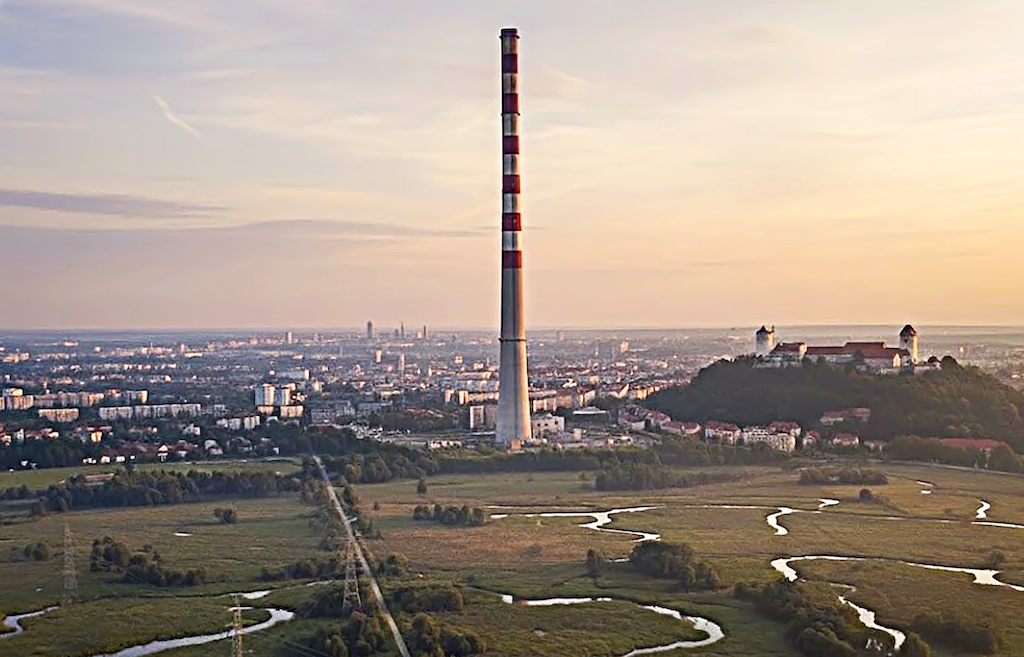
Based on this, he expressed the expectation that the chimneys of the planned incinerator would have to be at least that tall, so that we would not suffocate below. This means the chimneys of the planned incinerator would need to be 750 meters high or more. For comparison, the tallest chimney in Europe, and the seventh tallest in the world, is currently the Trbovlje chimney, standing exactly 360 meters tall. On the Marsh, the chimneys would have to be roughly twice as high.
For further comparison: the tallest building/skyscraper in Slovenia is the Crystal Palace in Ljubljana (89 m), and the tallest observation tower is the Kristal tower in Rogaška Slatina (106 m). No other structure comes close to 360 meters.
(The article was originally published in the print edition of Demokracija on December 25, 2025.)


