

By: Vida Kocjan
The government has adopted the starting points for the 2026 state budget rebalance and for preparing the budgets for 2027 and 2028. Total expenditures for 2026 are set at €18.4 billion, with increased funding for completing the Recovery and Resilience Plan and the related EU funds. Due to the unusually high growth of expenditures, the government is urging ministries to take measures to reduce the deficit. The rebalance is expected at the end of August, and the budgets for the following two years by the end of September.
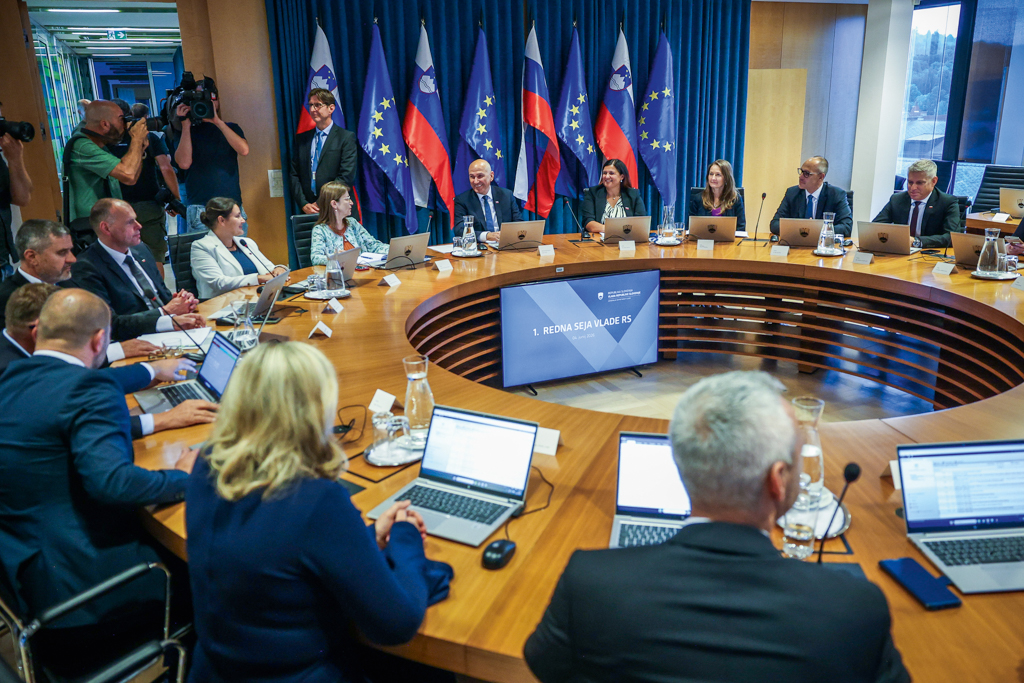
The government has adopted the starting points for preparing the draft of the 2026 state budget rebalance and has also launched the process of preparing budget documents for the following two years. The budget rebalance will bring the first concrete adjustments aimed at ensuring a sustainable public finance outlook, while maintaining key investments and social security. More detailed proposals will be known at the end of August or September.
The government has called on ministries to prepare proposals for measures that will enable the achievement of fiscal targets. It has also set the distribution of budget expenditures across ministries and other budget users – total budget expenditures for 2026 are set at €18.4 billion.
Fiscal reality: breached commitments and a call for action
Compared to previous plans, the distribution mainly includes higher defence spending and additional funds for the budget fund for implementing the Recovery and Resilience Plan (RRP). The increase in defence spending is intended to meet the goal for Slovenia to reach defence expenditure of 2% of GDP, in line with commitments adopted by the previous Golob government, which were drastically breached. Additional funds for the RRP budget fund are needed due to the final phase of implementing the plan (investments) and the associated drawing of EU funds.
When preparing the 2026 and 2027 budgets last year, it was foreseen that part of the expenditure for project implementation would be realised in 2027. Due to the conclusion of the RRP in 2026, the necessary funds had to be secured already in the 2026 budget.
The starting points for preparing budget documents are based on the latest information on the consolidated general government balance and the current state of this year’s budget, which the government reviewed. The information shows that the obligations of the state budget have significantly increased in recent months and that the fiscal commitment regarding the cumulative growth of adjusted general government expenditure for 2026 has been breached. The government has called on those ministries that have established budget funds to analyse their effectiveness. In cases where the funds are not being used continuously, they must immediately prepare amendments to the relevant laws so that unused funds are returned to the budget, which will consequently reduce the state budget deficit.
For the years 2027 and 2028
The government has also reviewed the draft budget memorandum and set the framework for preparing the proposal for amendments to the 2027 state budget and the proposal for the 2028 budget. For 2027, total budget expenditures are likewise set at €18.4 billion, which is €309 million more than the adopted 2027 budget (the majority of the increase relates to additional funds for implementing cohesion policy, which had been planned too low in the adopted 2027 budget). For 2028, expenditures are set at €19.1 billion.
Minister Šircelj: “Enormous growth in expenditures”
Finance Minister Andrej Šircelj has repeatedly warned in recent weeks about the rapid growth of budget expenditures. According to him, a comparison between the first five months of this year and last year shows an enormous increase in expenditures of €1.5 billion. “This was not the practice in previous years, not even in election years,” he emphasised.
The government is expected to adopt the budget rebalance in September. The goal is to keep the deficit below the Maastricht threshold of three percent of GDP.
The minister announced that savings this year will be sought in public procurement, especially in medical equipment. “This will already bring the first savings, also with the adjustment to the new government structure,” he explained, hinting at a smaller number of ministries. “We will first reduce expenditures; a higher VAT rate is one of the last measures,” he said. He added: “We will not introduce any property tax … and the situation in public finances is not such that ZUJF would be necessary.” In other words: the government will first thoroughly review expenditures and does not plan new taxes.
Important support from the business sector
Businesses and representative associations support the announced reduction of labour taxation and the limitation of public spending growth. They warn that a high deficit and public debt increase borrowing costs for companies in the long term and reduce competitiveness.
They seek predictability: a stable budget without sudden tax changes or cuts in infrastructure and investment.
Budget developments in the first half of 2026
The Ministry of Finance has published the budget developments for the first half of 2026. The data show that the state budget recorded €7.7 billion in revenues and €8.9 billion in expenditures in the first half of this year. Expenditures were higher by approximately €1.2 billion. Compared to the same period last year, more funds were allocated to social transfers, investments, and labour costs in the public sector.
Budget expenditures in the January–June period were 12.3% higher than in the comparable period last year and reached 50.6% of planned expenditures. Within this, labour costs in the public sector amounted to €2.7 billion (+11%).
Revenues reached 49.7% of the planned amount and were 8.4% higher than last year. Tax revenues amounted to €6.7 billion (+7.2%). Value-added tax (VAT) generated €2.9 billion (+11.6%), personal income tax €1.2 billion (+1.2%), excise duties €758 million (–€20.9 million), and corporate income tax €1.1 billion (+22.9%).
Strategic Council for the Economy
At its session on 9 July 2026, the government established the Strategic Council for the Economy as an independent advisory body. The president of the council is Marko Lotrič, entrepreneur (Lotrič Metrology) and president of the National Council of the Republic of Slovenia.
Members of the council:
– Igor Akrapovič (Akrapovič)
– Jernej Bortolato (stonemasonry master)
– Marko Bitenc (president of the Slovenian Business Club, private healthcare)
– Blaž Brodnjak (NLB)
– Leon Cizelj (Jožef Stefan Institute)
– Blaž Cvar (president of the Chamber of Craft and Small Business of Slovenia – OZS)
– Matjaž Čemažar (Domel)
– Ana Čermelj (Secretary General of the Craft and Entrepreneurship Trade Union)
– Polona Domadenik Muren (School of Economics and Business, University of Ljubljana)
– Marko Drobnič (Talum)
– Damir Jelenko
– Izidor Krivec (Celjske mesnine)
– Jure Knez (Dewesoft)
– Mariča Lah (Chamber of Commerce of Slovenia)
– Matej Lahovnik (professor, former minister)
– Medeja Lončar (Siemens)
– Gregor Makuc (Sandoz)
– Aleksander Mervar (Eles)
– Dušan Olaj (Duol)
– Mark Pleško (Cosylab)
– Jože Podgoršek (Chamber of Agriculture and Forestry)
– Igor Pristavec (Prigo)
– Ivan Simič (tax expert)
– Sabina Sobočan (Varis)
– Tibor Šimonka (president of the Chamber of Commerce and Industry of Slovenia – GZS)
– Jernej Tovšak (Paloma)
– Jernej Zupančič (Cleangrad)
The council brings together distinguished representatives of the business sector, academia, and experts. Its purpose is to advise the government on competitiveness, productivity, investments, and sustainable development, including fiscal policy and the budget rebalance.


