

By: Anamarija Novak
One must agree with attorney Damijan Terpin, who says that if Nina Betetto and Primož Gorkič are appointed as constitutional judges, we will have an even more distinctly left-leaning Constitutional Court of the Republic of Slovenia.
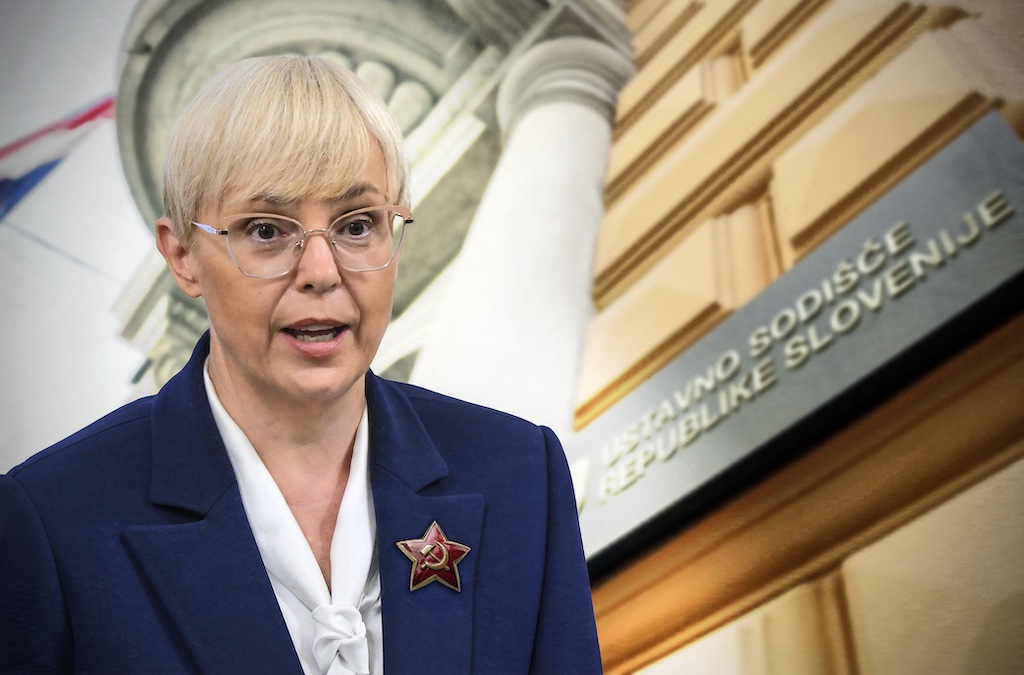
Last week, President of the Republic Nataša Pirc Musar submitted to the National Assembly the nominations of Supreme Court judges Nina Betetto and Primož Gorkič for the positions of two new Constitutional Court judges, as the terms of judges Špelca Mežnar and Marko Šorli are set to expire this autumn. The public call for candidate proposals, which received 13 applications, was published in the Official Gazette of the Republic of Slovenia at the end of April. Following consultations with parliamentary groups in June, the two Supreme Court judges are considered favourites of the current left-leaning coalition, which holds 50 parliamentary votes. To elect a Constitutional Court judge, who must be a legal expert at least 40 years old, a secret ballot requires 46 votes. In the coming months, the President will also initiate procedures for appointing three additional Constitutional Court judges, as the terms of Matej Accetto, Klemen Jaklič, and Rajko Knez expire in spring 2026.
Pirc Musar’s pretending
Ironically, the President emphasised the importance of a careful and transparent appointment process, stating that judges of the Constitutional Court, through their independence and expertise, are the cornerstone of safeguarding the constitutional order and human rights and fundamental freedoms. “The Constitutional Court is the guardian of our constitution and the rule of law. Therefore, Constitutional Court judges must be independent, professional, and committed to the highest standards of legal judgment, personal integrity, and ethics. I believe the proposed candidates meet these criteria through their knowledge, experience, and integrity, and will carry out their judicial mission responsibly,” her office stated. In selecting and consulting with parliamentary groups, Pirc Musar considered the legal fields covered by the outgoing judges (i.e., civil and criminal law), as well as the gender balance among judges at the Constitutional Court. Judge Špelca Mežnar’s term ends on October 30, and Judge Marko Šorli’s on November 19. “After consultations with parliamentary group leaders, independent MPs, and representatives of national communities, sufficient support for their election can be expected,” her office added. This was confirmed last week by Nataša Avšič Bogovič, leader of the largest parliamentary group, Freedom Movement, who told the media that “the Constitutional Court judges proposed by the President have the support of the entire coalition.”
Betetto, the left-wing favourite
Nina Betetto, a Supreme Court judge since 2006, serves in the civil division of the Supreme Court of Slovenia, where she also held the position of vice-president. She graduated in law (1985) and French, and earned her master’s degree in 1994. According to her official profile, she is a recognised expert in alternative dispute resolution and the efficiency of judicial procedures. Since 2009, she has been a member of the Consultative Council of European Judges (CCJE) at the Council of Europe, which she also chaired.
In addition to her long judicial career, Betetto has a political history of clashes with the opposition SDS party, with whom she has repeatedly come into conflict. Notably, journalist Bojan Požar consistently refers to her in his articles as a “hard-left favourite.” Let us recall: Betetto played a key role in the Patria case and faced heavy criticism during her 2016 candidacy for judge at the European Court of Human Rights (ECHR), where she was accused of attempting to legitimise post-war and wartime executions. Betetto also presided over the case of Aždajić v. Slovenia, in which the ECHR found violations of human rights. Constitutional law expert Dr Jurij Toplak commented at the time that “it appears Betetto unfortunately lacks a sense for human rights.”
A judge holding a Partisan cap
Primož Gorkič is currently a Supreme Court judge in the criminal division and an associate professor of criminal law at the Faculty of Law in Ljubljana. He was elected to the Supreme Court in December 2020 on his second attempt. The first attempt failed due to opposition from the SDS party, which at the time argued that he did not meet the criteria for a Supreme Court judge. Gorkič also clashed with SDS over the Patria case, when in April 2015 he published an article in the regime-aligned newspaper Delo titled “Patria for Dummies – Sorry, for Lawyers,” in which he criticised the Constitutional Court’s decision to annul the conviction of Janez Janša. According to his official profile, Gorkič graduated in 2002 and earned his doctorate in 2009. His research focuses on evidentiary law and privacy protection. He is the author of numerous academic and professional works in the field of criminal law. Journalist Bojan Požar wrote on the platform X that Gorkič is considered close to Aleksander Čeferin. Many were also disturbed by his staunch left-wing ideological stance, illustrated by a photo from the “Walk Along the Wire” event, where he is pictured with the Kombinatke group, holding a partisan cap.
A distinctly left-leaning constitutional court
Attorney Damijan Terpin told the news portal Nova24TV that “public trust in the judiciary, especially in its highest instance, the Constitutional Court, is crucial.” “Statistics show that citizens do not trust the judiciary, which is widely known. This move by the President of the Republic will certainly not contribute to greater public trust,” he said. In his view, the President is following political lines, which undermines the balance of the Constitutional Court. “Constitutional courts in developed countries are generally politically balanced. The U.S. Supreme Court, for example, is roughly split five to four. Italy’s Constitutional Court leans slightly left, but is not exclusively left-wing. In Slovenia, however, we are now heading toward an even more distinctly left-leaning Constitutional Court, which is not good for the country,” he warned. He added that the President of the Republic, who should represent all citizens, ought to understand these differences and act accordingly. “I fear she continues to behave as if she is still in an election campaign. During the campaign, she accused Anže Logar of being connected to Janez Janša’s party, as if the third of voters who support SDS were illegitimate or undeserving of political participation. That shocked me. Someone who thinks that way can hardly act as the president of all Slovenians.”
Lack of understanding of the political climate
Terpin also highlighted the President’s lack of understanding of the political climate in parliament. “The President cannot turn things upside down and blame parliament for not following her proposals. On the contrary, during consultations with parliamentary groups, she must understand the political climate and propose candidates who can earn the trust of the majority,” he emphasised. As an example, he cited the vacant position of Governor of the Bank of Slovenia, which prevents Slovenia from participating in decision-making at the European Central Bank. “Because the position remains unfilled, Slovenia has no voting rights in the ECB’s governing council in Frankfurt. That is absurd, and it is been going on for months, perhaps even a year,” he stated.
In his view, excluding certain political actors as illegitimate leads to a denial of democracy. “In Italy, they faced similar challenges in appointing a constitutional judge, but political parties eventually reached a compromise. Compromise is essential for political coexistence and the functioning of the state. In Slovenia, however, we continue to insist on exclusion – some are legitimate, others are not. That is unacceptable,” Terpin concluded critically.


