

By: P.J.; STA
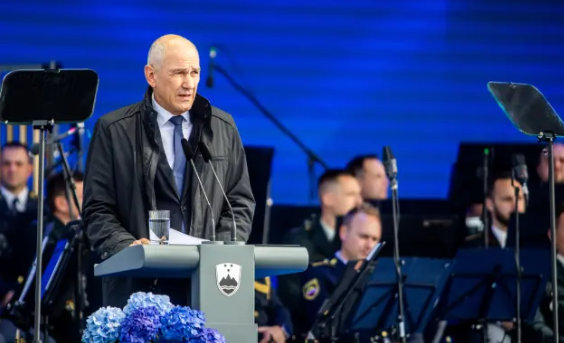
According to Prime Minister Janez Janša, Slovenia’s independence 35 years ago was the result of the Slovenian nation’s long struggle for its language, identity, and survival. However, while the country was on a promising path during the early years of independence toward becoming “another Switzerland,” this was followed by years of missed opportunities, he said during the state ceremony marking Sovereignty Day.
Sovereignty Day has been celebrated since 2015 in remembrance of the departure of the last soldier of the Yugoslav People’s Army (YPA) from Slovenian territory in 1991. During the night of 25 to 26 October 1991, the final ship carrying soldiers of the aggressor YPA departed from the Port of Koper. The YPA had attacked Slovenia on 27 June 1991, one day after the country’s official declaration of independence on 26 June 1991, triggering the ten-day war that followed.
“Today Slovenia is safe, and security is the primary condition for stability and, consequently, for economic prosperity,” Janša said in his address at the state ceremony in Koper, which was interrupted by protest chants and whistles.
As the most important reasons for Slovenia’s victory in the War of Independence, he highlighted a clear political objective supported by national unity and the plebiscite result. He noted that Slovenia did not underestimate its opponent, whereas the opponent underestimated Slovenia. At the same time, Slovenian forces were unified and highly motivated, while the opposing forces largely were not. He also cited timely defence preparations, good intelligence on the opponent, a humane approach aimed at avoiding casualties on both sides, and the effective organisation of civil defence despite facing an adversary superior in both numbers and weaponry.
According to Janša, Slovenians at that time dreamed of becoming “another Switzerland.” “Step by step, we stabilised the economy, established market institutions, opened the door to foreign competition, surpassed it, and oriented ourselves toward demanding Western markets.” He noted that Slovenia subsequently became a member of the United Nations, the European Union, the euro area, NATO, the OECD, and the Union for the Mediterranean.
“Sometimes it seems that we do not sufficiently appreciate what we achieved in the first half after independence,” he said, adding that this was followed by a “second half” marked by years of missed opportunities, as well as the making and correcting of major mistakes.
“We slid back into a system of privileges, vested interests, selective justice, the abuse of the judiciary for political battles, and open violations of the constitutional order,” he said, warning that Slovenia is today where it was in 2008, at just over 91 percent of the European average.
Janša described correcting the mistakes of this “second half” as the key challenge facing Slovenians today. “Today we stand before the challenge of correcting the mistakes of the second half and taking a new leap forward, and we will do so despite the fact that the international environment is far more demanding today than it was in the first half,” he asserted.
He then recalled 26 October 1991, when people gathered in Koper to celebrate the withdrawal of the last member of the aggressor army and Slovenia’s final liberation. Most believed they were witnessing a permanent change. They believed that the old Yugoslav and communist symbols and flags that had been removed from flagpoles would no longer haunt Slovenian public life and would instead end up in museums of totalitarianism, he said.
“We were very mistaken,” he continued. They forgot that for some people an independent and democratic Slovenia was never their preferred option. These individuals then set about undermining the country’s values by every available means: “Through monopolies in education, the media, and cultural institutions. Through funding Yugonostalgia. Through mocking the values of Slovenian independence. Through belittling the achievements of the generation that secured independence.” he stated.
“Not even in our wildest dreams did we imagine that we would live to see a time when some members of the National Assembly would mourn the former totalitarian state,” Janša said. He also mentioned the abolition of the Museum of Slovenian Independence, compensation payments to the so-called “erased,” the obstruction of the issuance of death certificates for those killed during and after the Second World War, and financial support for illegal migrants which, he claimed, exceeds most pensions. “We could not have imagined it even in our dreams, and yet all of this has happened. A great deal of work still lies ahead of us,” he concluded.
He further warned that Slovenians must not be naïve and stressed that it is their duty to leave future generations more freedom, greater enjoyment of life, more security, more opportunities, and more peace than they themselves inherited.
In addition to most ministers from the current government led by Janez Janša, the ceremony was attended by several representatives of Slovenia’s first Demos government, including then-Prime Minister Lojze Peterle and ministers Dimitrij Rupel, Igor Bavčar, Jelko Kacin, Dušan Šešok, and Igor Umek. Also present were members of the former republican coordination group from the ministries of the interior, defence, and information, which coordinated defence and security activities during Slovenia’s independence process in 1991.
Preparations for this year’s ceremony were overshadowed by political disputes over the interpretation of historical events from the period of Slovenia’s independence. As a result, opposition parties did not attend the event. President Nataša Pirc Musar also declined to participate due to disagreements with the government’s actions. Among the reasons she cited was the renaming of the holiday, a move that is also strongly opposed by the opposition parties Freedom Movement, The Left, and the Social Democrats (SD).