

By: G. B.
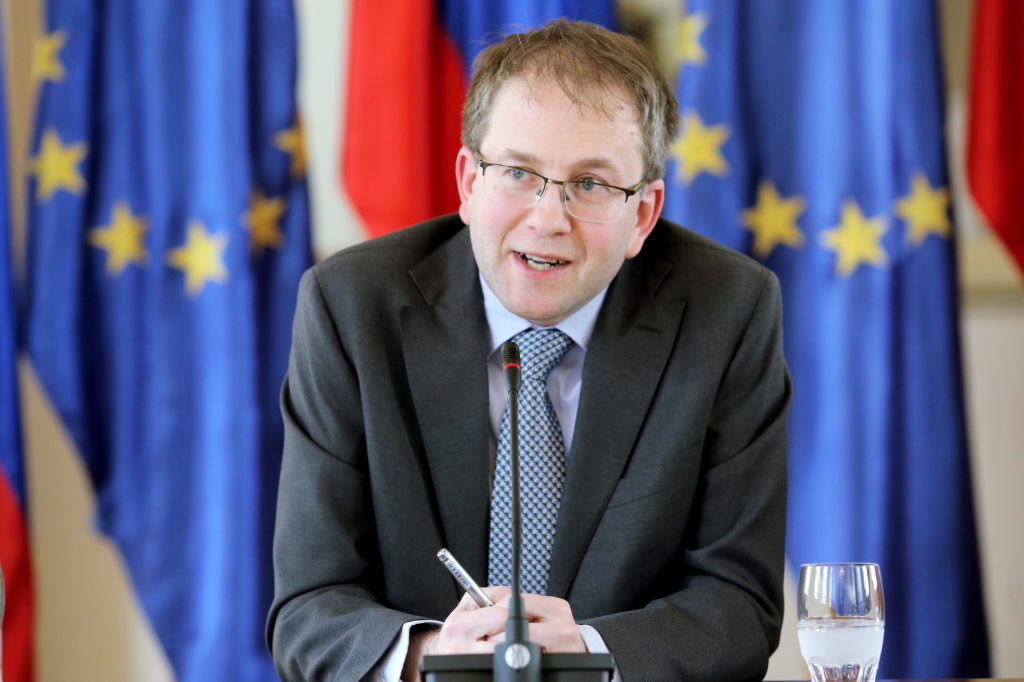
Dr Matej Accetto (born in 1974) is considered a legal expert who became a constitutional judge at a relatively young age. He assumed this role at the end of March 2017, which means his term will expire next year at the end of March, coinciding roughly with the timing of the parliamentary elections.
In his biography, it is noted that he graduated and earned his doctorate from the Faculty of Law in Ljubljana, and obtained a master’s degree from Harvard. He is an associate professor of European law at the University of Ljubljana’s Faculty of Law, indicating deep expertise in EU law. According to Wikipedia, he lectured at the Católica Global School of Law in Lisbon between 2013 and 2016, and was previously invited to educational programmes by the Social Academy, co-founded by the Slovenian Catholic Intellectuals Association.
Political ties with Miro Cerar
Based on his credentials, one might assume Accetto is a legal expert similar to Dr Klemen Jaklič, another constitutional judge. However, appearances can be deceiving. It is known that Accetto helped shape the programme of the SMC party (then the Party of Miro Cerar) at its inception. Despite this, he later ruled on cases involving SMC as a constitutional judge, when he should have recused himself. The extremely controversial conduct of Matej Accetto was revealed through email correspondence among key figures at the time, including Accetto himself. These exchanges came to light in October 2019, six years ago, but the then-president of the Constitutional Court, Rajko Knez, took no action.
According to reporting by Požareport, Matej Accetto’s political entanglement was evidenced by email exchanges between prominent members of the SMC party at the time, Milan Brglez, Erik Kopač, Peter Jamnikar, and Accetto himself. The original SMC is widely seen as one of several transitional “new face” political projects in Slovenia, preceded by Positive Slovenia and followed by LMŠ, Freedom, and now Prerod. Over time, the party’s key left-leaning figures abandoned it, especially after it entered a governing coalition under Zdravko Počivalšek. That move triggered backlash, and Počivalšek was later targeted by a political setup, one that has only recently been fully exposed.
Vili Kovačič revealed at the time that, a year earlier (in 2018), he had twice attempted to have Constitutional Court judge Matej Accetto disqualified from proceedings he had filed with the court. “Judge Matej Accetto explained that he did not participate in writing the party’s pre-election programme and that his only connection with Prime Minister Miro Cerar was that, as law professors, they knew each other solely through professional circles,” stated the Constitutional Court’s explanation. However, it later became clear that this was not true and that their collaboration was also political. As a result, Accetto repeatedly found himself in conflicts of interest. He should have also recused himself from reviewing the law on foreigners. The Office of the Human Rights Ombudsman had challenged a controversial provision before the Constitutional Court, which would have allowed Slovenia – upon declaring quasi-emergency conditions – to close its borders to migrants and prevent asylum applications. Accetto opposed the law in coordination with Milan Brglez.
Instead of punishment, a reward – Accetto became President of the Constitutional Court
In a more developed country, such constitutional judges would likely not only be dismissed but even imprisoned. But this is Slovenia. When someone acts in the interest of the ruling political class, they are duly rewarded. Thus, in 2021, Matej Accetto was promoted to President of the Constitutional Court, a position he held until last December. In that role, he hosted EU Commissioner Věra Jourová in March 2023. Given his deep knowledge of European law and the competencies of the European Commission regarding constitutional courts in member states, it will be difficult for him to convincingly explain to the public that he resisted any attempt by the EU executive to influence Slovenia’s Constitutional Court.
Let’s look at what happened after that visit. The Constitutional Court had suspended the implementation of the RTV law in February, and Jourová visited in March. On May 26, 2023, the Court lifted the temporary suspension of the government’s RTV Slovenia law. Four judges voted to lift the suspension: Matej Accetto, Rajko Knez, Katja Šugman Stubbs, and Špelca Mežnar. Rok Svetlič reportedly voted against, while judges Marko Šorli and Klemen Jaklič did not vote. Accetto and Knez, who had supported the suspension in February, apparently changed their stance, something even the MMC RTVS website reported.
At that time, the “depoliticisation” project, led by so-called “nobody’s servants”, was in full swing. The Constitutional Court only required minor amendments from the National Assembly, but the main outcome was that the “depoliticisation” brought back a system nearly identical to the early 1990s, when political motives led to the dismissal of RTV’s general director Žarko Petan, twice, and appointments were made through the RTV Council, which was formally led by a representative of the Olympic Committee but in reality by SD politician Janez Kocijančič.
Not only RTV is being “depoliticised,” but also the Constitutional Court
The consequences of “depoliticisation” are now clear: RTV Slovenia’s viewership and listenership are declining, and more and more former allies are being “thrown over the shoulder,” as the Golob-era neologism puts it. The Civil Initiative of Active Citizens of Independent Slovenia filed a criminal complaint against Accetto, though one had already been filed back in 2019 – with no outcome. Instead of accountability, the coalition is appointing new political commissars to the Constitutional Court. Following Accetto’s departure, two familiar faces, Nina Betetto and Primož Gorkič, are entering the court. As former SMC MP Jasna Murgel (now again a judge) once predicted, and likely to be followed by controversial Freedom MP Lena Grgurevič, “we are replacing constitutional judges.” So, everything is going according to plan!