

By: Gašper Blažič
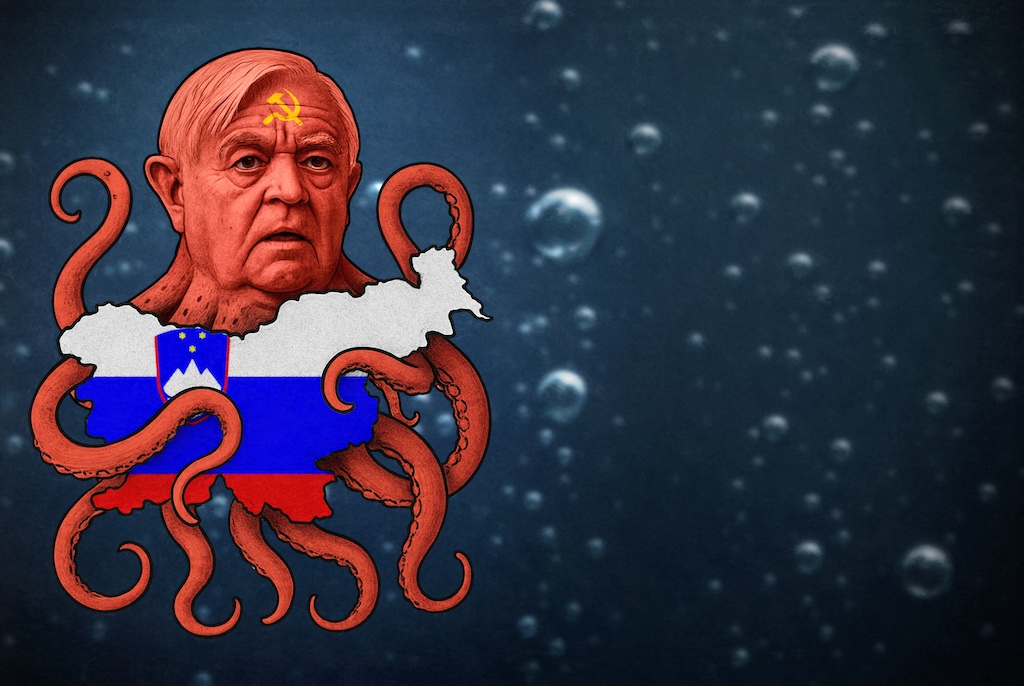
In previous issues of Demokracija magazine, we have already analysed the previously concealed activities of the last party chief, Milan Kučan, both in the past and more recently. But the essence of his activity lies primarily in the influential network he built long ago.
Let’s be honest: Kučan’s personal power has declined considerably in recent years (since some of his operatives, such as Janez Zemljarič and Janez Kocijančič, have died), and quite a lot of influence has already passed into the hands of other kingmakers, such as Zoran Janković, who has the greatest influence on the government. However, the strength of his network, which he has diligently built over the past decades, has not diminished. There are also some background powerbrokers who oversee their own “special fiefs,” such as Gregor Golobič, Borut Jamnik (finance), Damir Črnčec (security), etc., but they are competitors among themselves and lack the authority that Kučan still commands. It is therefore no surprise that Robert Golob is trying to wriggle out from under Kučan’s influence, but so far without success, since his direct superior, Janković, still listens to the “éminence grise.” That title originally belonged, back in the early 1990s, to Ivan Maček – Matija, who made sure that a vast amount of archival material was destroyed before it could be accessed by the “unauthorised,” namely those who took power through democratic elections in 1990.
The Russian Chapel, once again misused
We have often argued that, despite his advanced age – he will turn 85 in half a year – Milan Kučan is still the “uncrowned king of Slovenia.” Interestingly, of all the books that mention him, the one with the most noteworthy content is Milan Kučan – When the Godfather Speaks of Himself, which contains numerous Kučan quotations. Recently, both the book’s author and Kučan himself were found “on the same side” at the Russian Chapel on the Vršič Pass. Kučan’s attendance at this commemoration for fallen war prisoners (most of them Ukrainians) reveals more than meets the eye. The Russian Chapel should above all unite people in the spirit of truth and respect for all victims of war and for those suffering under Putin’s aggression in Ukraine. But let us remember: the last Communist Party chief clearly does not wish to offend Moscow’s “headquarters.” Back in 2016, during the centenary of the chapel’s construction, Vladimir Putin also visited Slovenia, accompanied practically by the entire ruling elite – from then–Prime Minister Miro Cerar, to Foreign Minister Karl Erjavec, to Slovenia’s President Borut Pahor. That was not Putin’s only visit to Slovenia; in 2001, as Yeltsin’s “baby-toothed” successor, he met with U.S. President George W. Bush at Brdo pri Kranju. Even then, a significant portion of the global left was already distancing itself from Putin, dismissing him as an authoritarian “right-wing” leader. Yet most of the world’s statesmen were still eating out of his hand – until the fateful February 24th, 2022. Even after that, some tried to justify the invasion of Ukraine or at least relativise the roles of aggressor and victim. Kučan, too, suggested that military aid to Ukraine would change nothing. Perhaps he was partly right that the previous U.S. administration under Joe Biden did not cover itself in glory with its support for Ukraine, while the current president, Donald Trump, has a different approach but far less patience with the Kremlin.
Roter’s scandalous legacy
We should also highlight another symbolic event that left a void in Kučan’s circle: on August 1st this year, Zdenko Roter, Kučan’s longtime adviser, passed away at nearly 99 years old. Officially, he held this role until the end of Kučan’s second presidential term in 2002, at which point Kučan repaid him with a state decoration. Their bond remained strong, with Roter’s book Fallen Masks even revealing how they identified Danilo Türk as the “right” candidate for the Slovenian presidency. Roter co-founded Forum 21 in 2004 and served on its programme committee, chaired by his academic colleague Niko Toš, a pioneer in Slovenian public opinion research (dating back to Stane Kavčič’s liberal-communist government). According to the late sociologist Janez Jerovšek (himself lustrated in the 1970s and later a Demokracija columnist), Roter was once considered for exclusion from the faculty, but he survived communist purges, just as Kučan survived them. In fact, Kučan advanced: in 1973, he became secretary of the League of Communists of Slovenia (ZKS) and a functionary in the Socialist Alliance (SZDL), likely under the influence of Mitja Ribičič, who opposed Kavčič during the so-called “road affair.” Like Roter, Kučan not only survived the purges but climbed higher. Was this thanks to knowledge of secret service operations? Kučan, after all, once headed the party’s Commission for Psychological and Propaganda Activities – telling in itself.
Kavčič’s diary saved Kučan
It is telling that Stane Kavčič, forced into retirement and isolation, expressed hope in his diary that Kučan would embrace his liberal ideas and shed the influence of authoritarian Stane Dolanc. Kučan partly did so by quietly allowing the publication of Kavčič’s Diary and Memoirs in 1988, while he was already head of the Central Committee. The manuscript was delivered to the journal Časopis za kritiko znanosti (ČKZ) by Niko Kavčič, who was himself forced into retirement but remained Maček’s “reserve” operative, active in parallel finance. Igor Omerza, in his book on the JBTZ trial, described in detail how the publication came about, and Janez Janša in his book Okopi emphasised Niko Kavčič’s double agency. The publication of Kavčič’s diaries actually worked in Kučan’s favour, enabling him to project a more “gentlemanly” leadership style, in stark contrast to the blunt France Popit, with whom Kučan even had a public quarrel in 1989. This softer style proved far more resilient to democratic changes, as it could adapt to them.
Kučan and Roter as masters of elusiveness
We must also highlight Roter’s elusive style. Publicist Jože Kurinčič remarked in an open letter: “It seems you are careful never to touch the myth in which you have lived, more or less safely, since 1941.” (Third open letter to Zdenko Roter, Časnik.si, March 12th, 2020). Both Roter and Kučan use this evasive method: their accounts are riddled with “holes,” half-truths, and omissions. This was useful in the 1980s, when it was necessary to create favourable public opinion for a “step down from power” while building a network that could thrive in a multi-party democracy. This also explains why Kučan wants to keep Golob, at least for now, as the main chosen one, with Prebilič as his “assistant,” helping to capture the votes of disappointed citizens. At the same time, they are trying to divert attention from Golob’s brutal governance by scapegoating both external (Israel) and internal (“Janšists”) enemies, an effort in which even supposedly “independent” pollsters such as Andraž Zorko are participating. This could suggest that nerves within the transitional left are badly frayed and that the “final battle of Kučan’s generation” could turn against the network. Meanwhile, political analyst Sebastjan Jeretič warns in an upcoming Demokracija Magazine interview that media manipulation could still succeed in convincing poorly informed voters to grant the coalition parties another mandate, so they can “finish the job” they began in the current term.
Following in Gregor Virant’s footsteps?
For now, Kučan’s network remains strong. In addition to the coalition and its social subsystems, its main weapon is control over the judiciary, the prosecution, key NGOs, and the mainstream media (especially RTV Slovenia, POP TV, and Odlazek’s media empire, financially dependent on political “uncles”). We can only speculate to what extent Anže Logar will be used to serve these interests. At the moment, he presents himself as opposing the government, but it is quite apparent that his main purpose is to siphon off as many votes as possible from SDS. This situation is reminiscent of the circumstances surrounding the formation of Gregor Virant’s Civic List, which, out of “principle,” undermined the government led by Janez Janša in 2013. The trigger was the supposedly “balanced” opinion of the Commission for the Prevention of Corruption (then headed by Goran Klemenčič) regarding the property-related irregularities of both Janša and Zoran Janković. Yet no one could ignore the fact that Janković was merely collateral damage at the time. The courts later annulled this CPC report, but the damage had already been done, and the entire matter shifted into the courts under the notorious “Trenta case,” which at the first instance ended with an acquittal. For Virant’s Civic List, participation in Alenka Bratušek’s government turned out poorly, as the party dropped out of parliament and eventually disappeared.
It would be naïve to think that all these matters are directed by Kučan himself. These days, he intervenes only in extraordinary cases. Otherwise, the “machine” is well-oiled and running smoothly, with much happening spontaneously. And this should not be underestimated.
Dr Matevž Tomšič on Kučan: His political influence cannot be disregarded
Dr Matevž Tomšič: “The influence of Milan Kučan is undoubtedly smaller than it was a decade or more ago. After all, he is already of advanced age. Moreover, some of his most important associates (Janez Kocijančič, Zdenko Roter) have passed away. Nevertheless, his political influence cannot be ignored, since the network of people in key positions (not only in politics but also in the judiciary, the media, education, etc.) is still very extensive.”