

By: C. R., STA
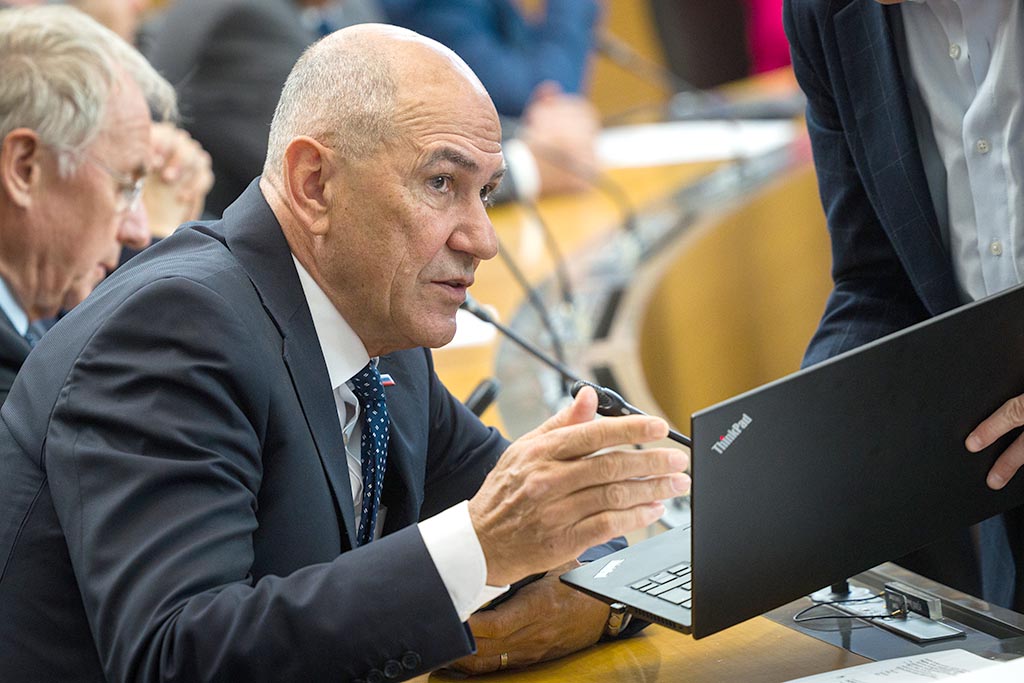
The proposed budgets for 2027 and 2028 provide the funding needed to implement the policies set out in the Development Law said the Prime Minister Janez Janša during an extraordinary session of the National Assembly. He reiterated that the number of employees in the state administration will remain unchanged but again advocated the redeployment of personnel. He also said he expects a consultative referendum on reducing bureaucracy.
The government’s budget proposals link fiscal responsibility with a stable economic environment, lower taxes on labour, increased investment, growth in better-paid jobs, and stronger prosperity said Janša while presenting the budget documents. He added that another objective is to accelerate the absorption of EU cohesion funds from the current funding period, while Slovenia is also actively negotiating the next EU multiannual financial framework.
“In this way, we are creating the conditions for reliable financing of security and healthcare, support for the most vulnerable, and more accessible housing, especially for young people and young families,” he continued.
Janša reiterated that the government’s policy direction is defined by the Development Law, which is expected to be put to a referendum, and that the proposed budgets for the next two years provide the funding necessary to implement it.
“The Development Law will determine whether opportunities to improve conditions for entrepreneurship, reduce certain burdens, and create more space for work and investment are approved or rejected. Both budgets before you are technical instruments for implementing the same policy. The decision on the Development Law will show how much room for manoeuvre we have,” he said. He warned that the referendum outcome would affect the lives of 1.5 million people in Slovenia.
The Prime Minister acknowledged that reducing financial burdens would require a more efficient state but argued that this should not be a major challenge in an era of digitalisation and artificial intelligence.
According to Janša, current policies encourage companies to create lower value-added jobs. Because there is not enough labour available on the domestic market, workers are imported from abroad.
“Slovenia has issued 150,000 work permits for foreign workers, creating enormous pressure on the welfare system, education system, and other public services. This is one of the main reasons why we have become trapped in a cycle of standing still while countries that were significantly behind us just ten years ago are overtaking us,” he argued.
“Slovenia has knowledge, successful companies, and untapped development potential that could enable it to achieve far more than it does today. The government’s task is to connect these opportunities and create conditions in which people choose to invest, businesses choose to expand, and young people choose to build their future at home,” he stressed. He advocated reasonable taxes, reliable infrastructure, faster administrative procedures, and above all, stability.
Among Slovenia’s strategic challenges, he highlighted the decline in the working-age population and broader demographic trends, which he said will require major structural changes in the future. “If we want to create more, we will have to make better use not only of human capital, but also of knowledge, technology, and investment,” he said.
Janša also spoke about Slovenia’s public-finance reserves and once again addressed the public sector. He repeated that the number of employees in the administrative part of the state administration will not change over the next two years. “The fact remains, however, that because human resources are limited, we will need a systematic reallocation of personnel within the public sector. Due to demographic trends, we face significantly greater needs in elderly care, partly in healthcare, and in several other areas. Such redistribution will be necessary if we want to maintain at least the current quality of services,” he said.
In this context, he announced an analysis of the situation and a comparison with other EU countries, followed by what he described as a “strategic decision on reallocating resources and expanding the use of modern technologies wherever possible.”
He also stated that “a consultative referendum on reducing bureaucracy will be proposed, meaning a direct consultation with the people.” According to Janša, Slovenia must reach broad agreement on ending the repeated changes in direction that occur whenever a new government takes office, since these shifts leave significant national development potential and resources underutilised.
He further identified several areas where savings and efficiencies could be achieved, including the treatment of unallocated surpluses, the financing plans of indirect public-sector users, stricter labour-cost discipline, more rigorous financial planning, and better integration of EU funding with domestic sources of financing.
Under the proposed amendments to the 2027 state budget, the government forecasts €17 billion in revenue and just under €19.4 billion in expenditure, resulting in a deficit equivalent to 2.9% of gross domestic product (GDP). For 2028, the proposal projects revenue of just under €17.7 billion and expenditure of €19.4 billion, which would reduce the deficit to 2.0% of GDP.