

By: A. H.
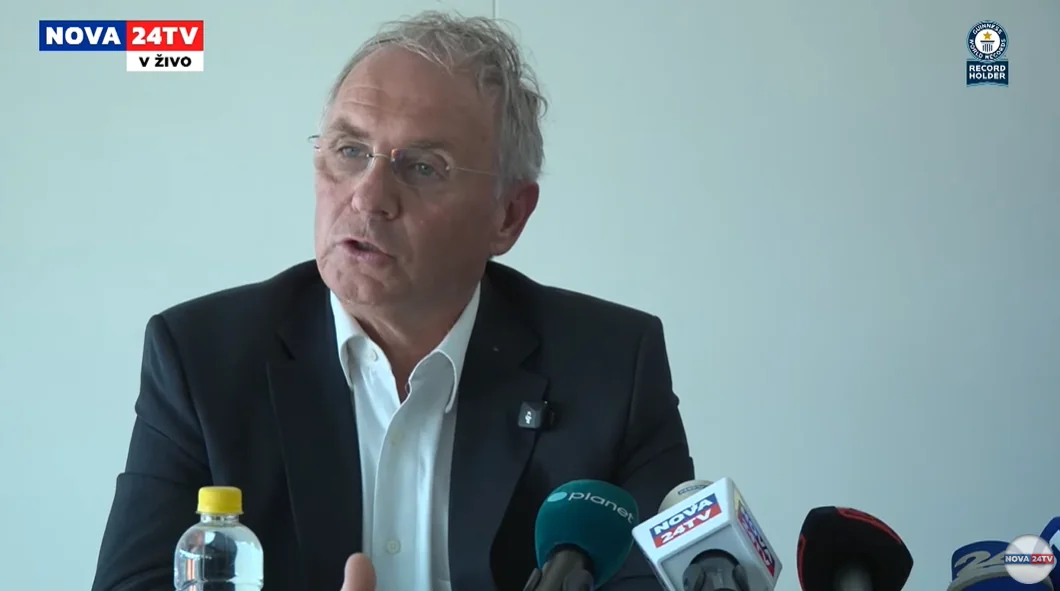
“None of the allegations against me hold any truth, and I want the matter to be investigated as quickly as possible,” said former Interior Minister Aleš Hojs. Today, he and his lawyer, Franci Matoz, held a press conference to explain the incident and outline the legal steps following yesterday’s investigation ordered by the Specialised State Prosecutor’s Office. According to Matoz, the warrant was, in his opinion, unlawful.
Yesterday, a house search was conducted at the residence of Aleš Hojs, former Minister of the Interior and Vice President of the Slovenian Democratic Party (SDS), ordered by the Specialised State Prosecutor’s Office due to alleged links to an organised criminal group. The operation, carried out just months before the elections, has raised suspicions of political motivation, as it echoes previous cases of pre-election investigations. Hojs has dismissed the accusations as unfounded.
At today’s press conference, Aleš Hojs expressed his position regarding the allegations and suspicions outlined in the warrant, which connects him to the alleged disclosure of information about investigations into the Kavač Clan. He emphasised that he was deeply surprised by the accusations and firmly denied them, stating: “None of the allegations against me hold any truth, and I want the matter to be investigated as quickly as possible.” He called for a swift and transparent investigation, during which the police would examine his phone and confirm that the alleged communication never took place.
According to Hojs, the suspicions appear to stem from correspondence between a drug dealer and a relative of his tenant, in which it was allegedly claimed that Hojs had passed on information about upcoming investigations into the Kavač Clan. He responded clearly: “I must say, this really surprises me, because I was never informed about any dates related to the Kavač Clan indictments. I never knew when any investigation was supposed to happen, I never spoke to anyone about it, let alone sent any messages or anything of the sort.” He added: “This is a complete lie, and I categorically deny it.”
Hojs expressed surprise at the time gap, noting that the alleged communication supposedly occurred in 2021, yet the Specialised State Prosecutor’s Office (SDT) only took action four years later. “That is why I have to say I am puzzled, what exactly were they doing for five years?” he remarked, also questioning the SDT’s jurisdiction over civilian individuals. He believes he was included in the warrant alongside an unidentified police officer to justify SDT’s involvement. He emphasised that only a handful of police officers were aware of the Kavač Clan investigations, making it strange that no evidence of his communication with the alleged officer has surfaced in five years.
Hojs clarified that his conversations with the subtenant were strictly about rent payments. “I never received any information about investigations into the Kavač Clan, nor did I pass any on. You cannot mention something you do not know,” he said. He added: “They accuse me of receiving information from an unknown police officer about when investigations into the Kavač Clan were supposed to take place. I assert that I received no such information and do not know any officer who would have passed anything on to me.” He also expressed outrage over a case in which a secretary from the prosecutor’s office allegedly leaked information to the Kavač Clan. At a meeting, he was “shocked by a statement from one of the participants who implied that it is understandable if poorly paid secretaries occasionally share information for extra income.”
In closing, Hojs stressed that he respects the prohibition on disclosing details from the warrant, as police strictly forbade him from doing so. Nevertheless, he believes it is right to respond to the accusations: “I will say what I think any normal country would consider logical, if you are suspected of something, you should be able to say so and respond to whether, in your view, those suspicions are justified or categorically false.”
His lawyer, Franci Matoz, explained that he and Hojs had discussed whether to share the contents of the search warrant with the public. The warrant is marked as internal, which is not unusual, as most search warrants carry such a designation to prevent disclosure before the investigation is carried out. “According to the Classified Information Act, confidentiality ends when a certain event occurs, such as a house search. Therefore, I believe the confidentiality should have ended once the search was conducted. However, during the search, we were informed that the document remains classified and that we are not permitted to disclose its contents to the public or to other individuals.”
During the house search, lawyer Franci Matoz pledged to protect the contents of the warrant in accordance with the Regulation and the Classified Information Act, which means storing the warrant in a locked cabinet and refraining from sharing it with others. After consulting with Aleš Hojs, they decided to disclose certain details, without names or surnames, as these may still be classified, while other information is already publicly known and therefore no longer qualifies as secret. “I believe the public has a legitimate interest in knowing the allegations, as Mr. Hojs is a prominent member of the SDS party, its vice president, and a key opposition politician,” Matoz explained. He argued that if the investigating judge imposed confidentiality, it must be weighed against the public’s right to know what a politician is being accused of. It is a matter of balancing public interest and secrecy.
“That is why we have decided to share copies of the warrant today, with redacted information that may still be classified,” he continued. Regarding the house search and the jurisdiction of the Specialised State Prosecutor’s Office (SDT), Hojs had already pointed out that their authority is questionable. Matoz clarified that in 2021, when Hojs was Minister of the Interior, he did not hold special powers, even though he was considered a public official under the Criminal Code. According to Matoz, SDT’s jurisdiction to execute the warrant cannot be justified solely by the assumption of Hojs’s status as a public official, he would have needed special powers as well. The jurisdiction might be indirectly justified due to the investigation of an unknown police officer allegedly possessing such powers. Matoz also highlighted an irregularity: the police officer leading the search requested the prosecutor to maintain confidentiality, even though such decisions fall under the authority of the investigating judge. Matoz sent a request for clarification on the validity of the confidentiality order to Judge Irena Topolšek, but received no response, despite also addressing the request to the Office of the President of the Ljubljana District Court.
Matoz: The warrant is unlawful
Matoz was unequivocal: “I believe the warrant is unlawful, as there was no sufficiently substantiated suspicion that Mr. Hojs committed the alleged criminal offense.” He added: “The fact that a third party referred to Hojs in a communication, without evidence such as message copies or other concrete proof, is, in my opinion, insufficient grounds for issuing such a warrant.” He expected the investigating judge to verify the credibility of the data found on the encrypted phone before issuing the warrant.
In criminal circles, it is not uncommon for individuals to exaggerate their connections to boost their reputation. Therefore, Matoz believes that issuing a warrant for a house search, which infringes on privacy and the inviolability of one’s home, was unjustified. During the search, only Hojs’s mobile phone was seized from his vehicle, along with sealed envelopes containing records and receipts. According to Matoz, the judge’s justification that the search was necessary and proportionate is based on speculation about possible data on the phone or in the cloud, which is not sufficiently concrete. Nevertheless, Hojs cooperated fully, asserting his innocence and stating that he had no intention of obstructing the process.
Matoz concluded: “In our assessment, this is a politically motivated prosecution, especially with elections approaching.”