

By: Spletni časopis
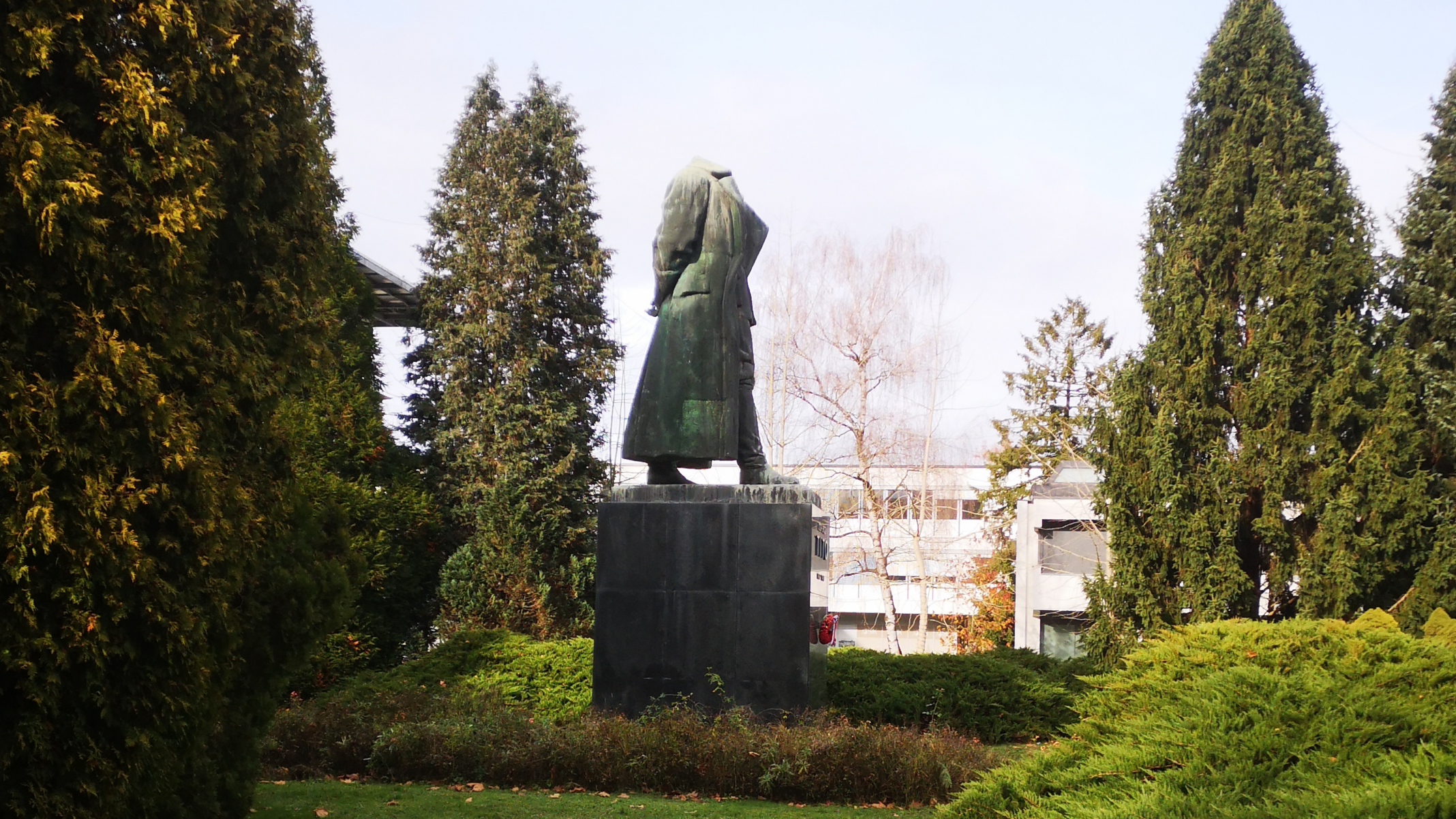
On Facebook and X, Miroslav Pačnik published an explanation of why the statue of former Yugoslav dictator Josip Broz Tito in Velenje – known in the SFRY as Tito’s Velenje – was left without a head.
The Slovenian Constitutional Court has prohibited state authorities from glorifying the former dictator and the actions of his regime, which abolished fundamental freedoms and was responsible for mass killings and property seizures. This was made clear when the Court prevented Zoran Janković from naming a street leading to Stožice after Tito. The Constitutional Court’s decision, with separate opinions, can be found here: decision.
Pačnik’s explanation, published on FB and X, of why he opposes the statue of the dictator in Velenje, is reproduced in full:
“WHY DID I LEAVE THE SYMBOL OF CRIME AND TOTALITARIANISM IN VELENJE WITHOUT A HEAD?
Above all, because Velenje and Slovenia deserve, in prominent places, memories of people who unite us, not the glorification of those who still evoke fear and pain in many hearts.
So that an argued debate is triggered, without labelling, leading to Velenje finally gaining symbols that unite and connect us, not monuments that divide us. Monuments that glorify a regime we left behind by plebiscite decision.
In the Act on the Declaration of the Fundamental Constitutional Charter on the Independence of the State, Slovenians wrote that we were leaving Yugoslavia – officially the Socialist Federal Republic of Yugoslavia – because human and national rights were gravely violated there. The symbol of this undemocratic, totalitarian state and its system was and will always remain Josip Broz Tito. A man who rose to power through a bloody communist revolution during World War II and the occupation of Yugoslavia. Under his rule, according to official data, hundreds of thousands of people were barbarically killed in Yugoslavia, more than half a million imprisoned in concentration and labour camps and prisons, and more than a million exiled or forced to leave due to political terror or poverty. Among the victims of his regime were also very many Slovenes. In a democratic state there must be no place for the worship of crime and totalitarianism.
The excuse that Tito also did good things does not outweigh the fact that he caused enormous suffering and is ranked among the greatest criminals in human history. Whoever does not believe my words can quickly check using numerous AI tools. Just type the phrase ‘Tito’s crimes.’
Monuments to totalitarian practices and their symbols, and their glorification, are contrary to Slovenian constitutional principles and to resolutions of the European Parliament and the Council of Europe. Local and state authorities should long ago have moved them into museums and memorial parks of the totalitarian period of our history, where visitors would be explained what they symbolise. Whoever still wants to worship them should go there. But such remnants of the totalitarian past do not belong in our squares. What are we telling younger generations with them? That it is acceptable to rule without elections? That it is permitted to imprison and even kill people without trial? That human rights can be ignored whenever the power of someone who declares himself ruler is threatened?
The erection and preservation of monuments to communism, National Socialism, and fascism is legally prohibited in many European countries. Recently, the Czech Republic adopted such legislation. Slovenia will one day have to take this step. I hope my protest action against the obvious violation of Slovenian constitutional and European principles will bring this step closer.
Not long ago, an initiative was submitted in the Velenje City Council to replace the monument to totalitarianism with a monument to Velenje’s miners, and to rename the square Miner’s Square. How could anyone oppose such an initiative, which by no logic could divide the citizens of Velenje? Who would be offended or hurt if we had a square and monument dedicated to thousands, tens of thousands of Slovenian miners, who for decades have cared for their families and local community, while also providing energy for the entire country? Let us erect a monument to them, who with their toil truly contributed to the development of Velenje, some of whom unfortunately recently lost their lives in the process. They deserve gratitude and honour of remembrance. A remembrance that does not divide but unites. Of course, erecting a monument to miners is only one option. Surely other noble ideas will be found.
The Municipality of Velenje now has an excellent opportunity to choose the path of unity. The statue of the dictator from the previous regime should be moved to a museum, where it belongs. In the relocation I, together with my many supporters, can help. I have already done some work myself, but the entire statue is too big a task for one person.
Let me conclude my message with sincere wishes for the upcoming holidays. Celebrate them in the circle of your loved ones, with a smile on your face and a sparkle in your eyes.
To all those I hurt with my action, I hereby extend a sincere apology. I did not wish to offend anyone, but I suggest you choose for your idol someone less controversial and more luminous.
Good luck Velenje… Good luck Slovenia.”
The Constitutional Court explained its decision that Tito must not be glorified as follows:
“Human dignity is at the centre of the constitutional order of the Republic of Slovenia. Its ethical and constitutional significance derives already from the Fundamental Constitutional Charter, which is not only the constitutional foundation of Slovenian statehood, but also outlines principles expressing the fundamental constitutional quality of the new independent state. With the adoption of the independence documents, there was not only a break in the state‑legal connection between Slovenia and the SFRY, but also a break with the fundamental value concept of the constitutional system. Unlike the former SFRY, Slovenia is a state whose constitutional order is based on respect for human rights and fundamental freedoms. Human dignity is a fundamental value that permeates the entire legal order and therefore also has objective significance in the functioning of authorities both in concrete procedures and in the adoption of regulations.
As a fundamental value, human dignity has normative expression in numerous provisions of the Constitution, especially concretised through provisions guaranteeing individual human rights and fundamental freedoms. As a special constitutional principle, the principle of respect for human dignity is directly grounded already in Article 1 of the Constitution, which defines Slovenia as a democratic republic. The principle of democracy in its content and meaning goes beyond defining the state system as merely formal democracy, but substantively defines Slovenia as a constitutional democracy, i.e. a state in which the actions of authorities are legally limited by constitutional principles and by human rights and fundamental freedoms. This is precisely because the human being and his dignity are at the centre of its existence and functioning. In a constitutional democracy, the human being is a subject and not an object of state action, and his (self)realisation as a human being is the fundamental purpose of the democratic system.
Unconstitutionality of a regulation or other state action with symbolic meaning can be spoken of when such a symbol, with the authority of the state, expresses values wholly incompatible with fundamental constitutional values such as human dignity, freedom, democracy, and the rule of law. The symbolic dimension of Tito Street is inseparably linked to the symbolic meaning of the name Tito. The fact that Josip Broz Tito was lifelong president of the former SFRY means that his name most strongly symbolises the former totalitarian regime. The reintroduction of a street named after Tito as a symbol of the Yugoslav communist regime can objectively be understood as recognition of the former undemocratic regime.
In Slovenia, where the development of democracy and a free society based on respect for human dignity began with a break from the previous system, state glorification of the communist totalitarian regime by naming a street after its leader is unconstitutional. Naming a street after Tito is not a name preserved from the previous system and today merely part of history. The contested ordinance was adopted in 2009, eighteen years after Slovenia’s independence and the establishment of a constitutional order based on constitutional values opposed to those of the pre‑independence regime. Such new namings in today’s space and time no longer have their place, because they contradict the principle of respect for human dignity, which has its foundation in Article 1 of the Constitution and belongs to the very core of Slovenia’s constitutional order.”