

By: Petra Janša
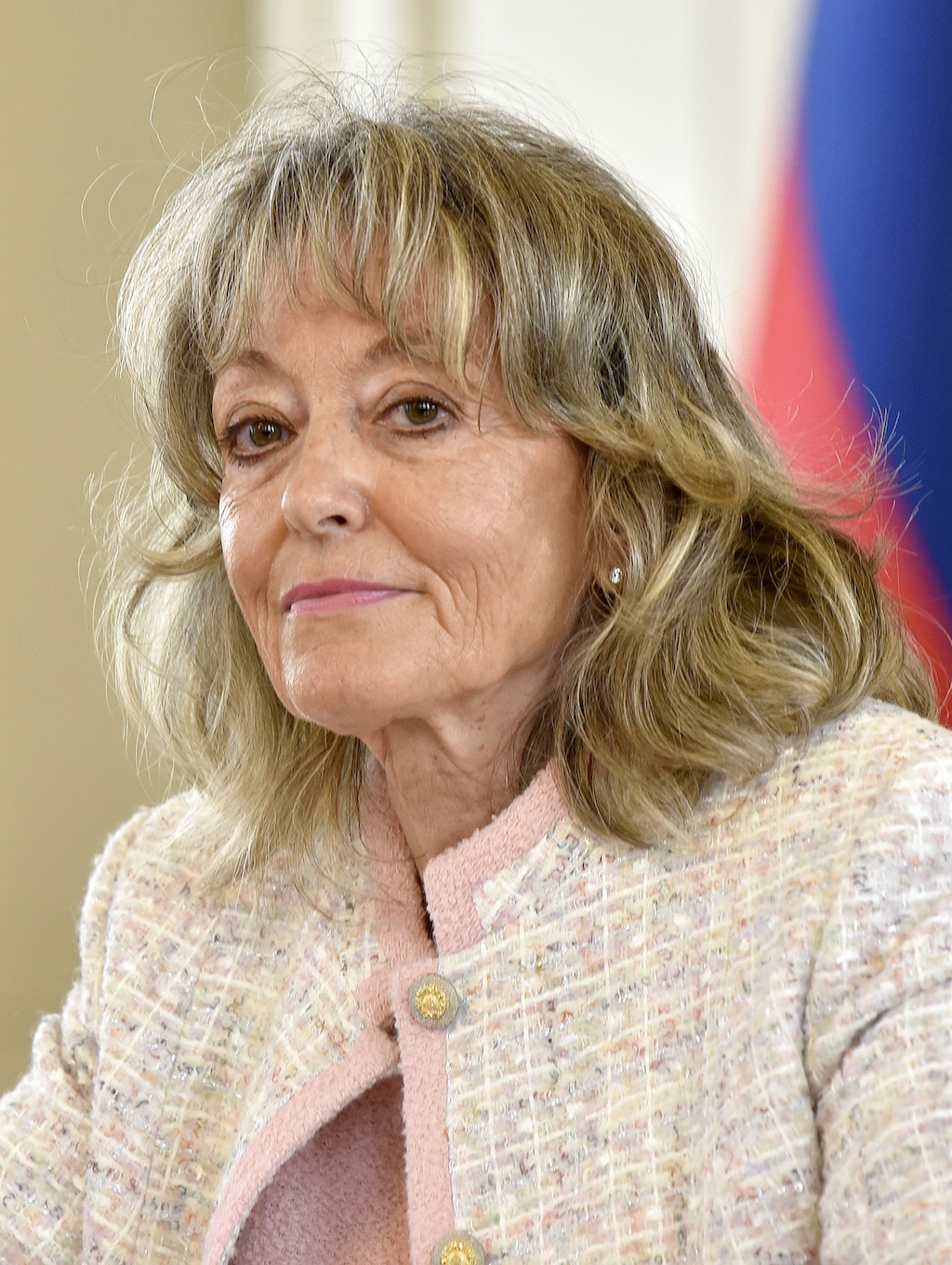
We spoke with Supreme Court Judge Barbara Zobec about the Kočevje Trial and the book dedicated to it, the state of the judiciary in Slovenia, oversight of judges and prosecutors, and the possibility of a compensation system for their accountability. The conversation also touched on the case of prosecutor Mateja Gončin, the prospect of an even more overtly left-leaning Constitutional Court in the near future, the consequences of the Prime Minister’s calls to “purge Janšists” and the lack of sanctions for inciting violence against them, as well as the meaning of transitional justice and whether, if ever, we will stop “wading through the meanders of an unfinished transition.”
Mrs. Zobec, let us begin with the book Kočevski proces: The Life and Death of Boris Kovač, published two years ago by Založba Družina. You contributed the foreword, and in it, Milan Zdravko Kovač retraces the crime committed against his brother Boris. At the book’s launch, you stated that the Kočevje trial was something horrific. For our readers, could you briefly summarise the tragic story of this staged process?
The fate of Boris Kovač deeply moved me. Barely of age, he was imprisoned in the Gonars camp by the Italian occupiers for his patriotic convictions and opposition to the occupation. After Italy’s capitulation, he joined the Slovenian Home Guard with sincere intentions to defend his nation and homeland. But before he could act, partisans captured the Home Guard members, most were executed coldly, while the rest were subjected to “criminal trials.” One such trial targeted Boris Kovač and eleven other young men, some of whom were minors. The main charge was that they “belonged to traitorous military formations.” All were pre-emptively sentenced to death. On March 10, 2022, the Supreme Court granted the request for legal protection filed by the State Prosecutor’s Office and issued an acquittal for all defendants, ruling that the indictment lacked the elements of a criminal offense. A person can only be convicted for their actions, not for their status.
Both the Supreme and Constitutional Courts, however, rejected requests for revision between 2018 and 2023 of the verdict issued by the revolutionary Extraordinary Military Court of the National Liberation Army and Partisan Detachments of Slovenia. As a result, the daughter of Viktor Habič, one of the convicted, filed a complaint with the European Court of Human Rights (ECHR). Please correct me if I am wrong.
You are absolutely right. I know the case well, as I participated in the Supreme Court proceedings and voted against the majority decision. My core argument was that the process violated fundamental civilisational norms and that the body issuing the verdicts was not a court. In September 1943, the revolutionary entity lacked the attributes of statehood. The internationally recognised subject was the Kingdom of Yugoslavia. I elaborated this thesis in a constitutional review request, at a time when Supreme Court judges were not yet permitted to publish dissenting opinions. As a member of the panel, I refused to sign the advisory memorandum because I firmly believed – and still do – that the secrecy of the vote was unconstitutional. I should also note that the main witness against Habič was herself convicted after the war for the same charge that led to Habič’s death sentence.
To this day, the ECHR has not issued a final ruling in the case – a decision that could set a significant precedent for the rehabilitation of victims of communist repression in Slovenia.
Certainly. Whether it will happen is hard to predict. Much depends on the national judge and the composition of the chamber. Sadly, that is the reality in Strasbourg today. I can only hope the court will be sympathetic to the victims of the Kočevje trials and their descendants. That would mark an important step toward national reconciliation. The first step toward reconciliation is the acknowledgment of wrongdoing and the rectification of injustice. Reconciliation cannot be built on lies and denial.
Why do you hope the ECHR will not compare the Kočevje trials to the Nuremberg trials?
There are several reasons. The most important is that the Kočevje trials were not genuine judicial proceedings, they were a staged performance targeting members of military formations not under the control of the Liberation Front. It was an act of revolutionary violence.
While reading the Constitutional Court’s decision in the Kočevje trial case, Constitutional Judge Dr Klemen Jaklič, in his dissenting opinion, pointed out judicial bias. Specifically, Dr Teodor Tominšek, who sentenced Viktor Habič to death, had previously performed at least part of the procedural actions as a prosecutor or investigator. In other words, the prosecutor was also the judge.
That is true. And more than that, some of the “defence attorneys” had previously served as investigators. This is precisely why the Kočevje trials cannot be compared to the Nuremberg trials. In the latter, all fundamental civilisational principles of fair procedure were respected, including the adversarial principle, which requires the roles of judge and prosecutor to be separate. The Kočevje trials were merely a façade of justice, a textbook example of so-called “kangaroo courts.”
You know, even today I often feel that prosecutors are judges, or, to be more precise, that judges simply follow the conclusions of the prosecution. Look, if the system of judicial accountability and oversight is entrusted to the Judicial Council, who oversees the prosecutors?
Prosecutors are overseen by the State Prosecutorial Council. As for your impression, I do not share it. That perception may arise occasionally, but in many high-profile cases, such as those involving the mayor of Ljubljana or his sons, the courts did not follow the prosecutors. Nor did the Supreme Court, at least not in the notorious Balkan Warrior case. The Novič case also ended in an acquittal at first instance. That said, the accused endured an indescribable ordeal that ultimately destroyed his life, despite the acquittal.
Speaking of the prosecution’s conduct – do you believe Specialised State Prosecutor Mateja Gončin regarding her revelations, particularly about irregularities in the police and the Centre for Protection and Security?
I watched her interview with Bojan Požar. I can say she came across as serious and convincing. Beyond that, since I am only familiar with the case through her interview, it is hard to say more.
Gončin believes she will not suffer the fate of her judicial colleague, former judge Zvjezdan Radonjić, who also challenged the system. What is your view?
If Prosecutor Mateja Gončin holds concrete evidence or has people willing to confirm her claims, then I believe she will succeed. My experience has taught me a simple truth: never speak publicly unless you have documentary proof – or other solid, irrefutable evidence – to support the claims you are making against others. If those others are influential and well-connected, all the more so. That was precisely Radonjić’s problem. It is not enough that people believe you. If you go up against structures that control the system, never do so without irrefutable evidence.
In your opinion, should the law regulate accountability and a compensation system for misconduct by prosecutors and judges or courts?
That issue is already regulated – through the principle of material immunity. Judges are not directly liable for their mistakes, nor are they subject to recourse claims. That system could be changed. I believe that a reform allowing the state to file a recourse claim against a judge in cases of serious constitutional violations or gross breaches of law would not be incompatible with judicial independence or Article 134(1) of the Slovenian Constitution (judicial immunity). Such forms of civil liability exist in comparable systems, for example, in Italy, and in Germany it is even a constitutional category. But I doubt it would work in practice in Slovenia. The decision to pursue a recourse claim would depend on the political will of the executive branch. However, if a judge is proven to have abused their position, deliberately misused their function, then they are criminally and civilly liable for such conduct.
The appointment of new Constitutional Court judges is currently a hot topic. Will we soon have an even more overtly left-leaning Constitutional Court?
I understand your question as rhetorical. Yes, it seems we will. The dominant transitional political forces will ensure a monolithic, loyal, and “depoliticised” composition, though for optics, they may install a token non-progressive, non-aligned judge. However, and this is key, that judge will not be of the calibre capable of writing incisive dissenting opinions or exposing the intellectual shallowness and argumentative weakness of the dominant majority.
How do you assess the general state of the Slovenian judiciary?
According to Eurobarometer, 55% of Slovenians trust the judiciary, which is slightly better than in previous years. But public perception is by no means a sufficient indicator of the judiciary’s actual condition. Austrian courts, for example, rank among the most trusted in Eurobarometer, yet based on my knowledge of their operations, I can say that unimaginable abuses occur there. Just look at the case of Aleš Štrancar before the court in Eisenstadt. And that is not the only one.
As someone familiar with the inner workings of the Slovenian judiciary, I can say that the overall situation is poor, though there are many good judges. The problem lies in the leadership structures – at the Supreme Court, the higher courts, and especially at the District Court in Ljubljana, which faces severe backlogs, particularly in cases involving minors or where minors are victims. These are cases that should be handled with particular urgency. The president of that court should have been dismissed long ago. Yet despite abuses and serious human rights violations confirmed by the highest courts, including the European Court of Human Rights, he continues his mandate. As long as this persists, the Slovenian judiciary will remain hostage to leadership structures that interpret the law in an authoritarian manner and intimidate critical colleagues. As long as such individuals occupy key positions in the hierarchy, the judiciary will remain ailing – a seriously ill patient.
Do you not think that the Prime Minister’s calls to purge “Janšists” from the police and RTV Slovenia, and the lack of sanctions for calls to kill “Janšists,” do little to strengthen democracy? All this seems more reminiscent of totalitarian times…
Under this government, Slovenia has regressed alarmingly, not only in terms of democracy and the rule of law, but also economically, internationally, and especially in the provision of public services. Oversight institutions, which ensure checks and balances and are a cornerstone of the rule of law, have been practically dismantled. Those that still function, like the Fiscal Council, have been marginalised and ignored by those in power. A system that has lost its self-correcting mechanisms is like an organism whose immune system has failed. That is why this current rule by self-absorbed authoritarians will sooner or later collapse in on itself.
Let me return to the beginning of our conversation. In the comprehensive anthology Consensus for a Historic Moment, we find your reflection titled Apologia of Revolution as the Legitimation of Evil, in which you write that you see the Kočevje trial as a litmus test of transitional justice. What did you mean by the term “transitional justice”?
Transitional justice is a widely recognised concept that refers to a range of legal, political, moral, and cultural measures by which a society, on its path from authoritarian or totalitarian rule to democracy, responds to injustices and atrocities committed during the undemocratic period. Transitional justice is the foundation for entering a world of equally free individuals. It encompasses measures such as the rehabilitation of regime victims, restitution, lustration, and the prosecution of those who committed crimes. It also includes political reforms and, ultimately, the cultural and moral healing of a nation. If we were to aggregate these criteria into an index of transitional justice, Slovenia would undoubtedly rank at the very bottom of the European Union. This is, after all, reflected in the European Parliament’s resolution on preserving the memory of victims of the post-war communist period in Slovenia. Just look at the former Eastern Bloc countries that took transitional justice seriously, such as the Baltic republics, Poland, and the Czech Republic. All of them have surpassed us in economic, cultural, and spiritual development, and ultimately in social welfare and quality of life.
If I may conclude by quoting your own words from the end of that essay – “Will we ever, on the sunny side of the Alps, gather the courage, conscience, and knowledge – or will we continue to wade through the meanders of an unfinished transition?”
Everything depends on us, the citizens. Although we are increasingly becoming an authoritarian-led state – Harvard professor Steven Levitsky calls this phenomenon competitive authoritarianism – we still hold the key instrument of democracy: free elections. I hope that with the upcoming parliamentary elections, the current trend of sinking into authoritarianism will come to a halt.
Biography
Barbara Zobec has served as a judge at all levels of criminal judiciary over her more than forty-year career. She has been a Supreme Court judge since 2002, and since 2008 holds the rank of councillor. In 2023, she became head of the Criminal Division of the Supreme Court of the Republic of Slovenia, after serving for many years as deputy head. She has presented papers on criminal law and criminal procedure at various domestic and international conferences, seminars, and judicial academies. She is also a long-standing member of the permanent examination board for the state legal exam in criminal law. Zobec has published numerous articles in the fields of criminal (procedural) law and criminology, and is co-author of the latest edition of the Commentary on the Constitution of the Republic of Slovenia and the Comprehensive Scientific Commentary on the Criminal Code. Her research interests focus on mass killings during and immediately after World War II, judicial executions, and other crimes committed during the totalitarian period, as well as the rehabilitation of victims of the communist regime.


