By: Gašper Blažič
If in recent days we witnessed a full‑blown drama over the alleged attempts to bribe MPs from the Democrats and Resni.ca, the vote delivered a surprise in the completely opposite direction.
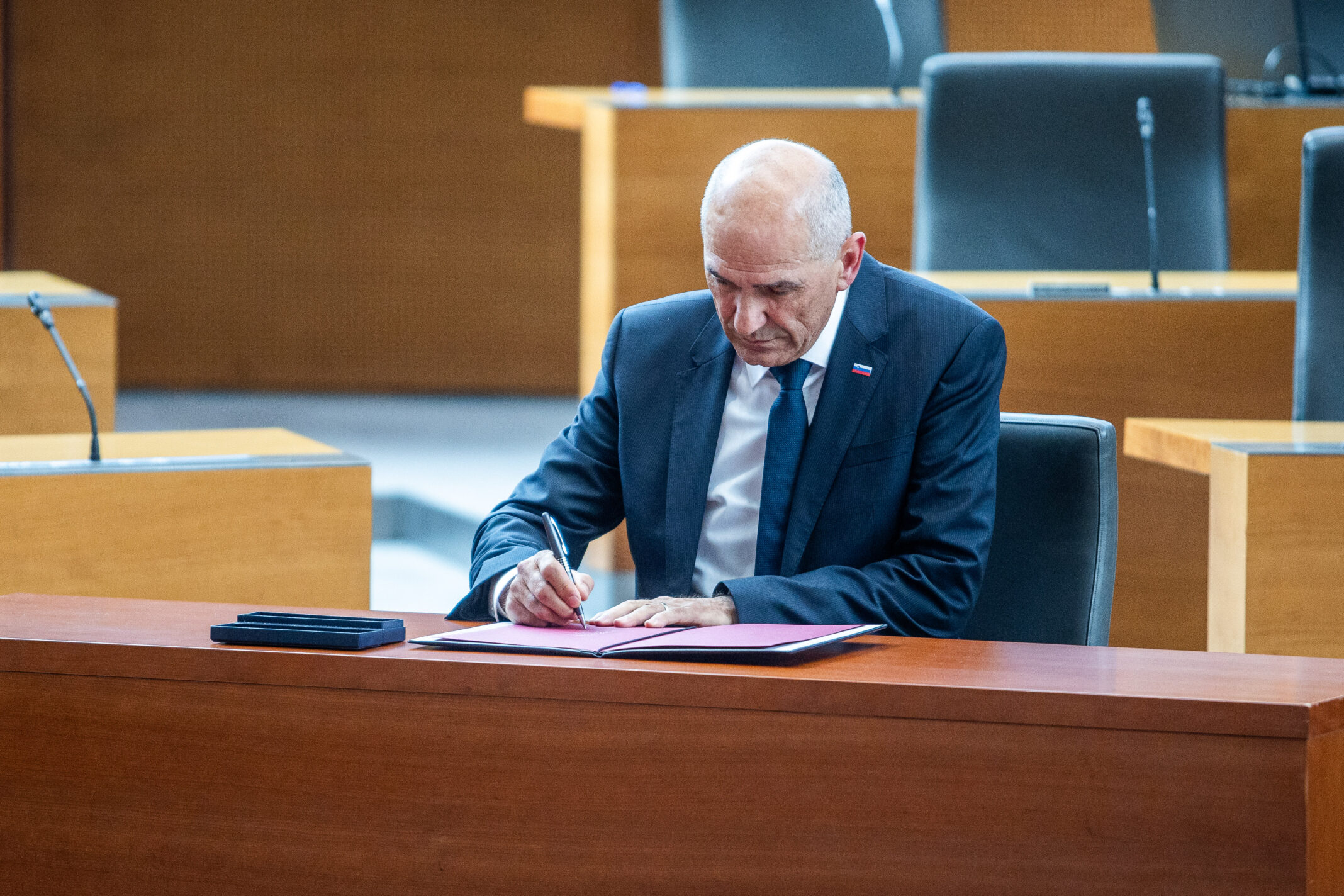
Janez Janša officially had 50 votes secured. This included the votes of all coalition parties – SDS (28), the NSi–SLS–Fokus trio (9), the Democrats (6), as well as Resni.ca (5) and the two minority MPs.
What is surprising, however, is that he ultimately received one vote more than expected. This means that one MP from either Svoboda, SD, or Levica must have voted for him. All MPs from these parties who spoke in the debate swore they would never support Janša. Theoretically, it is impossible for every single MP of the outgoing coalition to have voted against him. There is therefore a theoretical possibility that someone “made a mistake” or changed their mind. And the result will almost certainly trigger uncertainty and fear within the now‑former governing coalition, as it has shown that they themselves are the most vulnerable to internal “defections”.
It is also clear that three MPs from the newly formed opposition did not cast their votes or cast invalid ones, as Speaker Zoran Stevanović announced that 87 valid votes were submitted.
Incidentally, Janša is expected to be succeeded in parliament by Maruša Babnik, a Ljubljana city councillor and primary‑school teacher from Sostro.
Next comes the formation of the government. Since the coalition agreement has already been signed, the only remaining question is the distribution of ministries, which will be significantly fewer than under Golob’s government due to changes in the law. Within two weeks, Janša must submit the list of ministerial candidates, who are then voted on separately. This means the government will likely be elected in the first half of June, unless the Constitutional Court intervenes unexpectedly. According to Janša, talks on staffing will begin on Monday. Some names are already circulating, but these are still unofficial hints. Andrej Šircelj, the former finance minister, is reportedly returning from retirement.
As in his previous three governments, Janša is expected to offer the opposition a partnership for development.
Today’s vote is also something of a slap in the face for President Nataša Pirc Musar, who after the first round of consultations essentially gave up and announced she would not propose anyone, even though she initially said she would nominate whoever could secure 46 votes. Janša ended up receiving five more than required, and MPs proposed him only after the president had thrown in the towel.
In the coming hours and days, very interesting information is likely to leak from behind the scenes about what has been happening within the new opposition. Robert Golob has been even more irritable and angry than usual in recent days, something he also showed in last night’s Odmevi, where Rosvita Pesek cornered him with follow‑up questions: https://365.rtvslo.si/arhiv/odmevi/175223347?t=10&a=1&l=941
Interestingly, former SDS MP Dejan Kaloh, who left the party before the end of the term, has also sided with those who believe the Constitutional Court should annul the elections.
However, the chances that the Constitutional Court would actually annul the elections are very small, despite the ideological imbalance of the court, which, after the end of Dr Klemen Jaklič’s term, is entirely left‑leaning. After all, the published (and later deleted) post on Urška Klakočar Zupančič’s profile showed that filing the constitutional appeal is merely a “show” meant to “polish” public opinion. But this is not some strategically planned spin, it is an angry reaction from left‑wing actors who have now experienced such an unexpected outcome for at least the fourth time. The first such case was in 1990, when ZKS‑SDP won the most votes among individual parties and was already preparing Janez Kocijančič, then director of Adria Airways and part of Milan Kučan’s circle, as prime minister. But Demos secured a majority, and Lojze Peterle became prime minister. In 2011, Zoran Janković failed to form a coalition, and in 2020 Marjan Šarec, after famously “throwing in the towel”, expected immediate snap elections, but SMC and DeSUS chose otherwise.
Anyone who followed the session could see that the anger of Svoboda MPs was directed mainly at Resni.ca and the Democrats, accusing them of breaking their word by cooperating with Janša. True, every election brings its share of broken promises, but it seems the deep state misread the signals coming from these two parties.
Shortly before the election, our editorial office received information, initially sounding far‑fetched, that in the case of a very tight result, Resni.ca, with its liberal economic programme, would support whichever side was closer to its platform. This meant that Stevanović’s famous statement about refusing to work with Janša would soon be forgotten. On election night, analysts on Planet TV noted that the mood of the parties was also shaped by the composition of their parliamentary groups. Cooperation with the centre‑right became a realistic option especially after Stevanović became Speaker of the National Assembly (he received 48 votes despite strong protests from the left), and after Katja Kokot became the leader of the Resni.ca parliamentary group.
It will also be interesting to observe the behaviour of the media. Since Stojan Petrič’s Kolektor still counts on state construction contracts, changes in the strongly left‑leaning editorial policy of Delo and its other publications are quite possible.
“The National Assembly has just taken an important step toward making Slovenia more successful in the future. But this was not the final step for Slovenia to get a development‑oriented government,” Janša said in a statement to the media after the secret vote. He hopes Slovenia will get “a complete team working for the country’s future” in the coming days or within two weeks at most. He added that the coalition already has some established working methods from previous governments, and that talks on the distribution of posts will begin on Monday.
He reiterated that the opposition will receive a proposal for a partnership for development. Whether this term will be one of cooperation for the good of Slovenia or one of attacks and exclusion, as he said happened when the current opposition was in power, will depend on their decision. He hopes things will be different this time, but says they are prepared for anything.