

By: A. S. (Nova24TV.si)
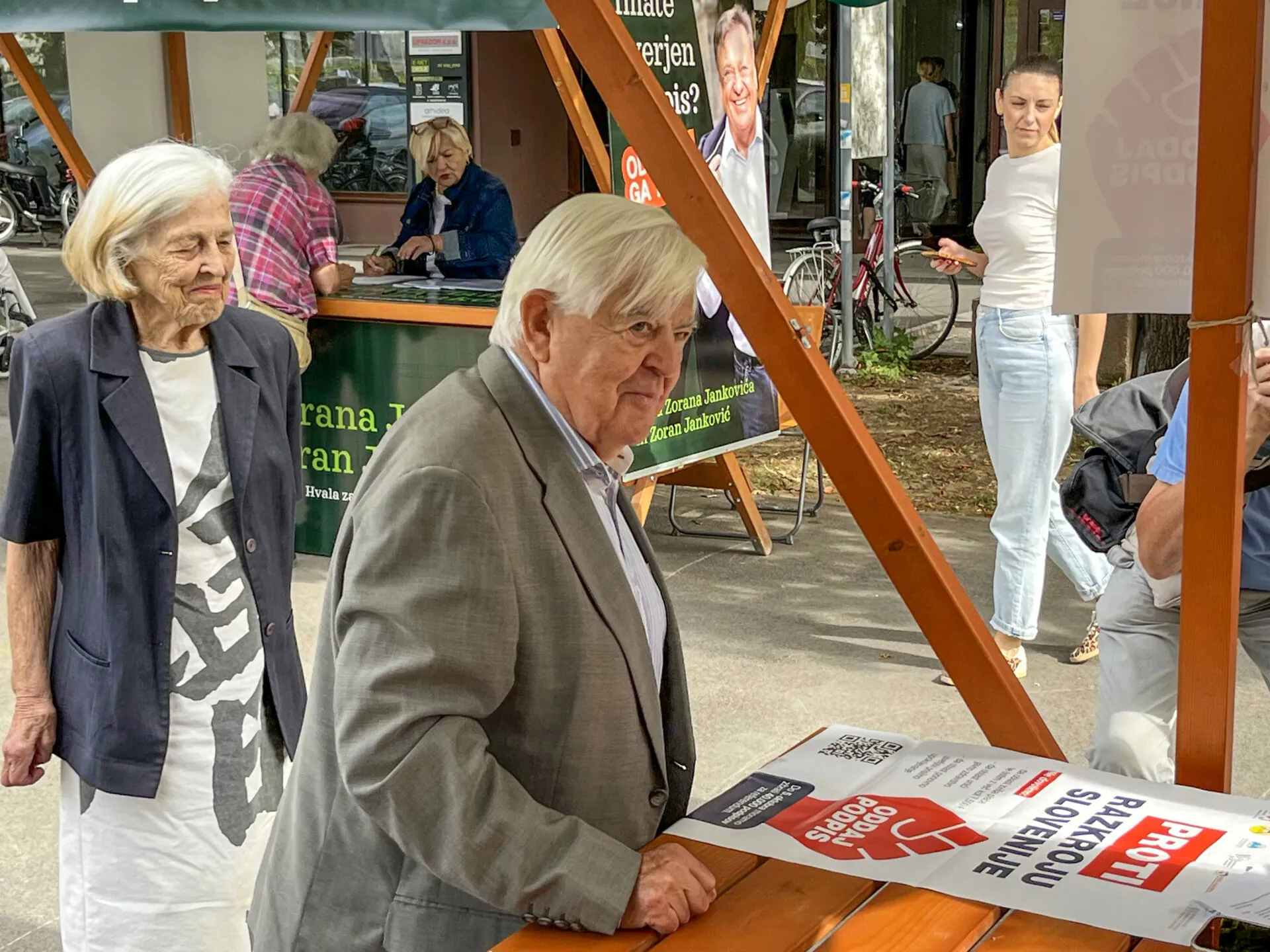
Kučan has submitted his signature in support of the referendum on the intervention law, and the political analyst sees his statement as an expected move.
The godfather of Slovenia’s transitional left, Milan Kučan, today submitted his signature in support of the referendum on the intervention law. At the Ljubljana administrative unit, he cast his vote together with his wife, Štefka Kučan. He also campaigned for the referendum, calling on the public to follow his example. He added that he supports “the unions’ demand to preserve and strengthen Slovenian society as a civic, national, and social community,” and claimed that with the law “everyone would lose in the long term.”
What exactly would Slovenia lose? Kučan says “the fundamental security provided and ensured by the systems of public education, public healthcare, social welfare, and the strengthening of public goods.” In the manner of his NGO‑aligned comrades, he warned of the loss of sovereignty, personal freedom, and the rule of law. Of course, Kučan is not concerned about sovereignty when it comes to the large sums from abroad drawn by left‑wing NGOs from the George Soros network, to whom Kučan, as president of the republic, once awarded a decoration. But when it comes to political opponents, he is quick to invoke the rule of law and sovereignty. He claims the referendum is “a clash between common sense and political deceit,” which might be true, except that Kučan is on the side of the latter.
The referendum was enabled by the Constitutional Court, which annulled the decision of the National Assembly declaring the referendum on the Intervention Measures for the Development of Slovenia Act inadmissible. It justified its decision by stating that an entire law cannot automatically be excluded from referendum decision‑making merely because it contains some provisions on which a referendum is not permitted. The government, on the other hand, warns that the provisions of the law eliminate unconstitutionalities previously identified by the Constitutional Court. For this reason, it argues that certain parts of the law fall among laws or legal provisions on which a referendum is not permitted due to constitutional limitations.
We asked political analyst Dr Matevž Tomšič for a comment regarding Kučan’s support for the referendum, as well as the Constitutional Court’s decision to allow it. He told us that Kučan’s support is, of course, expected, and that Kučan’s statement that everyone would “lose in the long term” is a typical cliché: “If Janša’s government proposes something, Kučan will of course be against it.” He holds a similar view regarding the Constitutional Court: “The Constitutional Court makes its decisions on a political basis. First, they decide what the correct opinion is, and then they try to justify it legally and legislatively. If an identical law had been proposed by a left‑wing government and the then‑opposition were against it, the same court would of course support the law.”