

By: C. R.
Niko Gamulin, an expert in digital technology and artificial intelligence, published a longer post on X about today’s press conference of the “left trio”.
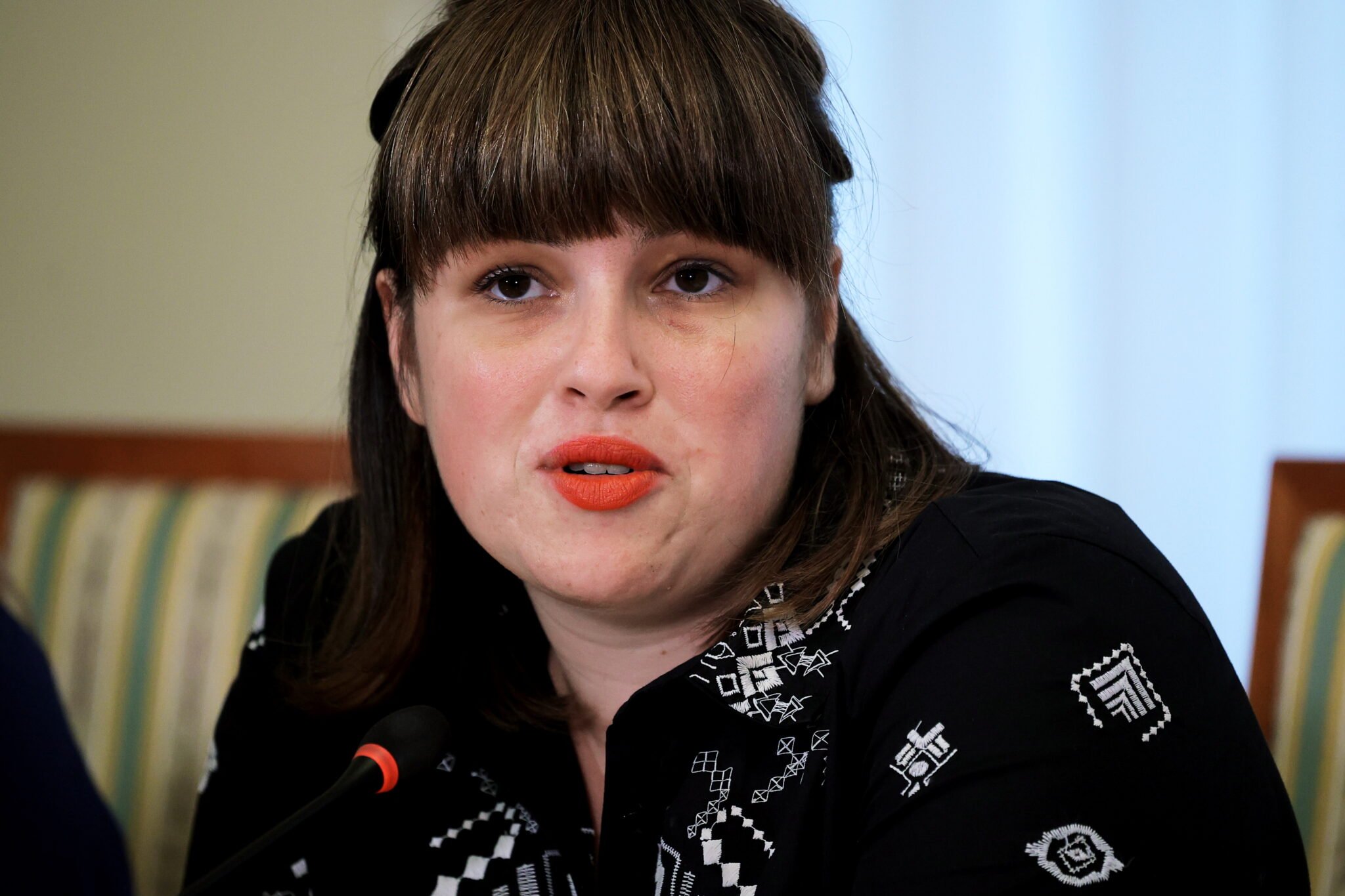
Today, on 16 March 2026, the 8 March Institute, Mladina journalist Borut Mekina, researcher Filip Dobranić, and Israeli expert on digital manipulation Achiya Schatz held a press conference. They presented a report claiming that the surveillance recordings published on the website anti-corruption2026.com were most likely produced by the Israeli private intelligence company Black Cube, allegedly hired by the SDS party.
The report is based on data about private jet landings at Ljubljana Airport, anonymous sources, and publicly available information. The parliamentary intelligence oversight commission (Knovs) has already begun verifying the claims with SOVA and the Criminal Police Directorate.
At the press conference, something happened that deserves a closer look.
The course of the press conference
The conference had a clear structure: first, Mekina presented data on aircraft and meetings; then Schatz provided international context on Black Cube’s operations; Dobranić added an analysis of digital traces. Nika Kovač spoke last and offered a political interpretation.
Up to this point, everything ran smoothly. Then came the journalists’ questions.
The question that exposed the purpose of the conference
A journalist asked a question that touched the core of the issue. Paraphrased: Are you trying to say that people should not vote for those who are an alternative to this corruption? Are you problematising the method of disclosure while the content of the recordings remains unaddressed?
This is the one question every newsroom in the country should have asked. And it was precisely this question that triggered the outburst.
The outburst
Nika Kovač cut the journalist off. She called him a “dude”. She lectured him about how they have always fought against corruption. Then she unilaterally ended the conference before any further questions could follow.
Before that, Dobranić had begun answering the journalist’s question, and Kovač cut him off mid‑sentence.
This is not a minor detail. It is the key moment of the entire conference.
Forensic rhetorical analysis of the response
I analysed the publicly available video of Nika Kovač’s response. I used forensic linguistic methods: tokenisation, extraction of rhetorical markers, temporal structure of argumentation, and acoustic voice analysis. The clip lasts 123 seconds and contains 304 words.
Deflection : Substance = 17 : 3
In the response, I identified 17 deflection markers – words that redirect attention away from the content of the recordings: Israeli service, Weinstein, Janša, sovereignty, election campaign. Substantive markers – words actually referring to the corruption described in the recordings – numbered 3.
The ratio is 5.7 to 1. In rhetorical literature, anything above 3:1 is classified as a deflective response.
Three phases: uncertainty, script, escape
I divided the response into thirds and analysed the distribution of markers over time.
Beginning (72 words): pure hedging. “I think” appears repeatedly. Deflection markers: 0. Substantive markers: 0. The speaker wanders. Buys time. Searches for footing. This is the behaviour of someone unprepared for a question that hits the core.
Middle (116 words): explosion. 12.1 deflection markers per 100 words. Here the prepared narrative activates: Israeli intelligence, Weinstein, attack on sovereignty, Janša invited them. Substantive markers: 0.9 per 100 words. The prepared narrative switches on as a mechanism, independent of the question.
End (116 words): dismissal. “I would conclude.” “I think we have done everything.” “That is it.” “Thank you.” A unilateral ending. The conference ends before the next question.
This pattern, uncertainty, activation of a prepared message, escape, has a precise name in rhetorical analysis. It is not a spontaneous response. It is an emergency exit triggered when a controlled scenario loses control.
Acoustics: the voice confirms it
The pitch (fundamental frequency) rises systematically: 185 Hz at the start, 223 Hz in the middle, 247 Hz at the end. This rising pattern corresponds to escalating emotional intensity.
But the content does not deepen. Arguments do not strengthen. The voice rises; the substance stagnates. This is the acoustic signature of rhetorical performance: escalation of tone without escalation of argument.
Jitter (voice instability) is 11.1%, moderate, below the threshold of genuine emotional distress. Assertiveness index: 0.38, low. The word “I think” appears 5 times in 304 words.
Six identified rhetorical techniques
- Red herring (17×): introducing unrelated topics instead of addressing the content of the recordings, Mossad, Weinstein, Hungarian elections, Israeli planes. None answer the question: Is what the speakers describe in the recordings true?
- Whataboutism (5×): shifting from corruption to alleged foreign interference. Effect: instead of discussing WHAT the minister describes about favours, we discuss WHO recorded her.
- Poisoning the well (5×): discrediting the source before addressing the content. The logic: if the source is bad, the content is irrelevant. This is a fallacy. Content is true or false independently of the source.
- Appeal to emotion (4×): “attack on state sovereignty.” This is an emotional frame. A substantive frame would ask: did the former justice minister really describe a mechanism of corruption? An emotional frame asks about feelings. A substantive frame asks about facts.
- Unilateral closure (6×): ending the discussion without answering the key question. In a press conference, a format meant for questions, this is especially telling.
- Ad hominem: calling the journalist “dude” instead of answering the question. When argument fails, discrediting the interlocutor remains.
The structure of the conference as a whole
Consider the conference as a finished product. Four speakers. An hour and a half of preparation. International references. Aircraft data. An Israeli expert. And then: one critical journalistic question is enough for the entire structure to collapse. The speaker loses control, cuts off her colleague, insults a journalist, and shuts down the conference.
A product that survives an hour of presentation but collapses under one question is not a research report. It is a script that works only as long as no one challenges it.
For comparison: when I was publicly challenged about the ENF analysis (the claim about the 200 Hz harmonic turned out to be a statistical artifact of full FFT), I publicly admitted the error, published a correction with a white‑noise control test, and updated all analyses. Credibility depends on the ability to answer criticism, not prevent it.
Broader context: two weeks without a substantive response
Since the first recordings were published in early March, none of the involved individuals have denied the content. Dominika Švarc Pipan did not say the conversations did not happen. Vesna Vuković explicitly confirmed that the voice on the recording is hers. Nina Zidar Klemenčič has remained silent. Rok Hodej has remained silent.
Instead of substantive responses, the discussion has followed a familiar pattern:
Step 1: AI. Gibanje Svoboda called the recordings “AI‑processed.” PM Golob called them a “splice.” Minister Mesec claimed “AI confirmed a deepfake.” Forensic analysis of nine tests found no indicators of AI or editing.
Step 2: deepfake. When the AI claim collapsed, the narrative shifted to the vague “the recordings are manipulated,” without evidence.
Step 3: Mossad. Today’s press conference. From AI to Israeli intelligence. At each step, the discussion moves further from the core:what do the speakers describe in the recordings?
The pattern is consistent: at no point address the content.
What the recordings actually reveal
I analysed 11 recordings, 6 independent speakers, and 21 mentioned individuals. Thematic analysis shows that 7 out of 10 identified themes are confirmed by at least two independent sources:
– GEN‑I (control, politicisation, privatisation): 4 independent speakers
– State capture (SDH, subsystems, clientelism): 3 speakers
– Corruption (mechanism of favours, “Janković’s 10%,” building permits): 2 speakers
– Lobbying and access to the PM: 2 speakers
– Staffing changes: 2 speakers
Robert Golob is mentioned in all 9 substantive recordings, by 5 independent speakers.
This is the content we are not discussing today. Instead, we are discussing Israeli planes.
A conclusion without a conclusion
The article needs no conclusion. The data are public. The recordings are public. The press conference is public. The forensic analysis is public.
If someone wants to know whether Dominika Švarc Pipan really described a mechanism of corruption in the government, they can listen to the recording. If someone wants to know whether Rok Hodej really explained how campaigns are covertly financed, they can listen to the recording. If someone wants to know whether the response to these recordings addresses their content, they can watch today’s press conference.
All 10 metrics I used to analyse Nika Kovač’s response are publicly verifiable. Anyone who doubts can repeat the analysis.
The only thing that cannot be repeated is today’s unilateral ending of the press conference. Because a prepared script is easy to repeat. A response to an unexpected question is not.
Methodology: OpenAI Whisper API (transcription), tokenisation and linguistic marker extraction (Python), acoustic F0 analysis (autocorrelation, ITU jitter), CBCA framework (Steller & Köhnken, 1989). Rhetorical taxonomy according to Walton (2008).