

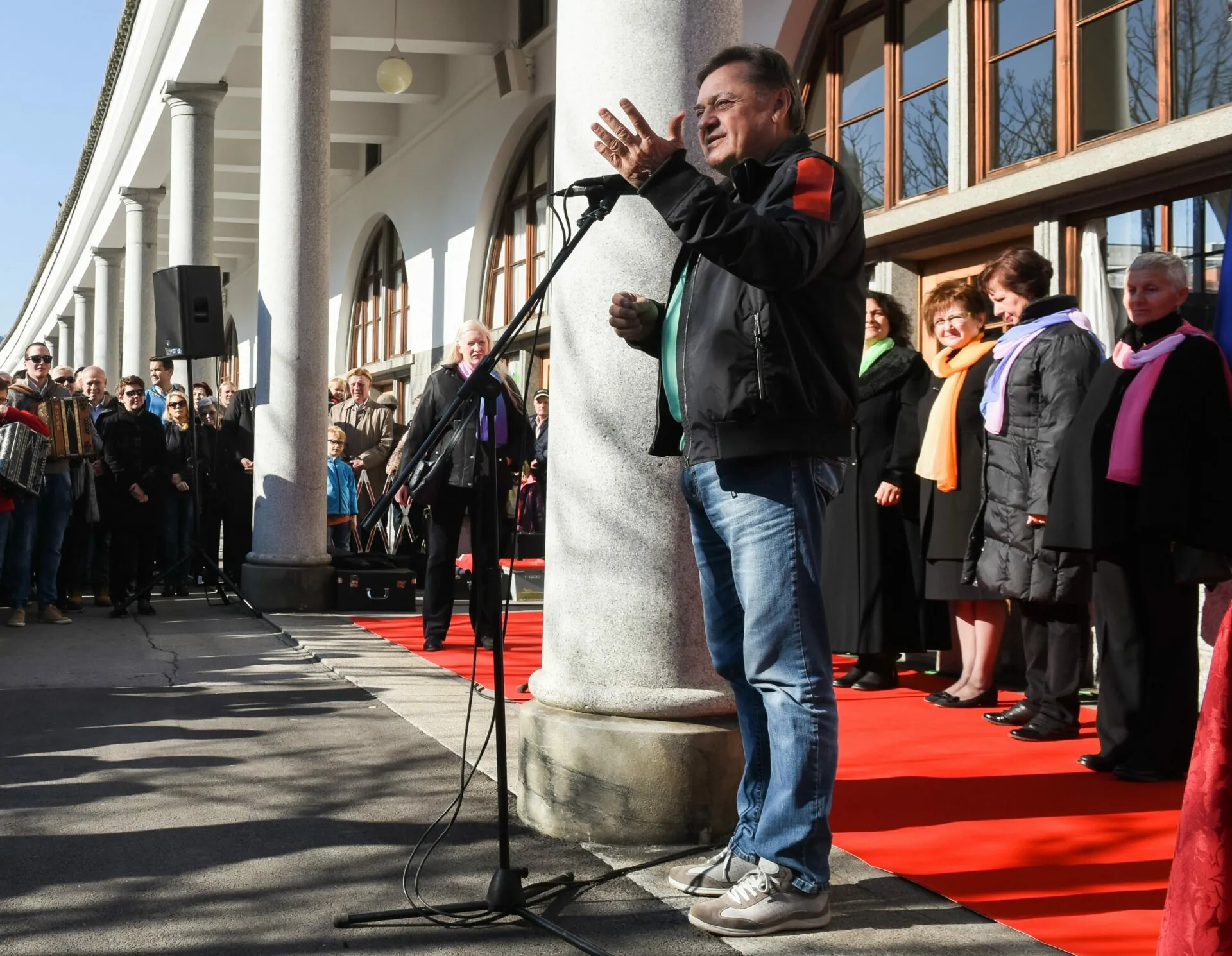
By: A. H. (Nova24tv)
Recently, news broke that the Ljubljana administrative unit has issued a building permit for the eighth and final section of the C0 canal, and another victory may soon be on the horizon for the mayor of Ljubljana. According to what we have learned, this could take the form of a building permit for the construction of a parking garage beneath Ljubljana’s central market.
Based on available information, it can be assumed that the Ministry of Natural Resources and Spatial Planning of the Republic of Slovenia (MNVP) will issue a building permit next week for the construction of a parking garage beneath Ljubljana’s central market. In doing so, it will disregard all objections raised by the civic initiative Tržnice ne damo (“We won’t give up the market”).
Initiative critical of the public hearing process
At the beginning of the month, specifically on September 4, the MNVP held a continuation of the public hearing, following a partial hearing that took place on June 10th of this year. According to the civic initiative, the proceedings violated numerous regulations, including international and EU directives, the Slovenian Constitution, and various national laws.
“At the first partial hearing, security guards at the entrance treated the investor’s representatives differently from the opposing parties, who had arrived well before the scheduled time. The investor’s employees and representatives, who came later, were immediately allowed into the meeting room on the third floor, even though the hearing was scheduled for the same time for everyone,” stated the initiative, represented by Marinka Kurilić. She added that this violated the principle of equal treatment and demonstrated bias on the part of the administrative authority. Both hearings, in June and September, were held in an MNVP meeting room that accommodates around 35 people. “Despite objections from opposing parties during the first hearing that such a small space cannot accommodate the public, which is required under Article 8 of the Aarhus Convention (to which Slovenia is a signatory), the Constitution, and the Access to Public Information Act,” they explained.
Representatives of the initiative believe the hearing should have been fully recorded, with an audio file attached to the minutes. This would objectively document what transpired and reflect the actual situation. “Instead, everything relies on individual testimonies,” they emphasised, adding that under the General Administrative Procedure Act, an audio recording is considered an annex to the minutes. They were also disturbed by the limited time each representative had to speak. The allotted time was effectively shortened because participants had to speak slowly for the stenographer. They argue that the ministry should have remained neutral during the hearing. According to the initiative, the moderator acted “in favour of the investor.” “Evidence of her bias is that her statements, threats, and other remarks were not recorded in the minutes,” they claimed.
They were further troubled by the lack of opportunity to confront differing opinions. “There was no exchange of views, as city officials, along with the project designer and Deputy Mayor Rok Žnidaršič, left the room immediately after their presentation and did not even listen to independent experts,” they stressed. They added that the minutes were incomplete and did not reflect the actual proceedings. “To be credible, the minutes should include all statements, including those of officials and the moderator,” they said. “Both sets of minutes, June 10 and September 4, state that they were read aloud. That is a lie,” they asserted.
On August 4 of this year, the Tržnice ne damo initiative informed Lazar Eloundou Assomo, head of UNESCO’s World Heritage Centre, of irregularities that could endanger Plečnik’s market, which is part of the world cultural heritage. A copy of the letter was also sent to Mr. Gašper Hrastelj at the Ministry of Higher Education, Science and Innovation, but no response was received.
A large portion of Ljubljana’s citizens, united in the civic initiative, have strongly opposed the construction of an underground garage at this site since 2007. The highest Slovenian scientific institution, the Council of the Slovenian Academy of Sciences and Arts (SAZU), which deals with culture and national identity, expressed its opposition in 2009. The academic community, including ethnologists, historians, art historians, and archaeologists, has also voiced strong objections, as have many architects and urban planners. “Due to past negative experiences, the geological composition of the soil, groundwater, runoff from Castle Hill, and the depth of the proposed construction, which would extend below the level of the city river, the project is technologically extremely demanding and risky, with unpredictable consequences,” the initiative warned.
Despite these concerns, information suggests that Mayor Janković may soon see his wish fulfilled regarding the parking garage project beneath Ljubljana’s market. Since the Ljubljana Administrative Unit recently issued a building permit for the eighth and final section of the C0 canal – 128 meters near the Stožice racetrack, completing the missing link in the controversial 12.1-kilometer project that threatens drinking water – many are now questioning whether the government is trying to reward the mayor for his support. This could also help the Freedom Movement secure continued backing in the upcoming parliamentary elections.