

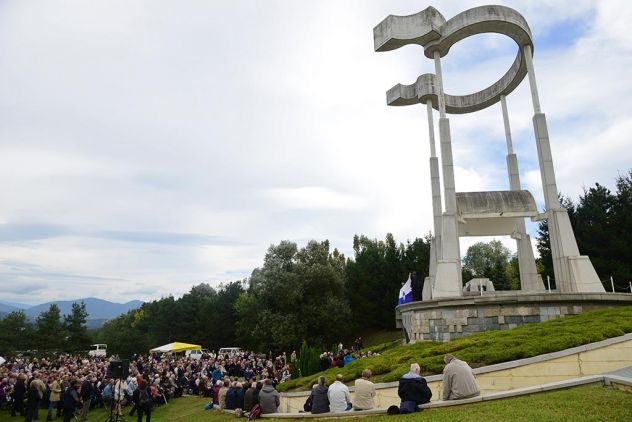
By: STA
At today’s memorial ceremony at Teharje, Bishop of Celje Maksimilijan Matjaž emphasised that reconciliation cannot be built on forgetting, but rather on truth, the acknowledgment of injustices, and efforts to remedy them. According to him, the memory of Teharje must not become a source of new hatred, nor should it serve as a reason to remain silent about past crimes.
The bishop said that Teharje is a place of great suffering, where people were humiliated, tortured, stripped of their dignity, and either killed or taken away to their deaths. According to him, the victims have the right to a name, to remembrance, and to a grave, while it is the duty of the living to restore their human dignity.
In his homily, he emphasised that forgiveness does not mean ceasing to call evil by its name. Nor, in his view, does reconciliation mean placing the victim and the perpetrator on the same level and forgetting the past. “Reconciliation is not born of equivalence, but of truth,” he said. According to the bishop, genuine reconciliation requires truth, acknowledgment of injustice, the correction of wrongs, and restitution.
While remembering the victims of Teharje, the bishop stressed that violence can take a person’s life, but it cannot take away their dignity. At the same time, he cautioned against romanticising suffering, insisting that a crime remains a crime.
The bishop also stated that history should not become a space for classifying people as being on the “right” or “wrong” side, but rather a space of responsibility. In this context, he cited the thought of academic Jožef Muhovič, who argues that reconciliation requires the rejection of falsehoods and concealed crimes, as well as the acknowledgment of a shared history, even when that history is horrific.
Philosopher Jan Peršič, speaking at the ceremony, emphasised that the consequences of the events that followed the Second World War extend into the present day and that, for this reason, these events cannot simply be ignored or no longer discussed.
He recalled events in Celje and its surroundings from mid-May 1945 onward, as well as the camp at Teharje, where Kočevje Germans, Slovenian civilians, and later soldiers of the Slovenian National Army and their family members were detained. According to Peršič, many were killed, initially near Teharje and later in locations such as Barbara Pit, Stari Hrastnik, and elsewhere. He also referred to violence, humiliation, and the torture of prisoners within the camp.
According to Peršič, the objective of the authorities was to eliminate potential opponents of the new regime, with members of security and military structures participating in the process. He cited testimonies and writings by former communist officials that, in his view, indicate that the killings were motivated not primarily by revenge but by efforts to consolidate the revolution.
As positive developments in recent years, Peršič highlighted the burial of human remains recovered from the mass grave below Macesnova Gorica and the registration of the victims’ deaths in the civil registry. He also warned that society should remain alert to new forms of ideological and political violence.
After the end of the Second World War, the site of the former German training centre at Teharje was used as a temporary camp for captured members of the Home Guard, soldiers, civilians, women, and children whom Allied forces had stopped in Carinthia together with refugees and escapees from Croatia and Serbia before handing them over to the new partisan authorities.
Most of them were killed without trial, some near the camp at Bukovžlak or in the wider Celje area, while many others were taken to their deaths in Huda Jama near Laško or in the mining shafts of Hrastnik and Pečovnik.
A memorial park was opened on the site of the former camp in 2004, although the project has not yet been fully completed.


