

By: Vida Kocjan
The reorganisation of the Ministry of the Environment and Spatial Planning, in addition to a 36.8% reduction in the number of organisational units and a 50% reduction in the number of directorates, also brought a significant rationalisation of the leadership structure. The number of ministers decreased from three to one, the number of state secretaries from seven to three, and the number of directorate directors from six to three.
Financially, this means savings of €1,211,952 per year solely in the salaries of the leadership staff. The new leadership has taken over significantly more employees – 102 more than in 2022 (from 437 to 538, or an increase of 23.11%). By 15 June, only 17 percent of the planned EU funds for the current budget year had been drawn.
The review shows approximately €8.5 million in potential savings or surpluses in individual budget lines. At the same time, additional needs amounting to approximately €19.9 million were identified, mainly for the restoration of municipal infrastructure after natural disasters and for the beginning of the closure of the Velenje Coal Mine. The net estimated gap therefore amounts to approximately €11.6 million.
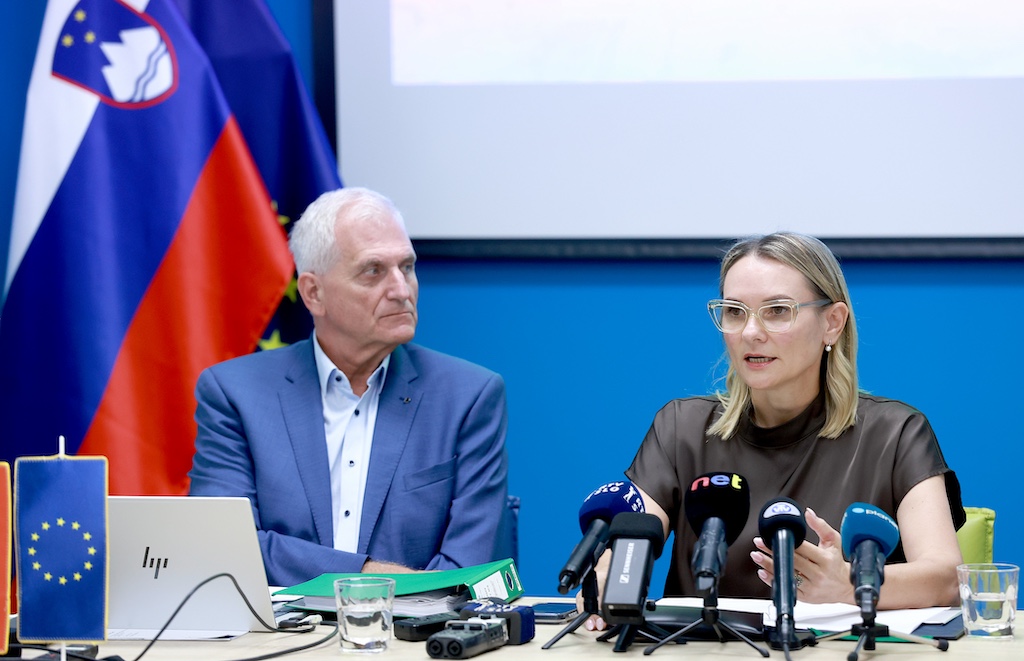
The Minister of the Environment and Spatial Planning, Polona Rifelj, together with the acting director of the Slovenian Water Agency, Roman Kramer, presented last week the first comprehensive overview of the organisational, financial, staffing, and project situation at the ministry at the start of the term, as well as a review of the implementation of projects from the Recovery and Resilience Plan in the field of water management.
Upon taking office, the new leadership took over a unified Ministry of the Environment and Spatial Planning (MOP), which combines the fields of environment, nature, climate, spatial planning, construction, housing, water, and post‑disaster reconstruction. These are substantively connected areas that directly affect people’s quality of life, the development of municipalities and the economy, and the safety of the country.
The first review revealed two things. On the one hand, the reorganisation has already reduced the number of organisational units and management levels, creating conditions for faster decision‑making. On the other hand, financial gaps were inherited, certain types of costs increased, the number of employees grew significantly, bottlenecks appeared in EU funding, and several demanding legal procedures were underway.
The reorganisation thus enabled the merging or unification of common services and the reduction of internal organisational units that performed comparable tasks. The achieved rationalisation is therefore not the result of reducing the scope of tasks, but primarily of eliminating duplication in the organisational structure and more efficient organisation of support processes.