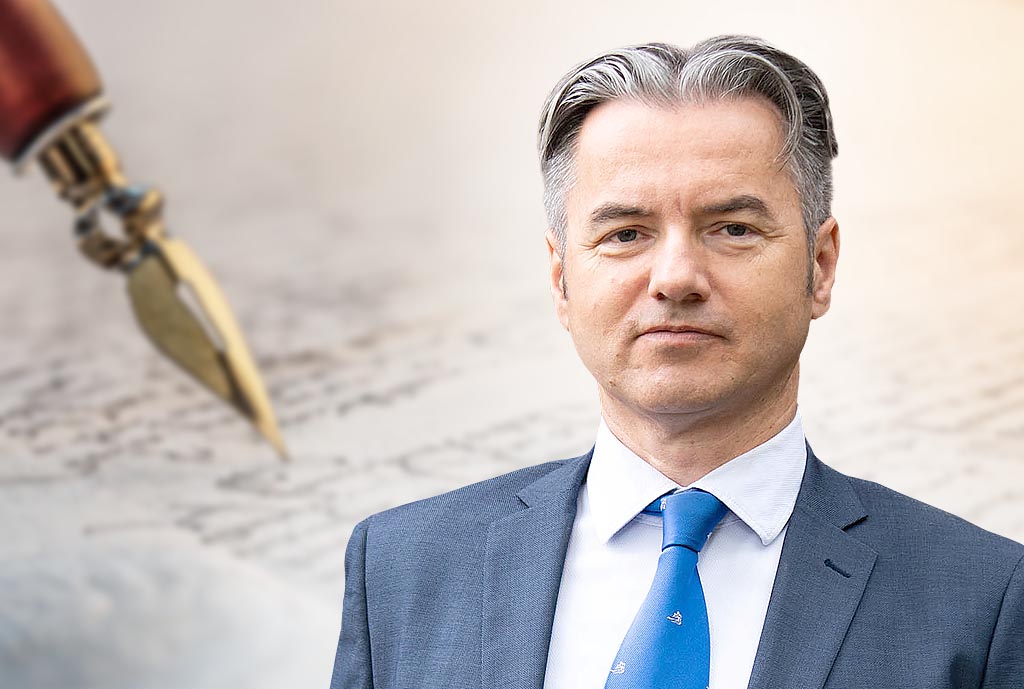
By: Dr Metod Berlec
At the end of June and beginning of July, Slovenians remember the most important events in our history, when we declared the independence and sovereignty of the Republic of Slovenia and defended it militarily. In 1991, during the War for Slovenia, we defeated the so-called Yugoslav People’s Army, the tool of the former communist regime, which, armed with tanks, aircraft, and lacking any democratic legitimacy, attempted to suppress the Slovenian people’s will to live in an independent and sovereign state. Military historian Dr Tomaž Kladnik writes in detail about this in several parts in the “Historical Memory” section of Demokracija. Persistence, courage, and unity were the weapons with which the Slovenian armed forces, under the leadership of Janez Janša, Igor Bavčar, and the Demos independence government, not only repelled the aggression but also paved the way for international recognition of the new European state.
In domestic politics, it is already becoming clear that we are entering the pre-election period. Political unrest is visible on both the ruling and opposition sides. One of the central roles is still being played by the last head of the Central Committee of the League of Communists of Slovenia (CK ZKS), Milan Kučan, who “just like in the old days, manipulates various party factions, which are now called political parties.” As Dr Peter Jambrek recently pointed out on the show Beremo on Nova24TV, we are witnessing “the collapse of the old regime, its decay, the loss of legitimacy, people are no longer afraid of it.” Sociologically speaking, according to him, a regime does not fall because it is too repressive, but because “the lid comes off” and people dare to say what they really think about it. Jambrek also highlighted something else. Kučan deliberately publicly distanced himself from Vladimir Prebilič, who “is as left-wing as Kordiš, if you just listen to him closely,” solely in order to place him more in the political centre, or even on the right. This would allow Prebilič to attract votes during the election that he could then deliver to the left.
That elections are near is also evident in the double game being played by the parties of the ruling coalition (GS, SD, and Levica) regarding Slovenia’s promises to the NATO alliance. Prime Minister Robert Golob pledged in The Hague that Slovenia would, like other NATO members, allocate 5 percent of GDP to defence by 2035. Now he and others claim that they are only committed to the defence resolution recently adopted by the National Assembly of the Republic of Slovenia, which foresees increasing defence spending to 2 percent of GDP this year and to 3 percent by 2030. Such a change in tune is not only a problem of credibility, but also a question of the strategic maturity of our country. The fact remains that our country is led by people who are not up to the historical moment, let alone capable of navigating major geopolitical shifts. Fortunately, just over three decades ago, we had leaders at the helm of the state who had a clear vision and were determined to seize the window of opportunity that opened with the collapse of communism, the breakup of Yugoslavia, and the fall of the Soviet Union.