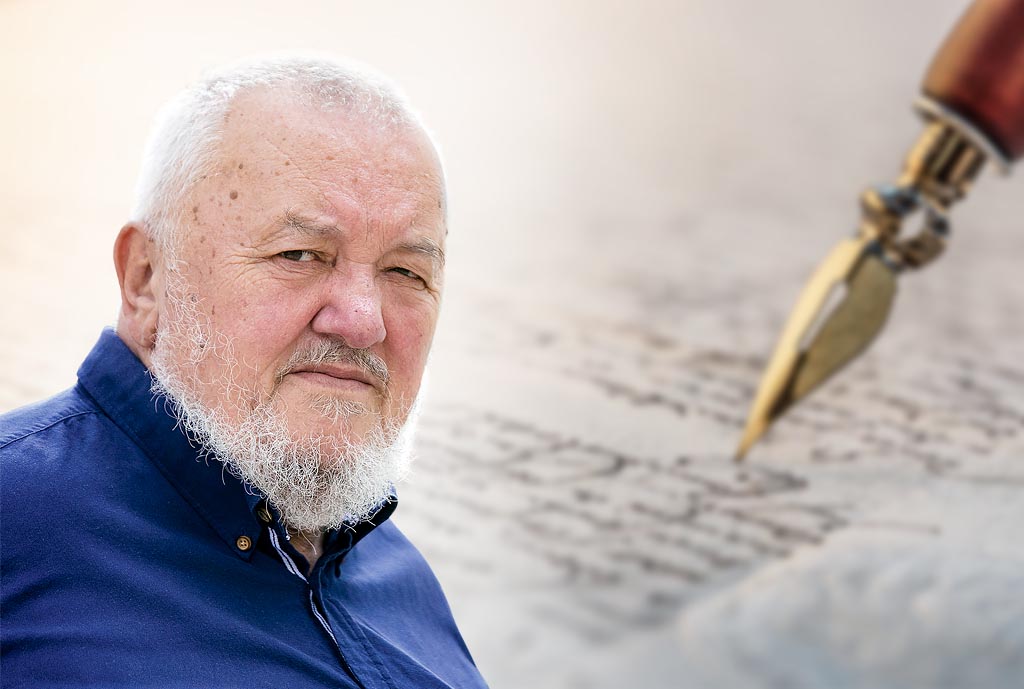
By: Dr Stane Granda
I claim the right to declare myself the most personally affected Slovenian, because the head of our parliament is a Serb, congratulated on his election by two Serbian leaders who are friends and allies (and much more) of Ljubljana’s “Mr. 10%.” And yet I remember that my dearest and oldest friend is a Croatian Serb, and a Pentecostal, on top of that. No one has ever helped me in life as much as he has. We have been friends for 70 years, and there has never been a shadow between us.
History is strange. We entered it with the help of the Frankish merchant Samo. But they first took away our internal autonomy, and around the year 830 our external autonomy as well. The Freising, today Munich, bishops gave us the Freising Manuscripts, the greatest and oldest proof of Slovene identity. Dalmatin’s Bible was paid for by those because of whom our ancestors sang: “Come together, come together, poor folk…” And so on.
The two people responsible for the greatest number of Slovene deaths were Tito, who was half Slovene, and Kardelj, a “pure Slovene” (unless he was of Roma origin, there is the well‑known Kardelly circus that operated in Žužemberk). And yet he is still an honorary member of the Slovenian Academy of Sciences and Arts, whose most prominent members deny the existence of Slovenes before the year 1800. They do not acknowledge the Slovene character of Carantania either. Kidrič was apparently partly Hungarian on his father’s side, a “fellow countryman” of the defeated Orbán. And yet no one did as much for the early history of Slovene identity as his father, who was half Hungarian.
The only good thing I have heard about Zoran Stevanović is that he is strongly Serbian in identity and an opponent of Yugoslavia, any kind of Yugoslavia. That he is not a pawn in Janković’s bag. Members of Golob’s coalition shout that Stevanović is a criminal.
The loudest are those who embody corruption themselves, those who wanted to use his help to form a “government of national unity” to protect and promote corruption. Who helped them now? RTV Slovenia is in an uproar, as if Stevanović had betrayed them. They praise Klakočar, who was a human, legal, and political disaster of the lowest order, to infinity. Why do they not appoint her director? Like attracts like. I will call him to account if he does not save us from paying the mandatory contribution for her. Before that, they must save the good parts of the institution and the technical staff. If POP TV can function without mandatory payments, then the national broadcaster should be a hundred times more capable of doing so. Or it will not. That would infinitely improve the news programme. Someone must finally put obsessed activists, like my fellow native from Novo mesto, where they belong, into the dustbin of history, alongside Kučan. I am amazed that those who still want to chant about (the misused) “brotherhood and unity” and “Comrade Tito, we swear to you that we will not stray from your path” are now against Stevanović.
Golob’s government was a catastrophe, one that would never have happened if we had remained faithful to the idea of independence. Those for whom an independent Slovenia was never an intimate option have turned democracy into “democratura.” It is no coincidence that Golob systematically persecuted the independence movement, declaring it criminal and treasonous. One would hardly expect such self‑accusation, such proof of an intentional continuation of corruption.
It is easy to make a fool of oneself. We face blood and tears. How will we fix the disastrous state of elderly care? And many other things that have gone wrong? There is no way back.
I am afraid of the future. But not because of Stevanović. Many “newly minted” leaders devote their primary political attention to tile‑layers and tire‑changers as the pinnacle of Slovenian entrepreneurship. Is that the Serb’s fault? Education as upbringing and the judiciary are the lungs of corruption. We need a swift and uncompromising reckoning with it. Eradication – or it will eradicate us. Let us hope the state’s first concern will not be comforting an unsuccessful constitutional judge and caring for his sailboat. In many ways we must return to the foundations of independence, or at least prepare the ground for them in the next elections. European and global circumstances demand a renewed understanding of the Slovenian state. We must not overlook that the first printed Slovene words were “stara prauda.” Slovenian politics is social, or it does not exist. Hayek‑style thinking is a shortcut to disaster. It is no coincidence that the unions have again chosen an old hand to channel and direct public dissatisfaction. Underestimating political opponents is a chronic illness of Slovenian politics.
Enough, one Golob was already too much. That is why any responsible government will first inform citizens about the “Israeli” affair. Because of it, we would soon have fallen into the Neolithic age of Svoboda.