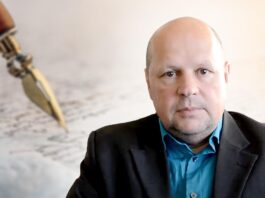
By: Dr Andreja Valič Zver
Dear readers, if you have visited Budapest, you have probably either seen or at least heard of the House of Terror (Hungarian: Terror Háza).
The former headquarters of the political police was transformed into a museum dedicated to the crimes of communist and fascist totalitarianism. It is not easily forgotten. After walking through its dark rooms and basement prison cells, one comes away deeply grateful for the blue sky overhead, the air one breathes, and the freedom to walk unrestrained through the streets of a great city. You become aware that you enjoy a freedom that Hungarians, and other nations living under the Soviet boot since the end of the Second World War, did not possess. The proud Hungarian nation, which swept into the plains of Europe from distant steppes in the early Middle Ages and inspired fear among the relatively small population of Europe at the time, faced many threats throughout its history. After converting to Christianity at the end of the tenth century, the Hungarians entered the sphere of Western European civilisation and thereafter defended it fiercely, especially during the era of Ottoman expansion into Christian Europe. In Slovenian national memory, King Matjaž occupies a place of honour, though he was in fact the Hungarian King Matthias Corvinus, the son of János Hunyadi, the fearless fighter against the Turks. Yet because Slovenian historical tradition blames János for the extinction of the Counts of Celje, our most powerful noble family, Slovenians remember the father much less fondly than the son. Nevertheless, thanks in no small part to the Hungarians, Islamic armies needed many more decades to advance through the Balkans and reach the gates of Vienna.
History is full of stories that teach us that the past repeats itself, usually in an even worse form. If we remain with the Hungarian example, the period spent within the Habsburg monarchy shows how strongly Hungarians sought greater autonomy, particularly during the nineteenth century. They eventually achieved this with the creation of Austria-Hungary in 1867. Nor should we forget the Revolutions of 1848, when the Slovenians and many other peoples experienced their own national awakening. The Hungarians were among the most determined and uncompromising participants. We should also remember the heroic Hungarian uprising against Soviet domination in 1956, and the controversial role played by Yugoslavia under Tito in the suppression of that revolt and the subsequent crackdown on the insurgents. The House of Terror preserves the memory of the human-rights violations committed during those difficult times and presents them in various forms to visitors from around the world, precisely so that such events should never happen again.
Today, however, the House of Terror is closed for what are officially described as “technical reasons,” assuming one believes the explanations of Hungary’s new authorities. Its director, Dr Mária Schmidt, who led the institution for twenty-three years, has been removed from her position. Some may argue that every government replaces certain personnel. Yet the author contends that we should raise our voices against a practice that destroys well-functioning institutions and drags them into a swamp of mediocrity and self-interest. Such conduct is simply not appropriate. Hungarians who have taken to the streets to protest these practices, carried out under the banner of the “rule of law” and the removal of Orbán’s supporters, have made this point very clearly.
I first met the former director of the House of Terror in 2008, when we began establishing the Platform of European Memory and Conscience in Prague. The determined Hungarian made a deep impression on me. In fact, the platform would almost certainly have failed without Hungarian support, because institutions in Brussels tend to turn away when confronted with the crimes of totalitarianism, especially communism. They do, however, show greater interest in Soviet studies and the study of Yugoslavism. To be fair, Poland, Hungary, and the Czech Republic are the three countries that most actively carry the banner of remembrance for the victims of communism. For that reason, any interference in the delicate fabric of memory, truth, and justice is risky and ultimately harmful.
Hungary’s new government has placed itself on the wrong side of history, where it has been joined by a former Slovenian prime minister who abolished the Museum of Slovenian Independence and effectively neutralised another institution, the Study Centre for National Reconciliation. Today, the centre deals with almost everything except the issues for which it was originally established. One wonders what its intellectual founder, Dr Lovro Šturm, would think of this situation. In short, an institution can also be destroyed by removing its leadership and changing its narrative.