

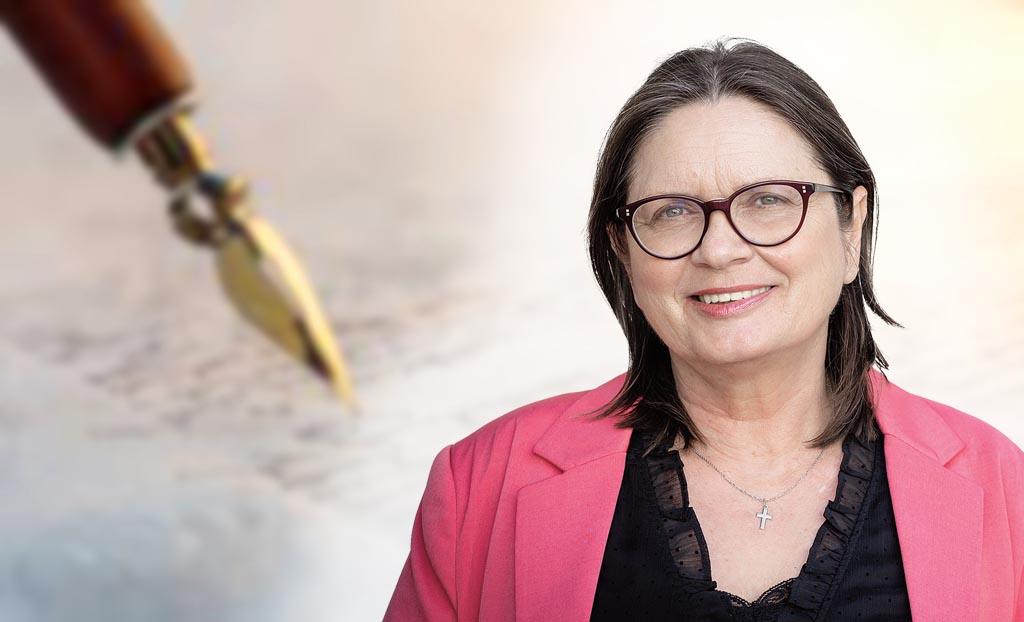
By: Dr Andreja Valič Zver
Janez Janša has become the Prime Minister of Slovenia for the fourth time. He first entered the political history of the Slovenian nation as the victorious Minister of Defence – a key figure of independence – in the war for Slovenia. Many expected that, because of this, he would already in the 1990s become the first among ministers. But all of us who remember the post‑Depala vas circumstances know why this was not possible. Yet he persisted, building his party step by step, and today, more than three decades later, we can say that he has built a solid pillar that “holds up” Slovenia within the family of democratic states. We cannot say that the transition to normality has been completely successful; however, it is difficult to imagine a democratic Slovenia without Janša’s SDS.
Hard times are behind the prime minister, and hard times lie ahead. Surviving the last weeks was like climbing Mount Everest, a sea of uncertainty that he clearly navigated skilfully. In light of this extraordinary effort, let me recall an article by Dr Jože Pučnik from October 2000 in the magazine Ampak, titled United in Disunity. In the piece, he not only analyses the moment of the time but also offers a perceptive reflection on the first decade of the transition. The author notes that in Slovenia there were no structural changes, no substantive changes; here and there only the language changed: “With this we established verbal lies, verbal frauds, and verbal bridge‑building, in which white is black and black is white …”
Today, when the tools of brainwashing are even more effective, things are not much different. At times, the left is even assisted by foreign actors in maintaining the system of lies and deception, with the blessing of Brussels institutions (the Jourova example). Control over the media is being established (the coup at RTVS), over the public sphere, traditional values are being neglected, cosmopolitanism is being promoted, and subsidiarity is being undermined at every step. I would very much like to hear Pučnik’s warning today, “We have had enough!”, and his call: “Let us modernise Slovenian society and the state!” How crystal‑clear was his analysis of the tricks of the former secret‑police networks, with which the continuity forces exploited the “bridge‑builders” in the first decade of Slovenia, only to mercilessly spit them out one by one.
Another point Pučnik raises, still relevant more than a quarter of a century later, is not only that “the granaries are empty,” but that various systems continue to operate in the old way, in no sense aligned with good governance. Such a disastrous state was inherited by Bajuk from Drnovšek, and nothing better awaits Janša after Golob.
And here is another gem from the same article: “Another realisation is that without principled conduct and a clear value orientation, it is impossible in the long run to pursue effective and successful politics. It is legitimate for parties to strive for power, but power cannot and must not be a goal and purpose in itself; it must be only a means through which they can and must assert their value orientation and pursue their strategic, i.e., long‑term goals: the normalisation of conditions in Slovenia, the modernisation of society and the state, and the increase of material and cultural well‑being for all citizens.” Particularly striking is his criticism of “value‑neutral politics” and bridge‑building, which supposedly eliminates differences. If we remove the value foundation of politics, then politics becomes merely a weapon for power. And if, through bridge‑building, we destroy freedom and pluralism – then this is cynical toward the autonomous individual.
This was a time when Pučnik was often critical of the anaemic and even mentally damaged citizen, who, sick from indoctrination, was unwilling to accept civic responsibility. Yet there are some promising changes compared to the 2000 elections. This year, turnout was higher, and there were more votes for the democratic bloc among young people. This gives hope that the centre‑right can repeat its mandate, because in just one term it will be difficult to normalise Slovenia in Pučnik’s sense of the word. Let us pray and work so that the fourth Janša government, and all of us who wish that “the skies finally clear for the Carniolans”, succeed!