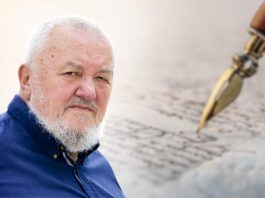
By: dr. Janez Juhant
August 23rd serves as a reminder, even if it is not acknowledged by the successors of the revolutionaries. But politicians must not trample on the constitutional foundations and are obliged to respect the principles of human dignity and justice. If they do not, they must be stripped of power at the elections.
Communism, which left devastation in hearts, culture, and civilisation, was, like fascism and Nazism, a criminal regime. The victims of wartime and postwar massacres are just as much victims as those of Srebrenica, Ukraine, Gaza, or elsewhere. Dictators seek to eliminate their opponents, do they not, you “proud successors” who oppress people with deceit and lies? The evasion in response to the demand of the EU and other democrats for a proper burial of the Home Guard and other opponents of communism, as well as for granting equality to their families and others affected in public and political life, cannot go on indefinitely. Slovenia is a democratic state, not the prey of privileged elites stemming from communism. Where, esteemed presidents and prime minister, amid your dedication to refugees, is your sense of responsibility for your own people, especially for the relatives of victims who cannot bury their loved ones? For politicians, respect for human dignity and rights is even more essential; otherwise, capable and loyal Slovenians will leave the country, while foreigners will take over and erase the nation because you do not care for your own.
In remembering the victims of communism, we cannot overlook Zdenko Roter. Not all condemned his activities in the UDBA, yet he was the chief interrogator of priests and Bishop Vovk. Witnesses attest that he was more refined than Mitja Ribičič, who was said to have physically trampled over Bishop Vovk during near-daily night interrogations. Roter’s wife once even reproached me for how “ungrateful” the Church was to her husband, “who did so much good for the Church.” What that was, I never learned. I once asked him about the remains of wartime victims murdered by communists – Ehrlich, Natlačen, and others – whose bodies were exhumed from Žale cemetery in January 1946 by German prisoners under party orders, then taken away to an unknown location.
Bishop Vovk once courageously declared in a sermon at the Holy Sepulchre that people had always respected graves, only at times had “hyenas desecrated them.” Roter feigned ignorance, claiming Ribičič knew more. Most likely, Milan Kučan does too. If he were to speak, he could break free from lies and reveal much about the brutal reality of the communist past he actively helped shape, an important step toward reconciliation for all. When Roter was decorated in 2002, I stated at a consultation with President Drnovšek, in the presence of Kučan and other influential figures, that it was difficult to speak of ethics if the president of a democratic state decorated a prominent UDBA member who committed violence against people. The room fell into deathly silence, and Drnovšek, leading the meeting, then began to speak rather uncertainly about the inappropriateness of my intervention, as can be seen on recordings. The late Danilo Slivnik wrote about this.
For the worshippers of communist dictators, instructive reading can be found in Dimitrij Želevski’s Island Without Mercy. The communists continued their wartime and postwar terror with trials of priests, Dachau inmates, and others, with camps and executions. In 1948, Tito, Ranković, Kardelj, and Đilas launched a massive crackdown on the Informbiro members, targeting over 3,500 military personnel and about 15,000 civilians: officials, officers, anti-occupation fighters, and public figures. Loyal communists were condemned to horrific torture and oppression on Goli Otok, St. Grgur, Gradiška, and Bileća – up to 20 years. Želevski himself was sentenced to 12 years, of which he served 5. The KPJ, through the Informbiro resolution, gained a “wonderful opportunity to settle accounts with all who disagreed with its policies”, including some who had participated in the postwar massacres of political opponents. Kardelj proposed, and the Central Committee with Tito at its head approved, Goli Otok and St. Grgur as suitable torture camps, isolated rocky islands of scorching sun and cold winds, impossible to escape. Selected tormentors, party mercenaries, themselves held under threat of punishment, were sent to abuse, break, and “re-educate” the prisoners. Some later committed suicide. Their task was to torment prisoners to the extreme.
Želevski explains how Tito’s regime exceeded the methods of Mussolini’s, Hitler’s camps, and Stalin’s gulags. The lists of names and detailed descriptions reveal the inhuman conditions of the prisoners, who were forced to break and carry stones in freezing cold and blazing sun, exposed to torture, humiliation, and indoctrination, mere numbers given at arrest. Yet despite hopelessness, most maintained solidarity, a human face, and hope, resisting the oppressive regime and their tormentors. Wives were mocked, some imprisoned, while children grew up without fathers. Želevski’s daughter was born while he was in prison. Visits were allowed only after years, and even then, restricted: his parents from Macedonia and his wife with his daughter from Kočevje once travelled to Bileća in vain. Upon release, he had to sign that he had spent the years farming but refused to sign cooperation with the UDBA. He concludes that “this century (the 20th) gave birth to three monsters: fascism, Stalinism, and Titoism…” but expresses hope that “youth will succeed where we failed, that democracy will prevail, that it will not have only one colour, and that young people will take great care to ensure that what happened to us will never happen again.”
August 23rd is therefore a remembrance and a warning to live a truly democratic life in truth and justice.