

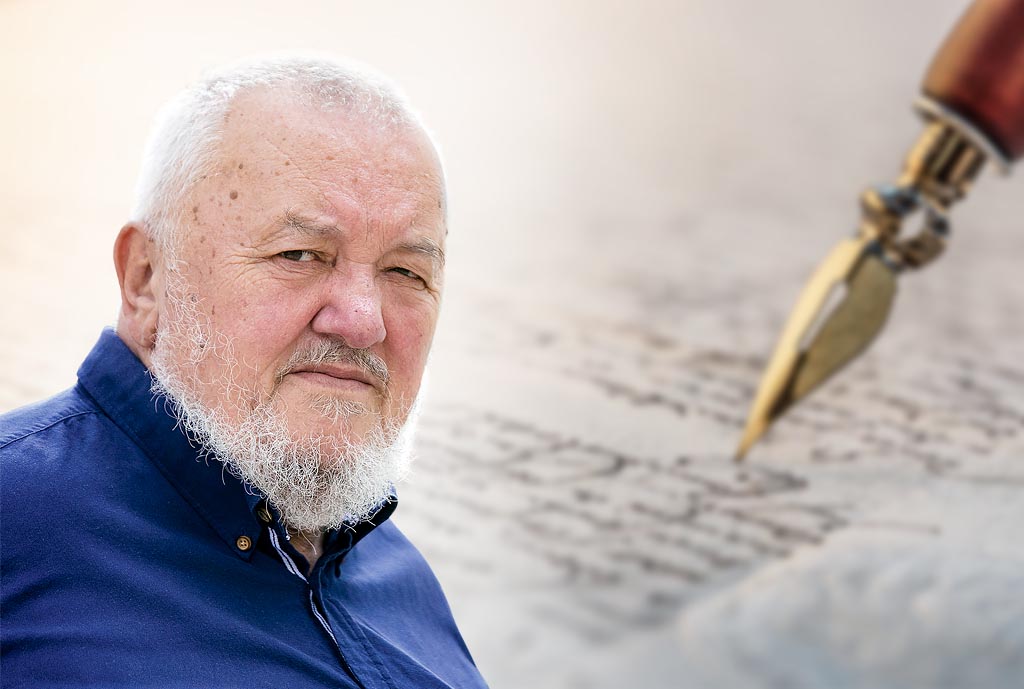
By: Dr Stane Granda
“…everyone has the right, and indeed the duty, to say what they think. In our parts, however, and especially nowadays, that is somewhat dangerous.” – Ivan Cankar, lecture Slovenians and Yugoslavs
I admit that I have never really understood the concept of the “deep state.” I cannot find a historical parallel for it. If it refers to the insatiability of the state, then I observe that the state can hardly be anything else. Parliamentary democracy was created in part to limit the demands of insatiable rulers. The source of those demands was luxury, often cloaked in culture. Some contemporary cultural figures engage in the same kind of abuse. Not artists of the calibre of Drago Jančar and others of his standing, whose artistic merit is beyond question, but self-proclaimed cultural geniuses and obscure figures who exploit and degrade culture. In just a few months, they are capable of spending sums comparable to the combined military budgets of the United States, Russia, and China. Drugs are expensive.
The intersection of “artistic” entrepreneurship, private and political culture, and political connections is vividly illustrated by the Fotopub affair, a symbol of the debauchery of part of the ruling establishment. The increasingly nervous reactions of Levica’s leaders whenever Fotopub is mentioned alongside them suggest that the background may be even more reprehensible than is publicly known. The meeting between a former Minister of Culture and my fellow citizen from Novo Mesto in Venice was clearly not a coincidence. Targeting an unfortunate individual who cultivated cannabis solely for health reasons and using that case politically to defend notorious drug users is deeply reprehensible. This characterised the government’s approach more broadly. They neglected the elderly and the sick, misused nursing homes, and targeted pensioners. Had the Ministry of Labour functioned properly, the case involving an MP from the Resni.ca party would never have arisen. The encouragement of Dolenjska Roma communities to oppose the state allegedly led not only to the murder of Šutar. Their role in drug trafficking is no secret. Does this explains Levica’s sensitivity toward them and whether responsibility will again fall on Andreja Katič or whether attention will finally turn to Luka Mesec. Can cocaine use serve as an excuse for criminal responsibility.
Drug users, like alcoholics, are unfortunate and vulnerable people. Well-organised states restrict and treat them in many ways. In Slovenia, and likely not uniquely, they appear instead to be governing the country. The demand for drug legalisation therefore seems like a logical consequence. Yet, the main problem is not the users but those who sustain the drug trade. Above them stand powerful drug cartels, which Slovenia has also had to confront. The Kavač clan is neither the first nor the only such organisation. These groups wield real power in many countries. Their power is not ideological but economic, and because they control addiction, it is absolute. Without a determined state and the support of broad sections of society, they are extremely difficult to defeat. They are also physically, organisationally, technically, and financially sophisticated, and almost always remain one step ahead of the police.
The government of Robert Golob has made falsehood a governing principle. To maintain itself in power, it has resorted to personal and political discrediting campaigns. The Black Cube affair focused on tarnishing the reputation of an alleged organiser rather than addressing theft and corruption, the root causes of Slovenia’s difficult social conditions. The affair also fostered a previously uncommon anti-Zionism in Slovenia, complemented by anti-Christian sentiment and mockery of post-war massacres.
Lies form the moral foundation of theft and corruption. Both are often inseparable components of governance. The Gen-I affair demonstrates this clearly. The government even prevented the establishment of an appropriate parliamentary commission to investigate the matter. Corruption is allegedly being normalised and embedded into public life. Slovenia is becoming “more Balkan than the Balkans themselves.” The Mayor of Ljubljana is directing and managing “Balkan-style” business dealings and is maintaining ties with individuals who deny the Srebrenica genocide and glorify Ratko Mladić. Milan Kučan is his political patron. Yugonostalgia has become intertwined with theft and corruption and has remained a central source of Slovenia’s moral and political problems since independence.
Despite its shortcomings and imperfections, the current government is the only source of a solution. Therefore, voters should support it in the referendums: Unconditionally! Four times YES! Otherwise, it will not only be “goodbye, Switzerland,” but goodbye to the Slovenian state as well. How far we have fallen?