

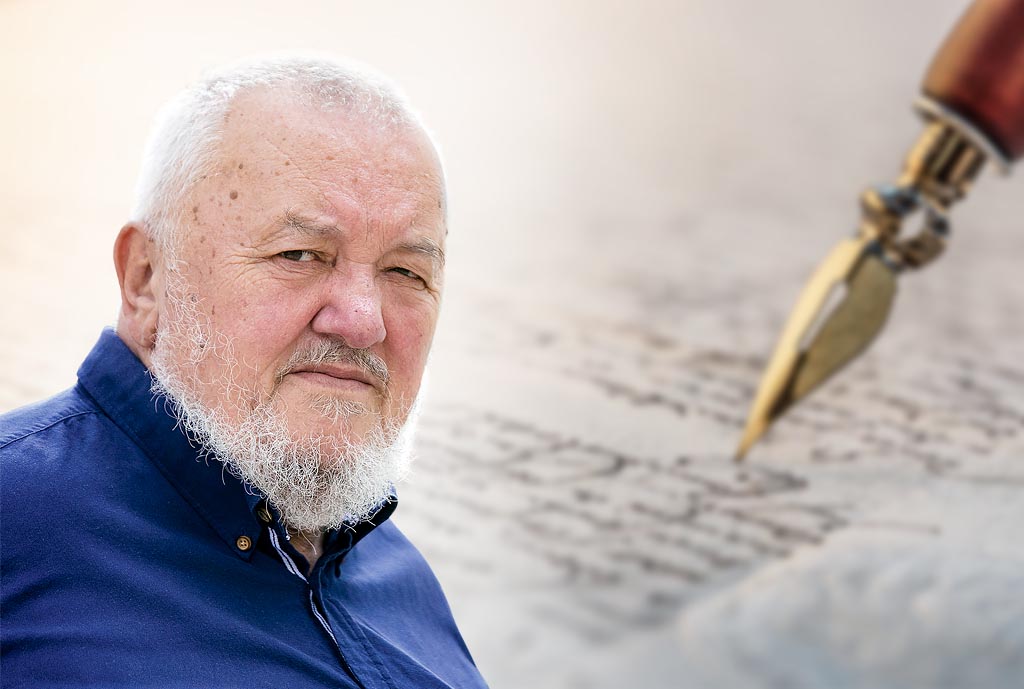
By: Dr Stane Granda
On anniversaries – and the 35th already surpasses Christ’s years – Slovenian intellectuals traditionally wrote a dedication, preferably in verse. Since I have not the slightest talent for that, I will not even try. I can only write that I am infinitely happy and proud that from the very first day – nothing heroic about it – I actively participated in the war for Slovenia. Therefore, I have the right to add a drop of champagne to the birthday cake.
The number of votes for Slovenian independence in December 1990 never impressed me. It was unrealistic, unhealthy, undemocratic. It smelled of Milošević’s politics. Of course, that politics was not present. But those who never considered an independent, internationally recognised Slovenian state an “intimate option” certainly were. They voted for it because they had no other choice if they wanted to survive politically. Given the fact that they had known about the imminent European end of communism for more than a decade (the news was supposedly brought from a meeting of former prime ministers by Mitja Ribičič) and had systematically prepared for it, the tycoons from the ranks of the former security apparatus and their associates were no longer bothered by the existence of the state as such. What bothered them more was democracy, which threatened their nearly half‑century‑long privileges guaranteed by the secret political police. The communists held external and internal material and economic power, whose greed exceeded the capacities of the state and its economy. This is also why the economy in all communist countries was permanently unsuccessful, and no reform could save it. Crisis after crisis – this is the permanent law of Bolshevik economics.
We now have Janša’s fourth and Slovenia’s sixth democratic government. Drnovšek was a conscious part of the previous political system. His closest associates confirmed this. His tensions with Kučan were more the result of his absolute desire for power than anything substantial. That is why Kučan never repeated the mistake after him. Pahor slipped from his control and paid for it dearly. Not only him, the entire United List, which has since been a political and governmental caricature of itself. Kučan was at the forefront of the wild privatisation and everything connected to it. For him, this was the “national interest”, which he manipulated masterfully. He never condemned the plundering of former state property. Janković and Pirc Musar demonstrate that he remains today at the head of the financial oligarchy, whose dominance is characteristic of practically all former communist states.
Action must be taken immediately! The road to hell is paved with good intentions!
Despite the incredible theft of former state property, its systematic destruction, and the transfer of billions of dollars to tax havens, Slovenia’s independence succeeded economically. This is not a success story, but a story of survival. In this area, there is no way back. A different and better path must be taken, one that will bring the alienated wealth back home.
For Slovenia’s future, the economy is not the key factor. Its overemphasis is a legacy of Marxism. The economy is driven by international forces, and individual countries merely adapt to it with varying degrees of success. What is crucial are Slovenian minds, the attitude of citizens toward their own state. And that attitude is in dire condition. This is due to the neglect of civic education and the underestimation of the importance of primary and secondary schooling. This is where patriots are formed. As demonstrated by the cyclists of Golob’s government and by Golob himself, these people were mostly educated during the era of independent Slovenia. The teachers’ union secured salaries for teachers that they had never had before in Slovenian history. They are not too high, if anything, the opposite, but for them teachers can thank only Štrukelj. That is why they follow him and his line in education. They disregard the Ministry of Education, which has the biggest problem with itself. Slovenia stands or falls with the youth and their political formation. The problem is the school system as such, and the main source of difficulties are subjects related to national identity. Due to the curricula – not the textbooks, which must be absolutely subordinate to them – these subjects raise Slovenian youth in the spirit of an almost century‑long civil war and unconditional veneration of killers and killing sites. The recent threat by the “Primorska rebels” to register participants of the reconciliation ceremony in Rog in order to repeat the massacre against them is not the rambling of a sick mind. It is the result of those who go to bow before the monument of Boris Kidrič. And where is this individual? Allegedly at the Ministry of Education.
Can Janša’s fourth government be the path toward a new Slovenian future? Action must be taken immediately! The road to hell is paved with good intentions!