

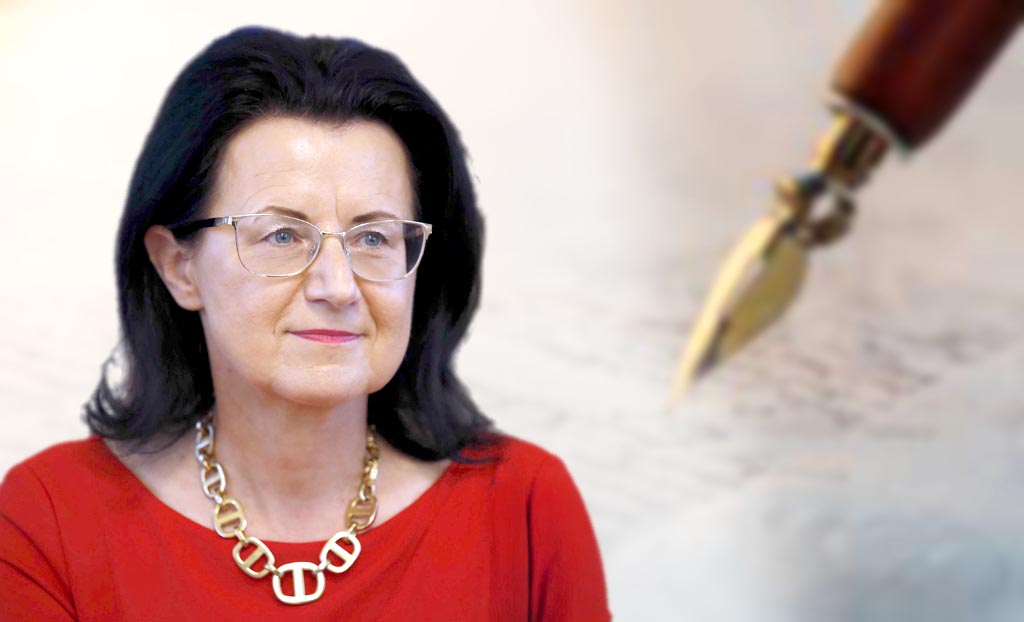
By: Prof. Dr. Verica Trstenjak
In the modern era, the rule of law is the measure of whether a state is truly contemporary, whether it respects fundamental civilisational norms and enables the democratic development of individuals, businesses, and society. The rule of law is like air and water for all of us, as Radbruch already warned.
For some time now, we have been observing that Slovenia is far removed from this ideal. I have lived abroad for more than 20 years. When you live abroad, your love for your homeland grows, but your attitude toward the state and its apparatus, including politics, becomes more objective. Your level of criticism depends not only on the view from within, but also on the view from outside and on comparisons with other democracies. When foreigners increasingly ask you what is happening to democracy in your country, Slovenia, whether we really want to return to socialism and Yugoslavia, how it is possible that we fail to appoint our representatives to certain EU institutions, what is going on with the economy, which is facing ever new and unexpected burdens, then it becomes necessary to point out that the Slovenian ship is unfortunately sailing in the wrong direction.
Let me highlight some of the main elements that, in recent years, have pushed Slovenia into the company of states that evoke not praise, but astonishment, ridicule, and criticism. And I am not speaking about the homeland itself, nor about the natural beauty of Slovenia, which foreigners admire and praise, beauty that belongs to no government and is not the achievement of any ruling political class. I am speaking about the attitude toward state institutions, toward the economy, and toward democratic institutions.
Attitude toward state institutions
A state without legally formal and functioning institutions is not a state governed by the rule of law. First, let me mention that human rights are the foundation of the rule of law. The Human Rights Ombudsman is a fundamental guarantee of these rights, something without which modern states do not exist. Allowing the state to function for an entire year without an ombudsman reflects the governing politics’ attitude toward human rights.
Another key state‑building institution is the Bank of Slovenia. It was one of the crucial pillars in building the new state, and today it plays an important role within the system of central banks and the European Central Bank. How can a country function for a year without a governor of its central bank? Who leads the Bank of Slovenia and represents it with decision‑making authority at ECB meetings in Frankfurt? No one.
The task of the president of the republic is to carry out constitutional state duties, to ensure that state institutions function legally and formally, and to enable this within the president’s constitutional powers. The constitutional duty of the president is not to attend local events, sports competitions, concerts, and so on. Being likeable is one thing; being responsible to citizens, to the state, to the homeland, to the EU, and to the international community is another. Madam President, your duty is to perform your constitutional responsibilities. The president is not a local politician posing for photos with local dignitaries. That may be important, but it is only a supplement to constitutional duties. If there are no legal sanctions for failing to perform these duties, political ones are still possible, they are called resignation. Of course, part of the responsibility also lies with MPs who reject presidential proposals. I do not claim that the constitutional arrangement is perfect, but it is valid, and constitutional powers must be respected. The president cannot have decision‑making authority if the constitution grants only the power to propose.
And then there is the legal pinnacle, the Constitutional Court, which should be an institution of respect, trust, and legal certainty. The chaos you are causing, Madam President, regarding the Constitutional Court and its candidates, is no longer tolerable. You juggle people, legal experts, as if they were bowling pins. Who will still be willing to step forward if you treat legal professionals with such humiliation? It is not that MPs reject them, you diminish all applicants yourself. Do you ever speak with law students, not as a politician but as a person? Where do they see their future? Important legal positions are losing their appeal, and more importantly, they are losing respect. I write this because I am independent of Slovenian appointments and uninterested in positions. I want the reputation of institutions restored so that the best candidates apply. I often criticised former President Pahor, out of idealism, because I see how other democracies and well‑functioning legal states operate. Sadly, the situation is now even worse.
Another example of disrespect for state institutions is the treatment of the Anti‑Corruption Commission. Politicians are obliged to respect state institutions, otherwise, we do not need them. The fight against corruption is not only a prerequisite for belonging to the community of modern democratic states; it is a fundamental element of the rule of law and essential for a successful economy. If the Anti‑Corruption Commission finds irregularities within its mandate, the sanction is political: resignation. That is why, alongside legal responsibility (fines, prison), political responsibility exists. In other countries, resignations occur over far smaller matters. Why did German President Wulff resign? And resignations are usually demanded by members of one’s own political camp, fearing electoral loss. A similar case occurred recently with Mahrer in Austria.
So, politicians, be statesmen, not politicians who think only of the next election. Take political responsibility. Think of your children and grandchildren. Do you truly want them to live in a country that sees Venezuela as an ideal? Be unifying, not exclusionary. Cooperate on the basis of programmes. Ensure that Slovenia becomes a model state in upholding the rule of law and modern democratic values in practice.
Who can change the direction? Voters. But also the media, which play a key role by being objective, realistic, and fair. Even the possible publication of this contribution in your outlet is part of that responsibility.
Vienna, 1 February 2026
Note: Publication (in written form) is permitted only in full, as an opinion piece (not as a letter to the editor).