

By: I. K. (Nova24TV.si)
For the far‑left NGOs and guild‑type associations (such as taxi drivers), Robert Golob’s government was a true Eldorado. Their two years of cycling through Ljubljana and chasing phantom fascists were not in vain. The government richly rewarded them with taxpayers’ money. Now the feast is slowly coming to an end, and panic is spreading among the fellow‑travellers of the left‑wing political parties – if they fail (as in 2022) to once again push the Freedom Movement and the two far‑left institutional parties (SD and Levica) through the parliamentary and coalition filter, a harsh winter awaits them. No more free inflow of taxpayers’ money, no more generous public tenders, and no more access to nepotistically obtained jobs in the countless offices of government ministries.
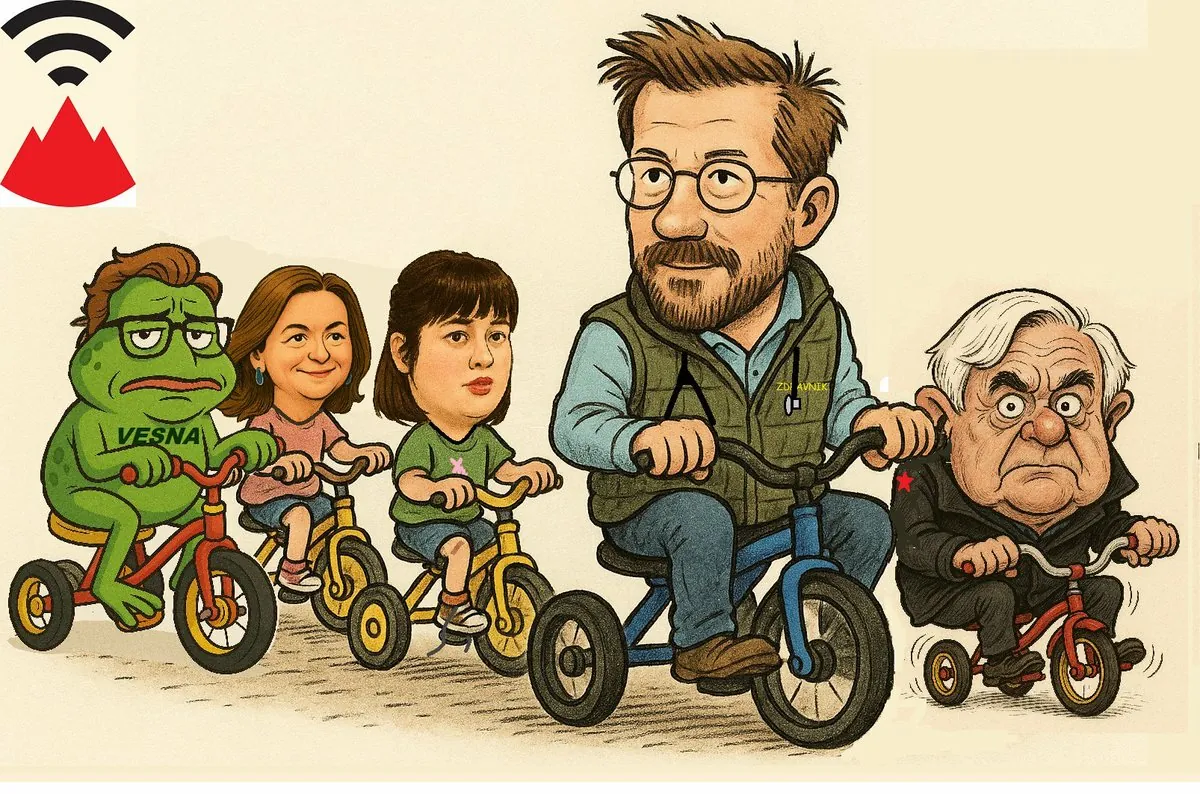
This is why they began mobilising months before the elections, and with the new year the fever is only intensifying. Director Jaša Jenull, the son of prosecutor Hinko Jenull, a man no one had heard of before the coronavirus pandemic, spent the government’s term mostly attacking doctors, advocating for centrally planned state healthcare, and holding friendly meetings with Prime Minister Golob, whom he himself helped bring to power. Now the Friday political cyclists, backed strongly by the corporate media machinery, will once again start spinning the pedals of their high‑end bicycles.
They quickly forgot the protests against the Šutar law
Opposition leader Janez Janša, reacting to photos of Jenull once again on a bicycle – as if we were back in the hysterical pandemic year of 2020 – asked ironically: “Does anyone miss the stolen women’s bike?” Interestingly, Jenull really is on a women’s bicycle, which means it is probably not his; even if it belongs to his girlfriend, it suggests that it is merely a prop meant to conjure up some old magic that can no longer be revived.
Let us recall: just a few weeks ago, before the adoption of the Šutar law, Jenull was criticising MPs, claiming they were passing a repressive and unconstitutional law, yet he was extremely careful not to mention any of the ruling parties. His message was directed exclusively at “politics” in general. Naturally, immediately after the law was passed, they forgot about the “noble” goal of striving for complete anarchy. In 2026, they will be cycling entirely in the service of the current government, the very one that has made all of us poorer (on average by more than 2,500 euros per person). They themselves, of course, are not any poorer.
Stolen bicycle, stolen taxpayers’ money?
It is important to emphasise that Janša’s question – although witty and mocking – contains a grain of truth. Since 2022, NGOs have carried out a veritable plundering of the state budget and contributed to a budget deficit that even Slovenia’s highly agile economy cannot compensate for.
Let us recall: practically all far‑left NGOs saw their revenues explode during Robert Golob’s government. How could they not, when the former interior minister Boštjan Poklukar described them as “partners in shaping the policies of the Ministry of the Interior; thanks to these meetings we are even better and more effective in our work.” It is therefore no surprise that ever since the formation of Golob’s government, we have been witnessing scenes in which the highest representatives of the authorities meet with NGO activists who helped bring them to power. Nika Kovač met with Prime Minister Robert Golob and the President of the National Assembly, Urška Klakočar Zupančič; Jenull, together with Tea Jarc, met with Golob, and last year also with Interior Minister Poklukar.
Non‑governmental organisations (NGOs) generated an astonishing €1,400,000,000 in revenue in 2024. This continues the growth trend of previous years, as the sector’s revenues have been rising since 2022 after the drop in 2020.
NGO revenues increased by approximately 6.78% in 2024 compared to 2023, while public funding for NGOs has been steadily rising during Golob’s government: €507.9 million in 2021, €539.3 million in 2022, €617.3 million in 2023, and already €648.1 million in direct revenue in 2024 (not including school‑related programmes and similar activities).
A clear increase in public funds received by NGOs is evident. From 2021 to 2024, NGOs recorded a revenue increase of €140 million, or 28% compared to 2021. The jump in the first two years of Golob’s government alone amounted to €78 million.
So far, these particular left‑leaning NGOs have already received nearly €40 million. Here are some of the recipients: Policy Lab (€346,535.95), Zavod Povod (€201,462.11), the Institute Danes je nov dan (€468,289.82), Umanotera (€1,843,084.10), the Slovenian Association of Friends of Youth (€4,201,804.78), the Forum for Equal Development (€1,714,181.38), the NGO network Varujemo naše zdravje at the Slovenian Public Health, Environment and Tobacco Control Association (€1,069,024.17), Zavod Krog (€1,803,397.80), the publishing, cultural and production institute Maska (€2,730,919.17), the Educational‑Rescue Institute Celje (€2,332.24), Zavod Knof (€1,336,461.57), the Institute for Climate Solutions, the homeless support association Kralji ulice (€8,504,987.98), Zavod Bunker Ljubljana (€4,573,741.25), IPak – Institute for Symbolic Analysis and Development of Information Technologies (€258,980.80), the Peace Institute (€6,224,851.63), Zavod Emanat (€1,794,290.48), the cultural association Gmajna (€199,720.96), the association Est=etika (€66,640.54), the Slovenian Third Age University (€552,697.05), and Zavod Dobra družba (€904,167.92).
Cycling is a business that pays off
A look at the numbers makes it quickly clear that the March “anyone‑but‑Janša” political cycling protest, already dusting off bicycles in January, will take place for one reason only: because it pays. Being a supporter and fellow‑traveller of institutional left‑wing political parties has become a kind of industry for social‑science graduates who are otherwise difficult to employ in the public sector. Politics opens the door for them to a practically bottomless bag of taxpayers’ money – something they could only dream of in the private sector, or even within the public administration itself.
The Ljubljana far‑left is, in reality, extremely enterprising, one could even say downright capitalist. They understand what the means of production are, what the product is, and who reaps the fruits of that product. In this case, the means of production is left‑wing agitprop in support of left‑wing political parties, and the product is us – or rather, our wallets. They have become a small Kučan‑style agitprop Komsomol army, which the parallel mechanism of the corporatist deep state will apparently use from now on in every election. It is, however, clear that they will never again be as effective as they were in 2022. Many people have since realised their mistake.