

By: Vida Kocjan
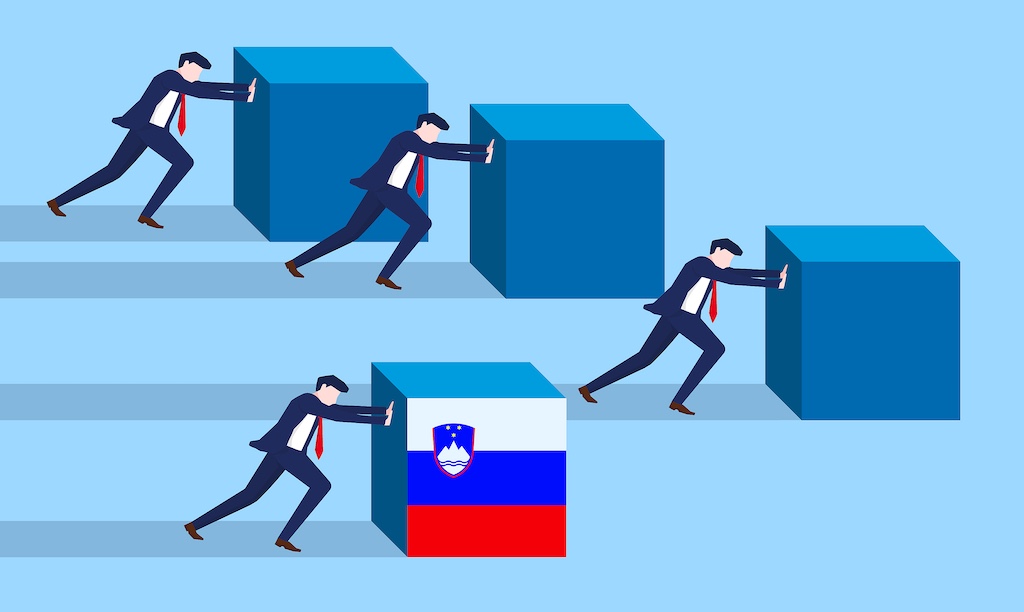
Slovenia has reached its lowest position on the competitiveness ranking in the past five years. In response, business leaders gathered in the Economic Circle are warning that without progress, Slovenia “will fall even further next year.” Representatives of the business sector reacted a day after Robert Golob misled the National Assembly by claiming how well Slovenia is doing under his leadership.
The European Commission already downgraded Slovenia’s economic growth forecast for this year in May, from 2.5% to 2.0%, and just days ago, the Bank of Slovenia lowered it further from 2.2% to 1.3%. On the competitiveness ranking published last week by the Swiss IMD Institute, Slovenia maintained its 46th place from last year. However, this is the country’s lowest ranking in the past five years.
Warnings from the business sector
Representatives of the Economic Circle, which brings together 17 business organisations, are emphasising the urgent need for measures to boost innovation, accelerate digital and green transitions, reduce the tax burden on labour, eliminate bureaucratic barriers, and improve the management of public services. Key priorities also include reviving the capital market, attracting foreign investment, and ensuring a stable legislative environment. A long-term strategy is required to improve competitiveness, upgrade the pension system, and better manage domestic capital. The focus is also on strengthening economic resilience, including food and energy sovereignty. Business leaders also highlighted the need to develop a new long-term strategy for enhancing international competitiveness and to increase the involvement of the business sector in policymaking.
Among the key problems and challenges they continue to highlight are low productivity, high taxation of labour, energy uncertainty, rigid labour laws, administrative complexity, and a shortage of labour.
Lost years cannot be recovered
Last week, representatives of the Chamber of Commerce and Industry of Slovenia (GZS), the Chamber of Craft and Small Business of Slovenia (OZS), the Chamber of Commerce of Slovenia (TZS), and the Slovenian-German Chamber of Commerce presented the current economic situation on behalf of the Economic Circle. The GZS warned that they have long been “raising concerns and making proposals on how to improve the business environment in the most important areas where Slovenia’s economy is not competitive.” The latest IMD competitiveness ranking once again confirms this. Tibor Šimonka, president of the GZS, emphasised: “If for the second consecutive year we fail to achieve the expected economic growth of between 2% and 2.5%, this will mean two lost years that we will not be able to recover.”
Proposals ignored by the Government
To increase competitiveness, the GZS proposes five groups of measures. In the area of taxes and contributions, labour should be relieved, the tax burden must be reduced in the long term for both companies and employees. Following the example of other European countries, the government was urged to prepare measures to ease energy prices, at least for energy-intensive companies in material industries. In the area of business investment, investments in the entrepreneurial sector must be strengthened. The digital transition must be accelerated, innovation efficiency improved, and public service quality enhanced by introducing modern human resource management and incentive systems. The government was also urged to reduce excessive bureaucracy and to speed up lengthy procedures for spatial planning, permit issuance, and similar processes. In terms of the labour market, they proposed measures to increase the motivation of the unemployed to return to work, encourage older people who are able and willing to work to stay active longer, and to expedite the employment process for foreigners where there is a shortage of domestic workers.
Decline in manufacturing and industrial production
GZS’s chief economist, Bojan Ivanc, pointed out that neighbouring Austria maintained its 26th place, Hungary advanced by six places, and Germany – Slovenia’s most important foreign trade partner – improved its position by five places, ranking 19th.
He also stated: “Data on the dynamics of industrial production in Slovenia show that it has been quite weak since the start of the energy crisis in 2022 and is lagging behind the average of EU-27 countries. Compared to the average level in 2021, industrial production in Slovenia was 1.6% lower this April, while in the average EU-27 country it was 3.3% higher.” “Unlike the EU-27, where industrial production slightly increased in the last quarter on average, it further declined in Slovenia,” Ivanc said.
Industrial production stagnates
Over the past 12 months, industrial production has stagnated. It declined more sharply in nine sectors, particularly those tied to the manufacture of complex machinery and automobiles, construction, and industries with high labour cost contributions to added value. Growth was only recorded in sectors such as electrical equipment, clothing, metals, and chemical products. In the case of the latter two, the recovery is partly due to the steep contraction in production during the peak of the energy crisis. Ivanc further stated that: “The sentiment indicator in manufacturing did not improve in May and remained lower than the EU-27 average, which does not suggest a recovery in the second quarter of this year.” He added that the decline in gross domestic product (GDP) in the first quarter is largely a result of the downturn in the manufacturing sector, where real added value shrank by 2.5% during this period. “If another weak quarter follows, this could lead to increased borrowing costs and a budget revision, as the corresponding tax revenues from a slowing economy would fall short of current projections,” Ivanc concluded.
High sick leave rates are crippling the economy
The Chamber of Craft and Small Business of Slovenia (OZS) additionally warns that high rates of sick leave are severely impacting the economy. The volume of sick leave has been increasing year after year, creating serious problems for businesses. Due to this, the economy loses over 18 million working days annually.
According to statistical data, Slovenia ranks among the top EU countries in terms of the share of sick leave. Every day, more than 56,000 employees are absent from work due to medical leave. The average number of sick days per employee is 21.6 working days per year, and the cost of sick leave compensation has multiplied over the past decade. Craftsmen and entrepreneurs have been particularly affected by this increase in recent times. The OZS notes that results could be significantly better if the government were more responsive to the chamber’s proposals and comments.
Statements by business representatives
Bojan Ivanc, Chief Economist of the Chamber of Commerce and Industry of Slovenia (GZS): “Among the top 10 countries, most are smaller states, which means that the conditions for a high ranking depend primarily on domestic circumstances, which are within the countries’ own control. The IMD ranking best reflects sectors that are export-competitive, among which I would highlight manufacturing.”
Marjan Trobiš, President of the Employers’ Association of Slovenia: “We can no longer build solutions on additional burdens on labour and employment – not through taxes, not through contributions, and not through administrative loads – but rather through the promotion of innovation and productivity.”
Enzo Smrekar, President of AmCham Slovenia: “Without a competitive economy, there are no high-quality jobs, no investment in healthcare or education. No sports or culture. Competitiveness is the foundation on which our ability as a society to progress, care for all generations, and remain open to the world depends.”
Dagmar von Bohnstein, President of the Slovenian-German Chamber of Commerce: “Slovenia is highly rated as a business location with efficient digital infrastructure and an innovation-friendly environment. However, due to chronic location-related shortcomings, it risks losing its appeal. There has been no improvement in already chronic weaknesses such as high tax burdens, inefficient public administration, rigid labour laws, and the lack of predictability in economic policy.”
Luka Vesnaver, President of the British-Slovenian Chamber of Commerce: “At the British-Slovenian Chamber of Commerce, we expect the (still current) government to implement targeted measures to improve the business environment in Slovenia, especially in attracting foreign investors who would bring highly skilled jobs and knowledge (also in industries beyond pharmaceuticals). Achieving this goal requires a complete overhaul of the wage system, lowering the personal income tax burden, and reducing taxation on bonuses and stock options. At the same time, a digital transformation of the public administration is essential.”
Blaž Brodnjak, CEO of NLB and Chairman of the Supervisory Board of the Bank Association of Slovenia: “Slovenia is one of the most open economies in the world and has enormous potential for further development, but our competitiveness is stifled by excessive regulation, lengthy and non-transparent administrative procedures, and an unpredictable tax and legal environment. The Slovenian economy has proven time and again that it is capable, and this time will be no different. It is high time we enable comparable competitive conditions so Slovenia can once again become the star of Europe.”
Dr Jože Podgoršek: In 2025, we further tightened the situation
Dr Jože Podgoršek, President of the Chamber of Agriculture and Forestry of Slovenia: “According to the preliminary assessment of the state of agriculture in 2024, factor income this year was below average and ranks among the economically weaker years in a longer timeframe. The trend of increasing import value continues. In 2025, the situation in agriculture and forestry has been further tightened by a package of legislation coming to the National Assembly. If the original legislative proposals are adopted, the conditions for farming in our country will become so restrictive that the survival of some family market-oriented farms is seriously threatened – at a time when food security and sovereignty are being tested. Therefore, we seriously question how to move forward.”
Marko Lotrič: Work must pay off – Competitiveness requires more than just survival
Marko Lotrič, President of the Association of Employers of Crafts and Entrepreneurs: “On last week’s IMD competitiveness ranking, Slovenia ranked only 19th among the 27 EU member states and 16th among the 19 euro area countries (the IMD report does not include Malta). Only Greece, Croatia, and Slovakia ranked lower. This is the worst ranking in the past five years, as the report notes.
The biggest problem is an increasingly unattractive business environment: inappropriate tax policy, changes to labour legislation, unattractive incentives for foreign investors, and excessive bureaucracy. All of this has already been reflected in a decline in investment and economic activity over the past year.
What is particularly worrying, based on the IMD study, is that as a society, we are becoming less and less flexible and adaptable, and increasingly fail to understand the need for economic reforms, which are essential in today’s conditions to maintain long-term competitiveness.
In light of these results, I cannot shake the feeling that only entrepreneurs see or feel the problems and are forced to adapt, while the other two social partners are focused solely on strengthening the welfare state at all costs.”