

By: Gašper Blažič
After the referendum on May 11th, it became clear that this was a strong slap in the face for the government and the coalition. As we have already written, the transitional left had become accustomed to winning referendums in recent years.
After two sets of triple referendums during Golob’s government, both of which ended in favour of the left, the myth that public opinion is on the government’s side clearly collapsed on May 11th. However, this did nothing to sober up those in power. Quite the opposite – just over a week later, the results were already forgotten, as the government is convinced that the majority obeyed Robert Golob’s call to boycott the referendum. The public opinion agency Valicon also attempted to interpret the referendum result in this way, but the numbers are quite symbolic. The law was rejected by roughly the same number of voters who supported the Freedom Movement (Gibanje Svoboda party) in 2022. One more painful blow.
Apparently, they will not scrap Tito’s law
The law was rejected. This created a rather odd situation, since the old socialist law from 1974 is supposed to remain in effect, even though it is in direct conflict with the will expressed in the referendum. Voters did not decide on this law in the referendum, which means it remains formally valid. It seems the ruling transitional left is counting on exactly that. The situation somewhat resembles the aftermath of a legislative referendum in 1996, when the SDS’s proposal to introduce a two-round majoritarian electoral system was approved in a referendum. However, through procedural tricks, two additional referendums were added, and all three were treated as a single one. The votes in favour of the majoritarian system were lumped together with all the votes from the three referendums, and it was concluded that the proposal had not gained a majority. The Constitutional Court later corrected this, but it did not help in the end. In 2000, a parliamentary majority composed of LDS, DeSUS, SNS, ZLSD, and SLS+SKD decided to adopt a constitutional law that cemented their preferred electoral system into the constitution. That proposal had received significantly fewer votes than the majoritarian one four years earlier. Therefore, it is unlikely that coalition MPs will follow through on a proposal to repeal the old Tito-era law on pension privileges – especially not while discussions about a new pension system are underway, which will, of course, further tighten retirement conditions. This is somewhat understandable: the population is aging, the number of working-age people is declining, and life expectancy is increasing. The liberal centre has been calling for such reforms for some time. However, the far bigger problem is that the current government, in addition to its typically socialist approach to social transfers, is throwing around taxpayers’ money for the benefit of its “friends.” Pressure is also mounting from RTV Slovenia for the government to raise the amount of the monthly contribution.
Censorship and silence
The events following the referendum show that early elections are almost certainly off the table – unless a miracle happens. After the “May Red March,” the transitional left gritted its teeth during the commemorations that followed. The central commemoration took place on Friday, May 16th, at Republic Square in Ljubljana, where the monument to the communist revolution still prominently stands. This dignified commemoration, which quietly highlights the government’s trampling of the dignity of silenced victims (the government also abolished the national day of remembrance and the Museum of Slovenian Independence), fell into a media “black hole,” as practically none of the mainstream media even mentioned it. The symbolic silence of Slovenia’s largest newspaper, which the day after the referendum put an article about hamburgers on the front page instead of covering the referendum, recalls the practice from 1988. Back then, political commissars removed a short news item about the arrest of Janez Janša from the first edition of the Delo newspaper on May 31st, 1988, and replaced it with a trivial crime report – someone had “fallen into a cave.”
Festival of (un)freedom
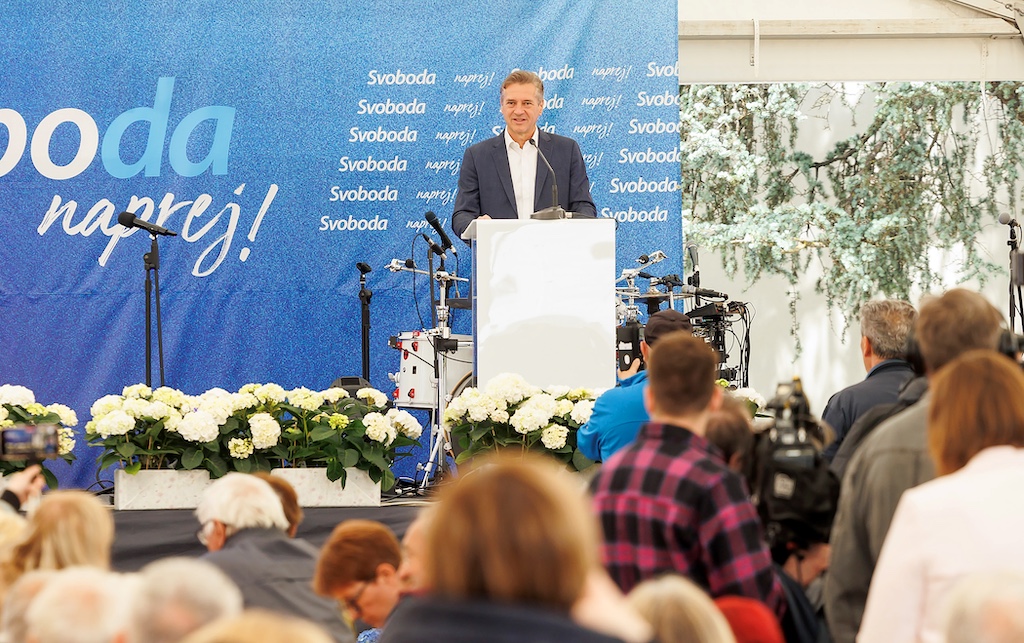
Immediately after the referendum defeat, the ruling party began its “damage control.” Part of that was the Freedom Movement festival, which took place this Saturday in Volčji Potok. Many were reminded of what happened last year after the festival in Zbilje, where Golob confidently presented his candidates for the European elections, including his nominee for European Commissioner, Tomaž Vesel. Soon after, both Vesel and Aleksander Merlo (initially tipped to lead the list) were dropped, and before that, Klemen Grošelj had already been discarded. This time, at the not-too-well-attended event, Golob gave a speech about uniting the left forces – an implicit admission that things are quite rocky within the coalition. He highlighted the mayor of Maribor, Saša Arsenovič, who is already a member of the Freedom Movement. However, he has not yet commented on the potential involvement of Vladimir Prebilič, who is currently a Member of the European Parliament but could be “called in” by party insiders to reengage in domestic politics. That job is, of course, less well-paid than the one in Brussels. Interestingly, the Freedom Movement is betting on a continued coalition with Levica and SD for the next term as well and reportedly sees no need for additional coalition partners.
At the festival, they also announced a change in the party’s secretary-general. To recall – after the infamous departure of Vesna Vuković, the role was briefly taken over by Rok Marolt, followed by the party’s multi-role player Matej Arčon. Now, the position will be filled by the current head of the party’s youth wing, Matej Grah, who ran for European Parliament last year. Grah is reportedly a big fan of Tina Gaber, which is said to have earned him extra points. Golob is counting on securing another mandate, in part through their approach to communication.
The Emperor’s new clothes
What exactly the Freedom Movement envisions under its new communication strategies is not entirely clear, but some of their recent moves – especially the appearances of Tina Gaber and Robert Golob on Instagram – suggest that the party is trying to present itself to the public as a moderate centrist force meant to protect the country from alleged right-wing “rural and backward” populists. These wishful aspirations are nothing new; the LDS party relied on the same platform, especially during the period after Janez Drnovšek’s departure, when Anton Rop took over leadership. In September 2004, LDS even held what was then a lavish pre-election convention at Cankarjev dom in Ljubljana, where the party’s then-ideologue Slavoj Žižek appeared via video message from abroad and solemnly declared that three minutes of a good film meant more to him than the fate of Slovenia. The convention drew a large number of celebrities from the entertainment and cultural spheres, aiming to show the public that not only the capital elite, but also the artistic and cultural elite, supported the party. It was an appeal for votes to secure another term in power. As we know, it did not work – LDS was knocked out of power in the 2004 elections.
It is evident that the Freedom Movement has not learned this lesson. Instead, it now seems eager to expand this blend of politics and celebrity even into the realm of religion and the Church. The “Instagram tribute” by Golob and Tina Gaber to Pope Francis’s baptism did not go over well, and three weeks later came another PR flop, when Gaber tried to frame her brief encounter with Pope Leo XIV in a charitable light (with the blessing of toys allegedly intended for children with cancer). On the website of Demokracija, this act was already analysed and concluded to be nothing more than the exploitation of both the Pope and the children for propaganda purposes. Perhaps this is the essence of the Freedom Movement’s new communication strategy. In other words – it is just the emperor’s new clothes, and the emperor is, in fact, naked.